
30 April, 2011
The Red Eye Portal

New blog from Shape Journal contributor Mick Schofield. News, Views and Reviews from the Left of Field.


29 April, 2011
Review: Horizon - Before the Big Bang

At last it seemed that the crucial unanswered questions were finally being addressed.
“What had happened before the Big Bang? What had actually caused it to occur?”
But, I should have known better! What causes can you ever find when you have long ago dispensed with such things, for mathematical forms of its essential equations?

Shape Down
Sorry everybody, it would appear we're having some problems with our website host for the journal.
We're still trying to find out exactly why the site is down, and will endeavor to have it up and running again as soon as we can.
We're still trying to find out exactly why the site is down, and will endeavor to have it up and running again as soon as we can.
02 April, 2011
Understanding Intelligence?
If I was going there, I wouldn't have started from here!

But, of course, that is NOT the case! It is merely a "useful" simplification used by scientists.
Yet, this assumption is ubiquitous (hence the saying above to counter it), and once you realise it, clear cases of it appear absolutely everywhere, and then stick out like sore thumbs, where previously they were "invisible". In a recent New Scientist (2784) there is an article entitled The 12 Pillars of Wisdom which is introduced in the very first sentence with:
The point is proven, is it not?
Photograph by Mick Schofield
The expression "You can't see the Wood for the Trees!" is ever resonant in the ways that we usually consider the World. I never realised it before, but it relates to our profound belief (our assumption) that Plurality is the way of the World; that the essence of all phenomena is contained within their "constituent Parts", and the converse of this - that properties of the Whole can be totally reproduced by means of the mere provision and juxtaposition of all these Parts.
Indeed, the major criticism of Plurality is that it exactly equates the Parts revealed, isolated and extracted by artificial erection of Domains, with its "brother" relation, as it exists, in the coherent real World Whole.
But, of course, that is NOT the case! It is merely a "useful" simplification used by scientists.
No matter how much we learn about the specimen forms of trees, grown in splendid and perfectly arranged isolation, such knowledge can never reveal, from that alone, the full full qualities of the Wood or Forest.
Yet, this assumption is ubiquitous (hence the saying above to counter it), and once you realise it, clear cases of it appear absolutely everywhere, and then stick out like sore thumbs, where previously they were "invisible". In a recent New Scientist (2784) there is an article entitled The 12 Pillars of Wisdom which is introduced in the very first sentence with:
"Can we ever understand intelligence? Only by building it up from its component parts"
The point is proven, is it not?
Now I could belabour the point throughout the whole length of that contribution, but I won't. The key point necessary has been made! Clearly the writer believes he is going to bring together as many aspects of "intelligence" extracted by various pluralist means, in order to deliver the nature of intelligence. But that is impossible. Many new things may be there, and the article will be worth reading for those things alone, but they will not, and indeed cannot deliver the secret of intelligence!
That would certainly involve a very different approach grounded soundly upon some understanding of the episodes of revolutionary qualitative change known as Emergences. For only when we begin to grasp how all such changes emerge, NOT as the consequence of the mere juxtaposition and summation of only small incremental changes, but as the reality-changing result of dramatic revolution.
01 April, 2011

05 March, 2011
The Life Factory

(Natural Selection before Life?)
Perhaps surprisingly, scientists have finally returned to Miller’s famous experiment concerning the Origin of Life on Earth, but with the purpose of going beyond the limited achievements of that effort so many years ago (1952). In an article in New Scientist (2797) by Katherine Sanderson the ideas of Lee Cronin of the University of Glasgow were presented, which put forward a new slant on that experiment. Along with the rest of the NASA-led sheep, he is persuaded that Life did NOT originate in such circumstances as were the basis for Miller’s Experiment, but in much more surprising places, such as the “black smokers” at the bottom of the oceans, or even at one of the many other unlikely places (that could even be found elsewhere in the Solar System, and even more distantly in the Universe, and hence justify the funding that NASA needs “to investigate”)
Now Cronin’s other new point is that there must have been a whole series of developments in the chemistry involved (in our case organic chemistry, but not necessarily there in other parts of the Universe) prior to Life. And in this he is certainly correct!
Of course, the actual mechanism for selection and development, or even “evolution” in these non-living things could not be Darwin’s Natural Selection, for the processes involved in that are predicated upon Life already being in existence, and upon competition between living organisms.
So some very different form of selection and consequent development must have occurred based upon an entirely different mechanism, to take the “organic broth”, to a position in which all the necessary processes, which would later be included into Life itself were made available.
NOTE: BUT both he, and almost all others investigating this field, assumes that Life was the direct result of the presence of such processes, which almost automatically shifted over into this New Form. But this is NOT the only conception of what actually happened. Indeed the main alternative has Life emerging out of a precipitated catastrophe of dissolution of a prior stability.
So taking his conception of pre-Life selection AND his idea of a direct precipitation of Life, he believes that he has a way of investigating such pre-Life developments. AND, significantly, that they could happen anywhere, and NOT just on Earth. [It begins to sound even more conducive to NASA’s conceptions, does it not?]
Cronin et al do indeed recognise an unavoidable pre-Life development period, in which, long before we could call it Life, there were processes “competing” for the same resources, and thus producing a strong selective effect on a sufficiently initially diverse mix of processes to lead to the dominance of certain sequences of systems of processes. Indeed, though his method is to establish such processes as generally available by experiment with his Polyoxometalates, the idea has already been developed theoretically by this author (J. Schofield) in Organic Chemistry in his paper Truly Natural Selection (2009), and published the following year in SHAPE Journal on the Internet. But Cronin’s experiment expects what he calls autonomous developments to occur right there in his apparatus, and considers that the only extras required to take things to significant levels, will be the external adjustments to various available parameters, and this is, I’m afraid, doomed to failure.
This is because he assumes a continuous, incremental series of steps travelling uninterruptedly through to Life itself, and that is never how such things actually develop. Such revolutionary New Levels never appear surreptitiously and automatically, but ONLY via what are generally termed Revolutions, or more technically as Emergences.
Now such Events do indeed happen throughout the history of Reality, and they always the absolute opposite of continuous and incremental changes into the New. On the contrary, they are invariably initiated by a wholesale collapse of the till-then established Stability, as the Second Law of Thermodynamics types of dissociative processes grow at an increasing rate, until they pass a crucial threshold and precipitate a cataclysmic avalanche of dissociations. This catastrophe seems to be sending things careering back towards an inevitable oblivion.
But it doesn’t do that!
Research into such Events has shown that ONLY via such an almost total dismantling of the prior stability can the available processes begin to rapidly form new systems unhindered by the strong forces of stability, which actually allowed the prior Level’s continuing stability. Only when those conservative processes are finally gone, could the actual possibilities of unhindered competition begin to form systems, which could ultimately be resolved into a single dominant system being finally established as the new Level. Life was no automatic transformation, but a successful Revolution, made possible by a prior, and almost total, collapse, of the preceding stability. Only when the old Level is dead could constructive (opposite to the Second Law) developments actually succeed.
Without any idea of the trajectories within an Emergence, NO experiment could ever be conceived of (never mind constructed) to facilitate these necessary Events. Cronin will produce only a confirmation that selection is possible, but the whole dynamic essential for a revolutionary overturn will NOT be present, and as with Miller’s magnificent attempt, it will not lead to real gains on the Origin of Life ON EARTH!
NOTE: This author’s (J. Schofield) design for a new Miller’s Experiment is already available via the SHAPE Journal’s Blog on the Internet.
I, Algorithm

(or Artificial Intelligence with Probabilities)
This article in New Scientist (2797) by Anil Ananthaswamy describes how the old (and now dead) Artificial Intelligence based on Formal Logic and Neural Networks has been re-vamped by the inclusion of Noise and Probabilities. It is, I’m afraid, not a new and great step forward, but an old “solution” to the unanswerable problem, “How do you improve upon a purely formal and pluralistic, and hence totally unchanging, artificial system, which is intended to deliver some sort of machine- based intelligence?”
So, instead of strict determinism only, you merely need to add a bit of random chance, and then deal in the probabilities of various alternative outcomes.To put this new system into the language of the participants, these new systems of Artificial Intelligence “add uncertainty to Formal Logic – in order to reason in a noisy and chaotic World”. It is a proposed “new” application of the same standpoint as was used in the Copenhagen Interpretation of Quantum Theory almost a century before. But the real world is NOT basically deterministic PLUS “noise”! It is holistic! And to attempt to analyse it pluralistically is doomed to failure. So the trick, as usual, is to continue with that old methodology, but to heighten the “flavour” with the added “spice” of Random Noise and the coherence of Statistical Methods – using averages and probabilities on top of a still wholly deterministic basis.
Now, to echo the revolution that occurred in Sub Atomic Physics may appear to be an important development, and in the same way may allow better predictions in this sphere as it did in Physics, but in BOTH areas it certainly does NOT deliver the Truth! In this particular instance it seems to apply very well in the area of infectious diseases, but we have to be clear why it works there, but also, and most importantly, why it isn’t the general solution that it is claimed to be.
It works when many factors are acting simultaneously, and with roughly equal weights. In such circumstances many alternative diagnoses are available, and hence various distinct results are possible. The important question is, “What is the correct diagnosis in a given particular case?”
Now Neural Networks had delivered a system that could be modified to more closely match real weightings of various alternative situations, but they were crude to say the least: absolutely NO indication of why and how these changes were effected were revealed. It was merely data without a cause!
Now this new version of AI returns to such ideas, but adds the 1764 ideas of Bayes embodied in the Theorem which carries his name:- which is,
if the conditional probability of Q implies the conditional probability of P
then
the conditional probability of P implies the conditional probability of Q - [Bayes Theorem]
And this was for the first time a basis for being used with Causes and Effects, not only in the usual direction but backwards too (that is diagnostically).
The constructed systems were so-called Bayesian Networks, where the variables were initially purely random, that is of equal weight, BUT thereafter dependant on every other involved variable. Tweak the value of one and you alter the probability distribution of all of the others. Now, this, on the face of it, appears to be very close to Holism, but has a clearly fictitious starting point, where all are equally probable. The “saving grace” was then that if you knew some of the variables you could infer the probabilities of the other contributions. Now, when you think about it, it doesn’t seem likely. Starting from a wholly fictitious starting point, why should the inclusion of some reliable data move ALL of the probabilities in the right direction? Clearly such systems and associated methods would have to be very close to Iterative Numerical Methods, and hence dependant on a convergent starting point for a useful outcome. And, as with such numerical methods, these too needed to be refined and improved until they began to become much more reliable than prior methods.
Even so, it is clear that such methods are full of dangers. How do you know whether you are considering all the necessary factors? Gradually researchers began to produce models in certain areas which were much more reliable. The key was to build them so that new data could be regularly included, which modified the included probability distributions.
But, as it did not deal with answering the question, “Why?”, but only the question, “How?”, it was still dependant on the old methodology, even if it was overlaid with Bayesian add-ons.
Indeed, to facilitate such programs, new languages began to be developed specially designed to help construct such self-modifying models.
To give some idea of their powers AND limitations, it is worth listing the principles on which they were based.
1.Equal likeliness of all contributing factors must be the starting point
2.Algorithms must be very general
3.New data must be straightforwardly included to update the probabilities.
Now, this is clearly the ONLY way that the usual pluralistic conceptions and analyses can be used in a holistic World. The basis is still Formal Logic, but real measured data can modify an initial model in which everything affects everything else, but as to how they do it, there are NO revelations. The ever-new data merely adjusts less and less arbitrary figures, and, by this alone, the model improves. The model learns nothing concrete about relations, but improves as a predictor, based on regularly updated data.
Nevertheless. There could be no guarantees. It is a pragmatic method of improvement and NOT a scientific one.
Also experience has shown that the gathering of new data can be altogether too narrow, and the seriousness with which it is collected much too slight for the methods to always be depended upon. Behind the robot diagnostic program, a very experienced “doctor” would certainly come in handy!
There is also the problem of ”current ideas” guiding the actions of the data collectors, and hence “tending” to confirm those current ideas. You cannot discover a new cause, if you are not measuring for it, can you? The method is NOT a genuine holistic one!
And the most important omission has to be that Time and Trajectory are not part of the schemas. Miller’s famous Experiment was indeed holistic, and produced amino acids from a modelled holistic system, but it too lacked Time and Trajectory information. This author’s (Jim Schofield) redesign of Miller’s Experiment has the same core set up as in the original, but surrounded by a time-triggered set of diagnostic sub-experiments, regularly sampling what was present at crucial positions throughout the set up and throughout the whole time that it was running. The results would then have to be laid out on a series of related timelines, showing WHAT was present and WHEN. The relationships over time and place would then be available and sequences and even cycles of processes could be revealed and interpreted.
The half-cock nature of the latest version of model based on Neural Networks but involving Bayesian principles, though it will produce ever better simulation-type computer programs, is still immovably grounded on pluralist principles, and so will be limited in its applications, and most important of all, will REDUCE the amount of real analysis and explanation to the Lowest Common Denominator of “the computer says that…..”
25 February, 2011
Dominance Breeds Stability, but Rust Never Sleeps

Perhaps there has been some confusion in this author’s papers on both Plurality and Emergence, in that though they refer to both these conceptions, they do not fully explain them.
Read More
23 February, 2011
08 February, 2011

11 January, 2011
From a Peak in Darien

The paper Holistic Equations is now quite old.
Now, my reasons for these remarkable conclusions are, of course, to do with pedagogy.
I have arrived at some crucial conclusions regarding how you must deliver Theory to those who have no idea of the necessary trajectory of development that must be followed to reveal the New.
Indeed, I now believe that the publication of a final, all-bells-and-whistles paper is almost always a Bad Thing! It does not encourage people to make their own contributions. Indeed, it invariably inhibits them from such undertakings. For such are usually, and sometimes purposely, intimidating, implying the arrogant sub-text that “If you don’t understand this, you are thick!”
So, on the contrary, the best educational papers are certainly not the final ones, but those which marked a realisation of where to go without yet having any experience of actually doing such a thing. As Hegel insisted, “Once you realise that a boundary exists, you have already passed it!”
Such turning points are packed full of real Science – mostly in the inevitable and necessary dead-ends, but also, and crucially, the occasional View as from a Peak in Darien, wherein a wholly new Ocean of Reality is glimpsed for the very first time.
For when the thinker finally stumbles upon such a View, a thousand possibilities are immediately evident within his head. He may currently have found himself up a sizeable Gum Tree, but he is still Full of Delight! He has certainly glimpsed the Promised Land can immediately guess at many of its features.
So, here is that paper from 2 years ago, which elicited a positive Adaptive Radiation of new lines of Thought, for it is when I, after 25 years of asking the same question and never getting any answers, I finally stumbled upon the answer for myself. The seemingly simple question was, “What are Iterative Equations really about?”, and its inevitable riders, “Why do we get different, and more real, behaviours from such equations, than are ever available from the usual pluralist forms, which currently dominate Science?” It took me a long time to realise that the users of such forms just didn’t know the answer, and perhaps even more surprisingly, didn’t want to know it! They worked! That was enough!
But they were profoundly mistaken!
In a trajectory that is only now coming to fruition this scientist and philosopher is only now finally treading the route he observed two years ago.
To deprive people of that experience is unthinkable, not only to communicate what I have gone through, but to experience real Science and not the drivel that is currently peddled everywhere, which certainly does resonate with, “If you don’t understand this, then you are thick!” What utter rubbish! Show me a serious worker, who has had innumerable failures along with his few successes, and I will show you a real scientist.
Holistic Equations was a signpost to NOW!
Its very errors, mistakes and wrong paths were its best qualities. Without them you will never understand!
Read Holisitc Equations
10 January, 2011
27 November, 2010

17 November, 2010
The Earth Simulator

How Plurality Misleads
Here we go again!
In the introductory paragraph the article The Earth Simulator in the recent New Scientist (2784), Philip Ball first mentions the bankers as the cause of the recent Bank Crash, and subsequent world-wide recession, but within the same sentence switches to the real culprit - “the complexities of a system…which allows this…to morph into ..an unavoidable.. systems collapse”.
Now this “necessary admission of the truth” then goes on to suggest the only way that we could avoid such a reoccurrence in the future, albeit in another area, but with similar consequences. That new way, it seems, says we must harness the number crunching power of modern computing with our emerging understanding of the Physics of Complex Systems, to enable us to rebuild our theories of Economics from the bottom up.
But, that crisis wasn’t caused by ignorance, but by knowledge and dishonesty. The perpetrators didn’t “lose their shirts” by themselves backing very dodgy long shots! On the contrary, they made damn sure they would walk away early with pockets stuffed with money, while others would be left to foot the bill, and ultimately (as is crystal clear now with the new Tory government) the ordinary people would have to pay in lost jobs, lost services and poorer education.
And therefore the “solution” proffered here must be seen for what it is - another tired and wilfully dishonest means of tidying away the real truth, and blaming it on mere natural and unchangeable Complexity.
For the suggestion about bringing in Complexity Theory will do nothing except make it easier for the same type of thieves to succeed again, without being sussed until it is too late, and they are already cruising out the subsequent crisis in the South Seas.
There is a system to blame however, but it is nothing natural.
It is the Capitalist System, and its crises are due, as always, to the unavoidable declining rate of profit. Where are they to get the funding from to finance the necessary innovation, and the expected returns on investment? Surely, only by telling lies!
The experts have to “use” that system to persuade, those who invest money on other people’s behalf (like pension funds for example) to “back this new certainty”, and while building the coffers of the Funds they work for, can do very nicely for themselves while they are at it.
Now, this is not a political paper. But it is, nevertheless, essential to demolish the seemingly authorative advice given by these “well-informed” people. We have to sweep away the papering over and be clear on what really happened.
But, in addition, we must also be informed of the total lack of substance in the promises made here about Science enabling us to avoid such “mistakes” in the future.
Now, I do not know who Philip Ball is, and why he should be in a position to be able to supply the solution to this problem. But, I doubt that he is as well qualified, and experienced as myself to pronounce on the methods that he is proposing.
I ended up as a Director of Information Technology in a College of London University, after previous posts in Hong Kong and Glasgow, where I was an expert in the application of computers to all kinds of serious research - from computerising complex kit such as Gas Liquid Chromatographs, and sophisticated Engineering rigs, and in difficult Physiological investigation via new taxonomies in Zoology, and even in the Teaching of Dance using Multimedia Resources (for which I and my colleague won a BIVA award).
For a time I was involved in helping researchers into… guess what? Chaos and Complexity Theory, and have recently published a Theory of Emergences after many years of personal research.
It is therefore not by chance that only one week before the issue of this particular New Scientist containing this article was published I was moved to severely criticise the whole standpoint revealed in the above position, and to tackle it from their own supposed ground. This resulted in the paper The Myth of Simulation: Pluralistic “holism” and the Real thing.
This paper is included here today!


18 October, 2010
Review: Bennett’s Theory of Evolution


The resplendent graphics along with the tables and graphs of Keith Bennett’s article in New Scientist (2782) promise a major revision of Darwin’s Natural Selection, and as that had been written as The Origin of Species 150 years ago, and as much has been discovered since then, you would certainly expect that many major additions and improvements, not to mention substantial revisions would have been discovered by now.
But Darwin’s Theory is hard to dismiss, not least because it is that rare yet essential factor in Science – a truly holistic theory. Instead of a straight forward encapsulation of carefully measured data into a deterministic equation, we have a set of ideas which explained how evolution happened – one you might call a real scientific theory as distinct from a merely abstracted relation. So, as someone involved in closely associated researches (The Theory of Emergence), I looked forward to more evidence to add to a raft of recent quality contributions (in the magazine), which certainly are pointing the way to important updates in Darwin’s Theory.
Yet, though this is a relatively short article, the first two thirds is concerned with his own and others current investigations (mostly on the fairly recent geological past in the glaciations and interglacials of the late Quaternary). His problem was that these dramatic and large-scale changes in the environment did not have the effects on Evolution, which Natural Selection would seem to infer. Yet, though these findings were certainly interesting, and correctly demand more than pure Natural Selection as the active processes involved, his extractions are, perhaps surprisingly, rewarded with the by now usual formal answers to all things inexplicable – Chaos!
Evidence of the impossibility of predicting (a key word in that view of Science) the future in Evolution, about which he is certainly correct, makes him proffer Non Linear Chaos as the engine for real, qualitative Change. He doesn’t deny the natural selection pressures on the phenotypes of individual organisms and hence on the genetic make up of those who will dominate the gene pool. But, he clearly promotes unpredictable changes as his primary factors in Evolution.
Now many would perhaps reply to such a position by saying that Random Mutations with totally unpredictable outcomes may be of themselves sufficient to deliver the same unpredictability. But, the irresistible momentum of current ideas on Chaos and Fractals at the present time seduces Bennett into making formal (mathematical) features as being those of central importance.
Now, the making of such choices are not unimportant. First, it does not remove Evolution from our usual ideas of determinism, it just makes the “disembodied drivers” non linear.
I’m afraid that is an easy get out!
Quoting the profound contributions of Stephen Jay Gould in Interrupted Evolution will not add credibility to Bennett’s thesis. Gould and others have stated that Evolution definitely occurs in rapid bursts, and not merely via the accumulation of small incremental changes until some threshold is passed, and a wholly new species is born.
Putting that down to Chaos is certainly not a progressive improvement, but a retrenchment compared with where Gould was heading.
It is, of course, the return to the ancient and ubiquitous, idealist strand in Science, which always wants to reveal “laws” – disembodied, formal relations, which “drive” Reality. The cosy home of Chaos and Fractals involves no new thinking at all! It is merely the latest answer to the ever-increasing evidence that a solely deterministic world is a simplifying myth. For, in this kind of mathematics, we have the marriage of formal deterministic equations (the absolutely essential ingredient in this kind of Science)) and unpredictability, which is increasingly evident in many aspects of Reality.
But Form is NOT Content!
It is only how we describe the patterns of things.
It is certainly NOT how we either understand or explain things.
I’m afraid this sound and indeed vital evidence is misunderstood, and matched to formal patterns in lieu of proper scientific explanations.
No, for all this evidence can indeed be accommodated, if we concede incremental change accumulation on a minor scale, but not leading to major redirections and true qualitative change. Indeed, what precipitates the latter is not progressive accumulation at all, but what Gould correctly saw as its very opposite. Major changes occur in relative rapid episodes termed Emergences, which are initially catastrophes for the prevailing status quo. They are the actual result of accumulation, but NOT of changes towards some “next stage”. They are the ever-present deleterious contributions, which have been recognised for very many years as the basis for the ubiquitous Second Law of Thermodynamics, which start by undermining the current stability, until they finally precipitate its wholesale dismantling. The New is NOT, as such, present within the content of the Old, “growing and ready to flower given a last push”. It is, on the contrary, wholly absent from any situation prior to an Emergence. The actual creation of the New can only occur in the aftermath of an avalanche of destructive change (like a Phoenix arising from the Flames), for such a cataclysm removes the processes, which ensured the stability of the prior Level.
All the evidence Bennett quotes is wholly consistent with such a trajectory of real qualitative change, To mix up micro (non revolutionary) changes with the real engine of Evolution is indeed a mistake, and to join the increasing chorus of applause for Chaos solves absolutely nothing.
Issue 14 of Shape
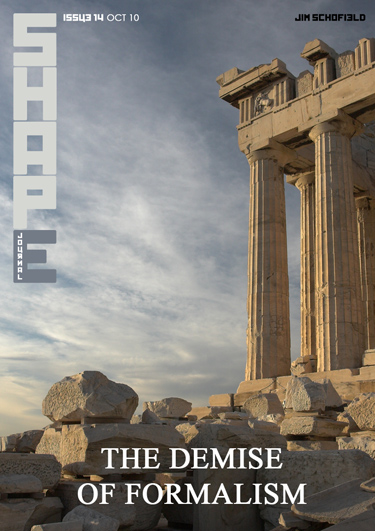
Introduction
In the mid 1980s I wrote an article entitled The Demise of Formalism. It was about Mathematics and the work of contributors like Gödel and Turing, who had proved that Hilbert’s conception of the nature of Mathematics was incorrect, and it was neither complete nor coherent, or even entirely consistent, as he had asserted.
But that was then!
The content at that time only addressed the discipline of Mathematics and nothing beyond that. After a further 25 years since then many new ideas have been developed, which take the area involved well beyond Mathematics alone, and well into Philosophy in general. The most obvious extensions were, as you might imagine, in the ideas involved in Formal Logic, and, of course, then into all disciplines which use Formal Logic as their “banker technique”.
Even further it had become more and more clear that the techniques involved had very limited areas of application, and in particular excluded all disciplines which involved significant Qualitative Change, and most especially in those interludes in development which were covered by the revolutionary Events termed Emergences. To be able to tackle THE most essential areas of Reality just had to involve these crucial Events, for otherwise they would only be addressing entities and relations embedded in totally stable periods.
Science would then be limited to the study of what was possible within Stability. Ideas such as the Origin of Life on Earth as well as its subsequent Evolution would be left out of the areas for study, and it soon became clear that the development of Planet Earth itself, not to mention the Cosmos, were also evolving systems and had to have their Emergences too.
Now these Events are remarkable interludes involved concentrated avalanches of Change, and each one, on completion produces its own entirely New Level, containing entirely new entities, properties, relations and indeed processes. To make matters worse, it had also become clear that the methods universally used in the Sciences up to now were totally inadequate to such cataclysms of Change within Emergences. Indeed, the nature of any Emergence could NOT be derived from knowledge of prior conditions, no matter how full they were.
Nothing could be predicted from before the crucial Event that would pertain after the Event!
Now though these features seemed to make this an impossible area to study, such Emergences had been identified as such in the past, and the touchstone and template for such Revolutions had to be the First Appearance of Life on Earth. In addition, once recognised and described, these Events seemed to be cropping up everywhere, from interludes within the development of the Cosmos, to the emergence of Human Consciousness in Man.
By October 2007, the research of this author had reached the stage where another, much wider Demise of Formalism was necessary, and this is it! But what is included here was by no means the last word in this area, which by October 2009 had resulted in the publication (in SHAPE on-line Journal) of The Theory of Emergences.
This paper can be seen as the immediate precursor to that Theory, and as such, several important differences will be evident between the two.
Jim Schofield September 2010
P.S. As this is a long paper, it will be published in instalments over a series of Issues of SHAPE.
Subscribe to:
Posts (Atom)