13 March, 2012

The Crisis in Physics (A Conspectus)


It has been decided to publish a Shape Special Issue dedicated to that brilliant work by Christopher Caudwell entitled The Crisis in Physics. This marxist-critique of the situation in the 1930s in Sub Atomic Physics, was a significant beginning, and were it not for Caudwell's death fighting Franco in the Spanish Civil War, there is no doubt he would have taken this subject a great deal further. 

As it is, no further significant contributions have been forthcoming from surviving "marxists", so 73 years after his book was first published, a reappraisal and development of Caudwell's contribution seems more than a little overdue. 

Coming soon to Shape Journal.

Muddy Boots in Scarcely Rippled Pools?


The Effect of the Observer

Why should the presence of an Observer cause certain revealed phenomena to collapse, and a seemingly totally contradictory, and classical version of what was happening immediately, and totally, replace it?

Such an inexplicable thing does indeed happen, and is sometimes described, rather irresponsibly, as the fact of the phenomenon being observed causing it to vanish.

Now, something significant certainly causes the change, and as scientists we must find out exactly what is happening, and, of course, why?

Such a superficial “cause” is not what is meant by those who stand steadfastly by such happenings as the truth of the investigated situations, BUT failure to explain what is actually happening, and why it happens, means that any mistaken impressions are not replaced by the truth, and so persist, misdirecting scientific attempts to solve the situation.

Clearly, the presence of some sort of intervention certainly removes a significant contribution to the unobserved (undisturbed) phenomenon. The intervention of measurement can indeed collapse such a natural system. It depends on what kind of effects the intervention introduces.

Let us take an interference pattern in a dead-still susceptible medium or substrate caused by a coherent and single frequency source which had its effects divided (as in the Double Slit Experiment), and then recombined as from two sources (one from each slit), so that they interfered and set up the expected interference pattern.

What might collapse that pattern, and hence destroy its effects on other things? Well we know that if a very still pond has been agitated by a tiny oscillation at its surface, it will deliver a pond-wide set of ripples. But if we throw on a large brick, or run through it with muddy boots multiple frequency effects will be generated at much larger amplitudes and will totally swamp the original delicate ripples entirely.

Any cork slowly being moved by the surface ripples, will cease to be so affected and if the destroying frequencies are sufficient in number and amplitude, these could overall cancel out and the main observation will be the vanishing of the prior pattern and its effects. Someone concentrating upon the cork and its trajectory will suddenly lose track entirely of that movement, and a much more common mix of multiple contending effects will instead determine what we see. The cork will keep moving but under very different imperatives: a different situation will have been produced.

Now whatever the intervention of an Observer involves, it will certainly have its effects on any ubiquitous medium susceptible to any disturbance.

If such considerations are to be applicable the Double Slit Experiments and the effect of introducing an Observer, then for this to be the case, there HAS to be such a medium filling the areas involved.

Now such has never been detected.

Yet that same “empty space” is totally capable of propagating electromagnetic radiation, with its two vectors 90o out of phase. How does this happen?

The discoveries of the Quantum era, replaced oscillations in a continuous medium by “particles” of radiation (Photons), which, because they were particle-like could indeed be shot out across total nothingness.

And if all subsequent phenomena were in concert with this conception all would be well. But they aren’t!

Indeed, sometimes the only explanations for phenomena seem to be that they are indeed produced by waves. We seem to need BOTH conceptions to cover all phenomena. Yet there is another possibility!

Empty Space would be paved entirely by Empty Photons. These would be individual entities, which would be capable of both holding, and passing on by induction, single quanta of radiative energy. All we need is for these to be totally undetectable – to have zero observable charge and zero observable mass to make them invisible, and if they also did not move, then how could they be detected?

Now, believe it or not, such particles have not only been devised and described, but also actually detected in accelerator experiments, where they are called positronium particles.

They are composed of a mutually orbiting pair of one normal matter electron of negative charge, and one anti matter positron of positive charge.

Now, these are NOT what we need here but a close and recent relative of an ancient type, called instead the neutritron, which is entirely stable and created soon after the Big Bang.

So without diverting into that whole discussion, let us here, consider how the presence of a universal paving of these entities (also called “Empty Photons”) could influence the phenomenon we are considering.

Clearly, such a paving could, by taking in energy from the passage of electrons (say), be disturbed into coherent oscillations, which moving ahead of the causing electron(s) would pass through both slits and interfere on the other side. The following electron would reach and pass through one or the other of the slits, and immediately encounter the interference pattern, which would affect the distribution as registered on the final detection screen.

BUT, the introduction of any Observation would surely destroy this pattern immediately and the electrons would behave, as we would expect them to without an interference pattern to deflect them.


Why Socialism II: Socialism within Capitalism?


The Socialist Economic Alternative I
(Socialism within Capitalism?)


The perennial question asked by any defender of the status quo to an avowed socialist is always, “Well, what would your Ideal economic System be, and why hasn’t it just naturally evolved from this current, supposedly congenitally inferior attempt?”

Well, it is a fair question, even if the motives of such an asker were not!

And, to ask of an inhabitant of this side of an Emergence (a revolution) exactly what will appear on the other side is both unreasonable, and, to be honest, unanswerable.

But we do know quite a bit about what is wrong, and what horrors it inflicts upon Humanity, and has done so for many centuries.

We also know from history and the current Arab Spring that revolutions do indeed occur, and it must be an important part of our task to begin to address that question, but not as a prediction whether as the word of God, or Marx, or anyone else - but, with clear attempts to remove the horrors.

An Emergence is best typified by its most wonderful and evident example of the history of the Earth – The Origin of Life itself.

Clearly, no prediction of the various consequent Forms of Life would ever have been available within the World before that Event.

So, let us, with more than a little humility, address the question of the nature of the possible economic alternative to Capitalism, perhaps expressed negatively as to what must be removed.


20 February, 2012

Why Socialism I: Primitive Accumulation

This is the first part of a new series on Socialism to be published collaboratively with The Red Eye Portal

Primitive Accumulation:
How Investors First Got Their Capital


At such a time as this, when Capitalism is being exposed for what it really is – it becomes increasingly important to recall just how it came to be – how our “entrepreneurs” accrued the wherewithall “to invest” and “support” money-making ventures of all sorts.

In other words, what forms of Primitive Accumulation produced the necessary Capital to fund a growing Capitalism?
Read more

A Brief History of Abstraction


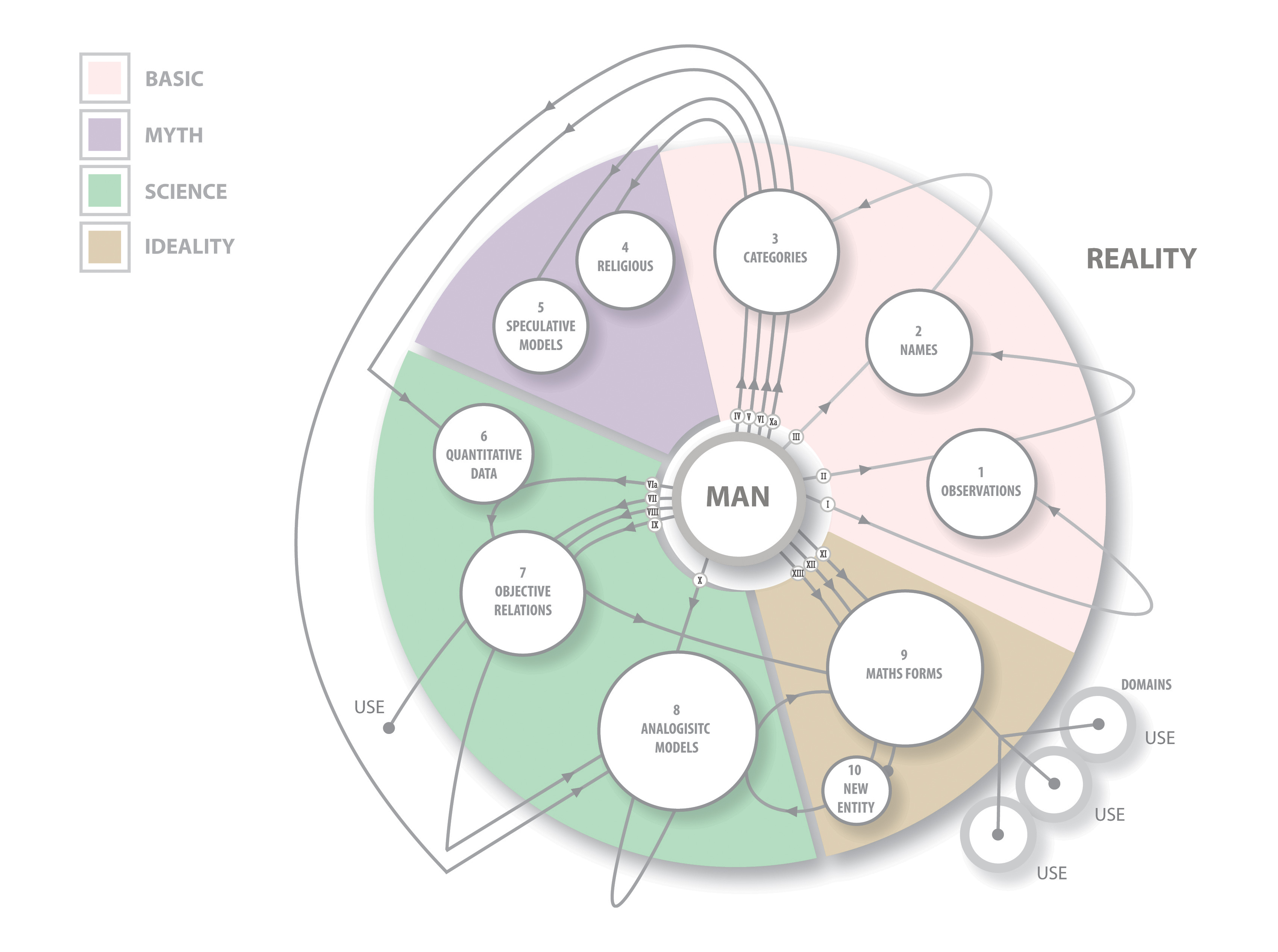
 A new video from Shape Journal exploring the ideas behind my Processes and Productions of Abstraction diagram.


27 January, 2012

New Special Issue on Nothing


A whole series of magazine articles by prestigious authors and Special Issues by office hacks, as well as many different TV spectaculars and series have found it necessary to expand upon their increasingly important concept of... well... nothing.

In seeking an Origin for the Universe (without a God of course), they have settled upon "Nothing" as their necessary source. But, as you might have expected, it is a very special kind of Nothing!

First of all it is man-made. Or, to clarify, we both call it "Nothing" and have defined what we think Nothing actually is.

And, secondly, as you might have guessed, there isn't a single, unambiguous definiton. Indeed, the indubitable origin of the concept of Nothing is definitely mathematical, and associated with the mathematicians new concept of "zero" (as a number without any magnitude). It is a formal "nothing", like zero, but made up of +1 and -1, or equal amounts of positive and negative charges, or even completely balanced forces which give the appearance of zero activity, and, of course, many others of similar ilk.

Indeed my favourite has to be the Physical Singularity, where something supposedly vanishes by successive contractions, until it shrinks into the tiniest dot, and then down to absolutely Nothing. And, lo and behold, in reverse... we can have the whole of the present universe emanating from an identical dimensionless dot. Magic, isn't it?

This is not an unimportant philosophical speculation: it is indeed the current consensus position of the vast majority of today's physicists and cosmologists. And it is a direct consequence of two important principles, which were both progressive and extremely useful for many centuries. These were the Formalism of Mathematics and the Plurality of analyses of things into seperable parts.

Now, though gigantic pragmatic and technological strides were made using these principles, which it has to be admitted, transformed our world - they finally, and inevitably, began to lead us astray. When our tools no longer work, we should cast them aside and replace them with something better. For such has always been the way of Science!

It is never as easy as it sounds. Those who benefitted greatly from their past use of such priniciples, and indeed, made them the cornerstones of all their contributions and theories, would always and ever defend them to the last as their own prestige was surely based upon them. And, in their defence of these now reactionary principles, these supporters will favour the most remarkable retreats, rather than admit that they were wrong.

In 1927 a totally reactionary conception of Physics won the day against "old fashioned" Einstein and his supporters at the Solvay Conference, with what became known as the Copenhagen Interpretation of Quantum Theory - a pragmatist/idealist retreat of major proportions, that cast out "fuzzy" reality as the final arbiter, and replaced it with "driving essences", which were affirmed to be
equations.

The story of this debacle and how it must be defeated, has to be addressed, and Shape Journal is finally ready to begin this vital task. This Special Issue, under the title of "Nothing" is to start the process, to address this current preoccupation, for it has certainly redirected science into an impassable idealistic mire.


25 January, 2012

Tory Science: The Study of Failure as Success


Horseshoe Crabs: celebrating an anachronism

I awaited the new BBC television programme on Evolution (Survivors: Nature's Indestructible Creatures) with great interest. The oft-repeated trailers for the show emphasized the recurrence of major cataclysms within that process, which had, on every occasion, wiped out most of the current lifeforms on Earth, yet had always left a few very resilient survivors, and everything that still exists today must have evolved from these remnants. The very fact that catastrophes had played a part was, I thought, extremely significant in what they had precipitated, and the fact that the presenter (Prof. Richard Fortey) was from one of the very best museums in London, led me to expect a great deal of valuable extra information that would be available to add more substance to my recently published Theory of Emergence.

But, to my surprise, the globe-trotting expert did not allocate any evolutionary credit whatsoever to the Emergent Events triggered by those destructive cataclysms, but instead concentrated upon the unchanging "living fossils" that, with great difficulty, he was able to physically present as still living relatively unchanged to this very day. 

At the end of a boring hour, looking at Horseshoe Crabs, Lampreys, Lancelets and Stromatolites, we got the bad news that this was to be a whole series of programmes. Good Grief!

So, instead of studying the crucial processes by which evolution had regularly rescued Life from wholesale mass destruction, our expert lauded the niche-surviving relics that hadn't had any revolutionary processes acting upon them for as many as 500 million years. What on earth was Fortey trying to prove?

Clearly, none of the freaks he presented to us were the reason for survival and development in general, or the vital accelerated adaptive changes involved - indeed, he was doing the exact opposite! His chosen "heroes" had survived by being extremely undemanding and resilient, and certainly not by being capable of rapid change in order to adapt and survive. Fortey even described with approval how a certain animal could go for an entire year without any food and still survive. How magnificent? I think not! Most organisms have survived by a mixture of maximal plastic variability and abundant reproduction coupled with certain individual deaths, not by living forever unchanged.

His examples were of where evolution failed to do its job and create new forms suited to radically changed environments, when faced with the most disadvantageous circumstances. 

Now, such errors are perhaps understandable, but also unforgiveable! For though the incrementalist, quantitative changes idea of development does still dominate science, that doesn't change the fact that such a standpoint is wholly wrong. The engine of general survival was always adaptive radiation - those interludes following major disasters in which, from a single species, a whole range of different species arise in a relatively short space of time. The pinheads changes that we can see do not become changes in qualities: the incrementalist thesis is a myth.

All developments, not only in Life, but also in all circumstances, display two dominant modes. The first, and of longest duration, is undoubtedly Stability, when an integrated system has become established, not only by its advantageous virtues, but also by its integrated defensive processes. Once established such systems can persist for very long periods, in which the only significant changes are not towards increased order, but to its opposite, via imperceptible and inevitable decay - The Second Law of Thermodynamics doesn't actually rule, but its dissociations do mount up until the system becomes totally undermined, and a wholesale collapse ensues. 

Now this is self-contained denouement, not that precipitated by externally caused catastrophe. But, either way, the immediate following period, which is the important part of the alternative mode, is always a short Event of major qualitative changes, which we term an Emergence.

For those who doubt that these Events actually occur, may I proffer a few important examples?
These are - The Origin of Life on Earth, the Advent of Consciousness and the Appearance of Directed Thinking. Complete overturns of what came before.

There can be no doubt, this alternation of long periods of incipient decline within a maintained Stability, and short, explosive interludes of revolutionary ferment and changes, is the pattern of all development. Now, if this is true, what must be the crucial area of study in order to explain innovation - true creative evolution? It can only be the detailed study of Emergences themselves.

But what does Professor Fortey do instead? He studies the failed remnants that have proved impervious to the creative processes of Evolution. He is lauding Conservativism. How can you talk about Evolution and not talk about progress and change?

By being a Tory?


18 December, 2011

Genius


A regularly used epithet?

Every now and then some individual is celebrated as being a real "genius".

Whether he is merely skilfully juggling a football, singing with great beauty, painting a few walls, memorising vast numbers of names and ideas or coming up with a revolutionary new theory, they all get this extreme title, yet I would be hard-pressed to agree to such an appellation to any apart, possibly, from the last example.

For though most of us spend our lives using what others have given us (in one way or another), the occasional individual does come along who transcends prior conceptions and assumptions, and sees, for the first time, a further dimension of Reality.

To append some built-in, already-existing quality to that individual (He's a genius!) misses the real point entirely. Something has happened in that person's thinking, which completely overturns the usual, generally held ideas, and moves into a wholly new scenario, in which many things begin to make sense, more profoundly than ever before.

If such an overturn happened in Society, it would be called a Revolution, and when a similar thing happened on this planet, among systems of non-living chemical processes within related entities, there was a major transformation, which we have termed the Origin of Life on Earth.

As it turns out, such events have been happening rarely but regularly, and definitely essentially, throughout the history of the Universe. They are termed Emergences!

And they are never just "developments" as we usually conceive of them, but in fact cataclysmic overturns to a current, long-term Stability, and involve a subsequent ascent to a wholly new Level of Stability, with vastly more entities, properties and processes than were possible before that transforming occurrence.

Indeed, when positioned within the normal flow of History, these Emergences are short, dramatic episodes between relatively unchanging and long-lasting Stabilities. And, literally all of our knowledge and understanding is based almost entirely, and very selectively, upon these long epochs of Stability. So we are therefore so lacking in being able to deal with certain areas of Qualitative Change, that the Emergences, when they come, are never predicted as Events, and can also never be described in any predicted detail, even when they are in actual process. What contents they will produce are always totally unpredictable before the event. They are entirely unknowable. 

They are always bolts-from-the-blue, and, even more perplexingly, they are invariably the final result of an enormous catastrophic collapse in the prior Stability, which, if anything, seems to promise only destruction and chaos.

Indeed, via studies (retrospectively) of periods in the history of human societies when Revolutions did, in fact, occur, we could only ever discern the prior drives towards collapse - never any possible positive and constructive moves at all. And dreamers, who desired such events to rid their societies of repressive regimes, always assumed that such events would free things up once and for all.

But serious study of Emergences has shown that they only arrive and remain at a new higher stable Level, by being as strongly conservative as the previous regime - to ensure the continuing survival of the new Level.

So clearly, knowing so little about these events, and also inevitably packing their study with stability-based and extracted "laws" and myths (not to mention dreams), means that when it is the revolution in the thoughts of a "genius", we are hopelessly ill-equipped to say anything meaningful or helpful about what happened in that person's head. Yet as active social revolutionaries know, you cannot just observe a revolution occurring, all by itself, and wait for the "good times to roll". You have to have objectives to be achieved during the creative inner phase of the Revolution itself, for even if the New Level is achieved, major changes thereafter will certainly be impossible. Such can only happen in the mêlée of the event itself.

Now, such lessons can help when we are considering all kinds of other forms of Emergences including, of course, within Thinking. The question must be, "What must be done to facilitate such an Event (if anything)?"

The feature of Emergences which always acts against any such objectives, is the evident opacity of any yet-to-occur overturns of this nature. We cannot predict its detailed creations!

In a world totally without any Life, of any sort whatsoever, living things could never be even conceived of: they appeared on Earth as a kind of miracle, so devastating that a single initial organism rapidly spread to a prodigious extent across the Globe. And also "no one" attempting to predict the nature of such entirely new entities, would ever have got anything even remotely right, even if some sort of alien observer could have been present, and guessing what would happen next!

An Emergence is a very special kind of calamity, best illustrated by the metaphor of "The Phoenix arising from the Flames of Destruction". For that certainly fits most known Emergences. 

But how does this relate to Genius?
Another common metaphor is that, "There is a fine dividing line between genius and madness!" Such clichés are, of course, beguiling suggestions, but one-liners never deliver anything more than the merest glimpse of what is happening: the truism.

But recent research can deliver something, for where Emergences are studied it becomes clear that NO Stability is eternal. Each and every one always contains the seeds of its own demise within it, and when they finally cause the ultimate cataclysm of dissociation, that dismantles that stability, they will return the situation back(?) to some state with no real order, and that means no prohibitory or self-maintaining constraints will remain, they will all have been swept away.

And it is only in such seemingly ultimate turmoil that the productive capacity of Reality towards Order asserts itself. For without the abundant constraints of an established and stable order these can develop conducive and productive relationships and actual multi-process systems begin to appear. Clearly and importantly, such forms of Order will emerge, and they can never be a repeat of the similar process, which established the prior stability. For the very occurrence of that epoch will have changed things, and its produced detritus, after dissolution, will remain despite the calamity, and will enable wholly new forms, impossible in the prior Emergence. Thus as they say, "You can never swim in the same river twice!", it is always a different river, and so it is with the potentials in the Chaos produced by the cataclysm of dissociation that initiates all Emergences.

When it comes to the emergence of genius, the break through will have been precipitated by a breakdown of all bankers, which assured that prior stability. The individual will be cast into such Chaos, and will inevitably see new things and certainly new possibilities.

But, as the Theory of Emergences has shown, there is no obvious or easy ascent! The creation Phase in an Emergence always involves, in fact, a violent zigzag between the creation of new Order, and its immediate dissociation. Such an inevitable absolute cancellation is not what always happens, however, because gains can be made, but only by the marrying of system orientated constraints, which oppose both dissociation and rival constructions too.

A permanent achievement of a new and persisting stability is never guaranteed though. Unless a viable and self maintaining system with adequate constraints is created, the final stability will not emerge, and the situation will either remain in the pair of chaotic alternating construction and dissolution processes, or retrench back to a previous stability. 

Madness in genius is the seemingly permanent limbo of this incessant zigzag.

Of course, when it comes to ideas in the Human Brain, we are effectively in a wholly new realm, that no longer obeys its wired-in patterns of behaviour elicited by triggers in sense perceptions, but instead "simulates" internally the consequences of possible phenomena and their built-in processes. Indeed, this aspect of particularly human thought requires learning, and definitely the ability to think critically; such processes actively seek breakthroughs - Emergences in Thought! 

The initial work on Emergences was by Hegel and addressed this very same area.

So, though we can use the discovered trajectory of "An Emergence" to help us consider such happenings, we are, once again, looking at Form, rather than Content.

To consider a supernova, the Origin of Life and Human Consciousness as exactly the same kind of event, is obviously rubbish. So, what we do is notice their similar trajectories of change, and sequences of phases, even though what is happening in concrete details will be vastly different. And, in an important sense, what happens within the Human Brain is happening in a "different Universe" of possibilities to all prior concrete instances of these Events.

For, instead of them being overtly physical systems (such as those underlying these processes inside the brain as strictly chemical and electrical activities), we are instead considering things at an entirely different Level of the organisation of matter. We will NEVER reduce such things to those physical/chemical processes, just as we will never reduce Life to purely non-living chemical processes. To attempt to understand it that way misses the whole nature of Emergences.

For these mighty versions create wholly new Levels, which, though they include and use multiple processes from prior Levels, are maintained and controlled at the new Level by entirely new meta-processes totally impossible at any prior level alone.

In conclusion, we cannot "arrange for" genius, just as we cannot engineer a revolution. We are more likely to do the opposite of what is required, for such occurrences look like their absolute opposite in their unavoidable primary dissolutionary phase. 

And incorrect uses of the term certainly don't help.
Stephen Fry is not a genius: neither is David Beckam.

Hegel, on the other hand, certainly was.



09 November, 2011

The Red Herring of Observation


I have received much criticism from the YouTube brigade on my Double Slit animation, for not fully addressing the role of the observer / quantum erasers et al. This was never my intention with the work, which was addressing how electrons could build up an interference pattern in the Double Slit, without the need for resorting to probability distribution, which I see as a mathematical "trick" to get the right answer. I hope the following papers will help to clarify my position on this aspect of Quantum Physics.


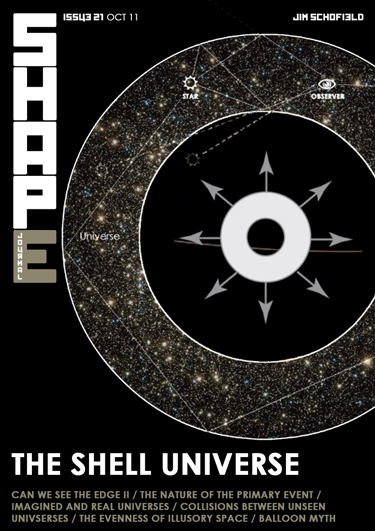
Issue 21 of SHAPE


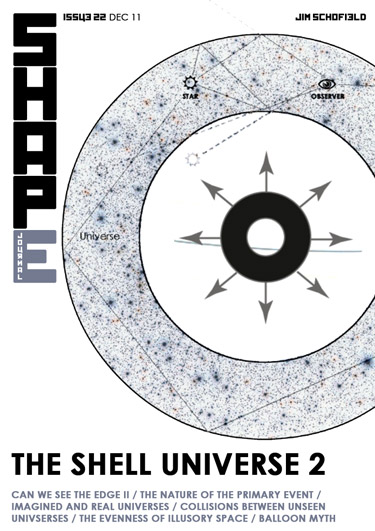
First part of a two-part issue on the Shell-Shaped Universe
(see video in previous post)
Part 2 will be published in Issue 22 of the Shape Journal next month.

“Chasing the Do-able” may well accelerate growth in Science, but the consequences will invariably, as in all such undertakings, cause the growth to be both etiolated and aberrant by such a process, with a major canker at its very heart, almost unavoidably included from the start. And Cosmology is certainly no different! Vast strides have been made, but have they all been in the right direction? The answer has to be a resounding,”No!”

How can such conceptions as Physical Singularities and Parallel Universes be anything other than frigs imported from that seductive World of Pure Form alone, which we term Ideality? And the nature of that “door” to such developments can, at the time of opening and entry seem to be not only harmless, but also positively encouraging. For in that wide-open view, all things seem eminently do-able.

The turning points were, of course, Einstein’s contribution on Relativity and the general acceptance of the Copenhagen Interpretation of Quantum Theory as bases for an entirely new turn in Physics and Cosmology.

No longer was Explanation the “number one” priority! Mathematics and the worship of Equations seemed eminently preferable. But also, many consequent assumptions were unavoidably taken as the foundations for this New World, and not least was the belief that light could propagate across entirely Empty Space without any transmitting medium whatsoever, and to “solve” the resulting problems, the Particulate Nature of Light (via moving Photons), became a cornerstone of the new system.

The following, alternative set of ideas, in contrast, turns its back upon such premises, and instead requires a particular form of medium for light propagation, and therefore makes transmission across totally Empty Space impossible. By such changes, the whole Universe is transformed!

Now, to immediately proceed along such a route cannot be done. For, though some sort of self-consistent body of ideas can be constructed, there are other, much more profound and significant philosophical standpoints and consequent methodologies to be addressed too. We must start by not looking forwards to the New Ideas, but by looking back to the Big Bang itself, and seeing it in a wholly new way.

Issue 22 will continue investigating these ideas and look deeper into their ramifications. We also have a new video up on our youtube channel, boldly titled, The Shape of the Universe!

28 October, 2011

The Shell-Shaped Universe


What Shape is the Universe?

A new issue will follow this video in coming days, explaining further how the theory of Empty Photons could have dramatic ramifications on how we see the Universe. Could the known Universe exist in a thin shell? Could every galaxy be an illusion? Watch this space to find out more...

08 September, 2011

New Special Issue on Form & Probability


This Special was a commendable task!

It was intended to reveal the nature of statistical and probabilistic Law as a special type wedded indissolubly to experimental evidence, and the revelation of this was to be a plank in the final and complete criticism of the Copenhagen approach to Science, as put forward by Bohr and Heisenberg. And it is a contribution to that objective! But, it certainly isn’t, as yet, part of a comprehensive argument.

It got deflected into absolutely necessary component issues, and diligently followed various lines, that were revealed as having to be solved to have any hope of completing the full task. In such crucial reversals of methods a whole range of component issues have to be addressed prior to a final integration: The terminally ill but not yet dead semi-copse has to be seen to its final demise, before we bury it for ever!

I am sure that this offering will energise others, as it has this writer, for the task is essential, and the rewards will be prodigious. Sub-Atomic Physics was wrecked upon the rocks of real Qualitative Change and the emergence of Levels within the development of Reality. And such problems (in all areas of Science) will only be properly addressed when the problems raised in this area of Physics are finally solved for good!

14 August, 2011

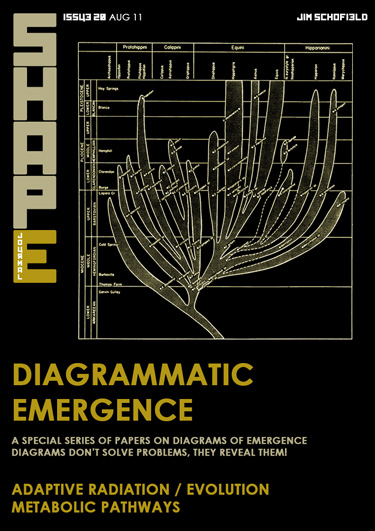
Issue 20 of SHAPE


This issue of SHAPE Journal contains a closely related series of papers, in which the trajectory of significant qualitative change in an Emergence is tackled,diagrammatically. Of course, the elements of such considerations are still concepts, processes and transformations, but the spatial idioms of diagrams delivers that extra “dimension” of simultaneous portrayal, which does, indeed, allow quite involved transitions to be laid out, considered and significantly improved.

A words-only argument can be as much about winning as revealing, and it is clear to this author that without these kinds of diagrams, we would not only find solving such problems considerably more difficult, but we would also be bereft of the best initial means of communicating the ideas involved too.

The trajectory of Creative Change in an Emergence, such as that of the Origin of Life on Earth, involves contradictions, phase changes, and major transformations – even of the probabilities of events, and it is these features that must be understood. These papers do not complete the job, but they were fundamental in the creation and publication of this author’s Theory of Emergences in 2010.

22 July, 2011

New Special Issue on Empty Photons


What is Intelligence?


In the article Claws for Thought in New Scientist (2819), Emma Young ranges about various studies in the animal world to find evidence that convinces her that “animals lie on a kind of spectrum, from a primitive kind of awareness, to the rich and complex stream of thoughts in the human mind”. And in doing this reveals that she (and those she refers to in her piece) have a pluralist approach to such questions.

By this I mean that every animal is measured against Intelligence (–the human kind) to see if they have it, or part of it, and this seems to reveal a continuous range with Human Intelligence at the top, and lower animals with this same commodity, having ascended, step by step, some way at least towards this ultimately possible state. You might ask why such is deemed to be pluralist (in the philosophical sense and not either the religious or political senses). Well, Plurality sees everything in terms of Wholes and their constituent Parts, and hence any investigative process attempting to reveal the nature of things is basically analytic, applied first to an observable Whole, and subsequently to each of its Parts, to thereafter make possible an explanation of the original Whole.

From the outset, perhaps centuries ago, the property of intelligence was allocated only to Human Beings, and other “mechanisms”, such as hard-wired instincts were awarded to all those below the qualifying limit.

But, such a standpoint has long been severely undermined, but the alternative of a spectrum cannot be any better, for it implies quantity rather than quality – amount rather than wholly new processes, and even, perhaps, that it is sufficient quantity of what is involved that can jack things up to each and every Level in this range of the given facility.

Yet, the study of Development in general shows that such is never the case. Significant Qualitative Change only happens in short-period interludes termed Emergences, which are NOT mere stages in a particular quantitative spectrum of changes, but actually totally transforming revolutions. And these transformations are never incremental. Indeed, they involve seemingly terminal crises initiated by wholesale avalanches of dissolution, which only when that process has dismantled the situation almost to the state of complete chaos, does it turn round and then create the wholly New.

And when this is used as a template for development, and hence in Evolution too, the work must be to first identify these crises, and explain why they occurred, as well as the following creative phase which brings in wholly new qualities and establishes a New Level of Reality. With such a development scenario the changes are neither gradual or incremental, but revolutionary, and each major advance involves a significant step-change in possibilities, so ideally each of these new Levels should have its own unique name: they are not all the same but differing in quantity: no spectrum of these Levels can be constructed.

Therefore, Intelligence in Humanity is not a general quality with different amounts at each Level of development.

To assume the latter merely becomes the apportioning of amount to each phase without any investigation of how the Event of Transformation occurred. Instead, it is assumed to have merely increased by some pedestrian process which when passing an important threshold (merely of quantity) enabled the “new facilities”.

No! I’m afraid this is not how these things occur!

And to do as the researchers into the Origin of Life on Earth do, and merely study the prior conditions for the actual causes of the development will (as it continues to do in that important area) always and inevitably fail. Even the searching for the causes of a Revolution in prior circumstances will also be inadequate.

What has to be addressed is the relationships between Stability and Emergence, - so that the studying of prior circumstances can only deliver reasons for the initial crisis and cataclysm, and not for its resolution within the creative Phase of the Emergence.

For such a study must expose the real dynamic or trajectory of changes within an Emergence, and also deliver why the New is ever possible. My point is that the kind of research related in this article, with its implied current methodology is doomed to never reveal what is actually happening, and why, but indeed it is merely logging what appears and when.

17 June, 2011

Issue 19 of SHAPE


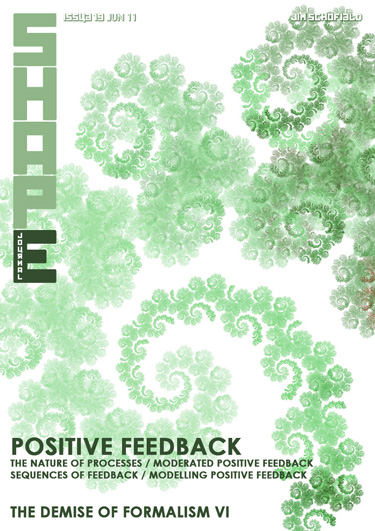
In this issue of SHAPE Journal we carry on with the next installment of The Demise of Formalism. A significant part of this part of the paper addresses the essential change of standpoint that is necessary when tackling Emergent Change, from the usual formal and pluralist approach to a dramatically different holisitic one!

Also in this edition we are trying out a very different structure to a standard issue of the Journal. Not, I must hasten to add, in the Design or in the Content of SHAPE, but both in the quantity that we publish in a single issue, and in the intrinsic relationships between the set of papers included.

In the past we have divided all of the longer papers into a series of installments, which were then spread over a series of issues episodically - and we usually only had three unrelated topics in each issue. The success of the Special Issues of SHAPE has demonstrated to us that that choice was mistaken, and complaints have made it clear that more coherence and continuity would be acheived by publishing related sets of papers within a given issue.

So, for a few issues at least (and maybe for much longer) we will be changing our policy. First, the issues will be larger in size. The articles will be longer than the original 1000 word limit, there will be more of them, and they will tend to be all upon a related or even on an identical topic.

In this issue, therefore, will be seven separate contributions, thus raising the content well above the usual limit, though in this first tryout we have chosen fairly short papers with more diagrams. Most of these were written at different times starting 4 years ago, and it is interesting that the very act of composing this latest version has catapulted the editor into another bout of writing on the same topic. Clearly, it is hoped that this format will reveal something of the actual development of the ideas involved, and may even elicit more contributory responses from our readers.

This current set is on Positive Feedback scenarios, which turned out to be an absolutely crucial concept on the creation of the Theory of Emergences and in radically transforming in the research into the Origin of Life on Earth.

15 June, 2011

Shadowlands


Why was there such a thing as Shadow Theatre?
It is, in a way, a kind of minimalist means of telling a story, but it also involves the most striking symbols of the types of people, places and events that are involved. And I characterise them as symbols with good reason: images or representations would be simply not appropriate. For they are immediately recognisable, and can “perform” in standard recognisable ways all sorts of “characteristic” actions, which would be difficult to present in a real theatre with actors and props (though in Far Eastern theatrical traditions, and ancient Greek Theatre, they did also attempt to do it with masks and/or dramatic costumes).

The suspension of disbelief was considered paramount; so the inadequacy of direct portrayal by perhaps less-than-convincing human representations, and the use of symbols seemed to greatly aid this requirement. Also, the ambiguity involved in using shadows allowed the imaginations of the audience to “fill-in” what was not there, and also allowed the effects, possible with shadows, could also be put to “magical” uses. The rhythm of the actions and the possibility of transformations by merely changing the angle of presentation of the puppets (or even the distance from the screen to deliver indefinite, ghostlike” images, could elicit in the audience a magical imperative of a story-line, almost impossible by other means at that time. It was, indeed, a very telling means of delivering a known and striking legend or myth.

Four different shadow views of the same object
demonstrating the illusory effects of shadow distortions

Now, this brief introduction may surprise its readers, when they discover that this essay is actually about Mathematics!

The writer is both a mathematician and a scientist, and has for many years sought a characterisation of what is involved in these two seemingly closely related areas, but which turn out to be very differently grounded. They turn out to be not the most comfortable bedfellows by any measure of means.

By far the most difficult to pin down was always Mathematics. It is, at the same time, considered both as the most abstract representation of Reality, while also its inner imperative – its actual driving force! And these are certainly inherently contradictory characterisations.

How can Form – the substance of all Mathematics, be both abstract and also the cause of all concrete phenomena? The only answer is that it cannot be both!

Yet, some seemingly sublime things can be unearthed by Mathematics alone, so what is actually going on? What is Mathematics really? What does it deliver? Can it really be the essence of Reality?
These are important questions, and are, even by the giants in those fields of endeavour and explanation, very poorly understood. Indeed, the whole History of Science (and even of Philosophy) has displayed a constant oscillation between disembodied Form and Concrete Content as the basis of Everything – indeed between Idealism and Materialism! And sometimes, the imposition of what are clearly idealised Forms upon aspects of Reality has proved amazingly fruitful, and even in the most surprising applications, for solving real, everyday problems.

Nothing could be more idealised than Euclidian Geometry with its dimensionless dots, and lines of zero thickness, not to mention its perfect circles and infinite perfectly flat planes. And yet it proved to be packed full of resonances with certain aspects of Reality and was so formally coherent that sound proofs could be constructed within this Ideal World alone! It empowered Man to solve real problems in his concretely existing World, by tackling them in a totally idealised World! No wonder these early mathematicians endowed their subject with transcendental properties to deliver the actual essences of Reality.

But, of course, it simply wasn’t true! It did not deliver a single CAUSE!

It delivered what came to be called Pure Form (unadulterated by the noise and dirt of the Real World) And knowing and understanding Form of itself could be extremely useful, even when applied in a much more complex real World. Indeed, it proved (much later in History) to be possible to manipulate Reality to clearly expose such Ideal Forms, which “proved” once and for all that these essences simply must be there! How could you reveal something that was merely a figment of your imagination? NO, you were extracting something that Reality actually contained!

The careful construction of appropriate Domains of Reality, with the control and even the suppression of many factors could indeed transform a situation, so that the most important relations were exposed clearly, and could be both extracted and presented mathematically as Equations.

Man did seem to be exposing the hidden essences of Reality, and they were indeed Forms! The World appeared to be constructed out of multiple contributing Forms, which Mankind was getting increasingly better at extracting, manipulating and even using! But, the question still hung there unanswered, “Could purely abstract relations actually cause concrete phenomena, or were the concrete phenomena generating Universal Forms?”

After many attempts to correctly characterise Mathematics, which had to explain how what seemed to be intrinsic Form, it was clear that these could not only be recognised and extracted, but then could be manipulated in isolation from its place in the concrete World, to some really useful purpose. There was something clearly objective even in abstract Mathematics! What could it be?

Perhaps the Shadow Theatre could throw some light upon these questions!

I suddenly realised that doing Mathematics was like shining a powerful light to reveal only the Shape of things by the shadows that they could cast! The analogy was more than a clever, but superficial, construct. It included the possibility that different things could cast very similar shadows, and were also capable of misinterpretation! Shadows require not only a source of light, but also a receiving surface, where the shadows could be cast. And the nature of the latter could certainly both select single Forms from many, or even distorts them markedly. Yet measurements of such shadows would still contain some Objective Content: they would have been caused by real concrete set ups. Even though the receiving surface could be at an angle, or curved, or even uneven, they would never be valueless, they would still contain real features of the original, though mediated by the overall circumstances of their projection upon the receiving surface. Even the nature of the casting light would have its effect but would never be arbitrary. Imagine the difference between the shadows projected by a point source of light upon a flat surface compared with a spherical surface surrounding both the light of the object to be studied.

Giorgio de Chirico's architectures of shadow

Yet the very limitations of Form delivered by such means, was simplified, without totally losing any objectivity. Even in a distorted shadow, there will still be Objective Content from the really existing concrete source. And the mixture of simplification and Objective Content could be very informative, especially if the simplification could be appropriately controlled and adjusted to expose a chosen feature.

Finally, the constancy of capture – shadows on a screen, would certainly impose a consistency on the things studied – a crackable universality. So, if all this is legitimate we have Mathematics as the Shadowland of Reality – a filter and a dramatisation that does facilitate the possibility of a beginning to its understanding.

Yet it also removes forever the idea that Form exposes the driving essences of Reality. That clearly is a myth!