SHAPE Reviews - taking on today's biggest philosophical and political thinkers... oh and Zizek too ;)
Showing posts with label Slavoj Zizek. Show all posts
05 August, 2018
05 June, 2017
The Contradictory Processes of Stability & Development
Introduction
I: How it originally emerges
II: How it finds a self-maintaining-Balance
III: How it is undermined and finally collapses
IV: How it then recovers from a Nadir of Dissociation
Now, in posing it in the above way, we are really positioning our analyses well beyond the particular contents of these important occurrences. We are, in fact, going beyond the Physics or Chemistry of what is happening, to a more general meta-dynamical-level, indeed the famous Dialectical Level.
But, though Dialectics releases us from the misleading bounds of the usually entirely pluralistically-pursued disciplines, it presents us instead with the currently hard-to-employ, and very different, holistic approaches demanded by Dialectics.
Indeed, the required answers will still have to be revealed in the appropriate primary discipline levels. They can, with a great deal of study, be wrested from the old pluralistically-studied areas, but only by transferring our basic assumptions and premises, to a very different dynamical perspective.
For, while traditional disciplines find all their Ground in-Stability-alone, Dialectics focuses our attention upon the determining Dynamics-of-Change occurring in real multi-factor situations. And, this-alone allows the understanding of real qualitative developments - those involving significant major changes, and even actual Creative Emergences delivering the wholly New!
Now, in spite of consolidating a few concepts at the Dialectical Level, to remain at that level can easily turn any analyses into mere, if dialectical, descriptions alone. Dialecticians, like Slavoj Žižek, do indeed describe a wide range of real world situations dialectically, but he regularly falls short of explaining anything in many of the areas he addresses.
I must concede that he does get closer to the mark in his "explanations", when dealing with Psychoanalysis, due to his admiration for, and study of Lacan, but, that is eminently possible without making the necessary transition from Idealism to Materialism: in other words both Žižek and Lacan remain as purely Hegelian Dialecticians - as idealists!"
![]() |
| Psychoanalysis; Dialectics; Idealism https://experpractice.blogs.lincoln.ac.uk/2013/08/07/zizek-how-to-read-lacan-ch5/ |
Žižek recently included a chapter on Quantum Physics in one of his books, which, without-a-doubt, proves the above point emphatically. For, his evident ignorance of Physics allowed him to claim that the currently dominant tendency in Sub Atomic Physics (embodied in the ill-famed Copenhagen Interpretation of Quantum Theory), as being "on the same side" as himself and other "Marxists".
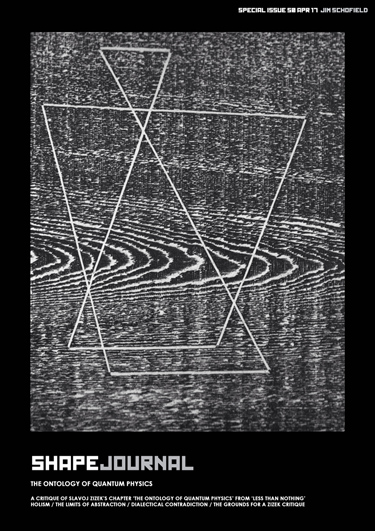
As both a professional physicistand a Marxist, myself, I couldn't believe it, so I undertook a detailed critique (published as Special Issue 50 of SHAPE Journal in April 2017 on the Web), which exposed that ignorance very clearly, and also demonstrated that he is far from being a Marxist.
The lesson for this paper was emphatically proved! It isn't sufficient to apply Dialectics to a serious discipline, without being an expert in that area of study too. Indeed, absolutely all the principles established in the Meta-Discipline of Dialectics were initially discovered within a single particular discipline: and though that was initially only in Thinking (by the idealist Hegel), Marx's transference of all the gains achieved in Dialectics, into the very different Materialist Stance, extended the possibilities enormously!
He was able to apply them effectively in his primary area of study and qualifications, namely History, but in then turning his attention to Economics, he effectively had to become a professional Economist to carry it through. It literally took him the rest of his life, to complete that vital process.
You couldn't just apply general principles, as Žižek does, you had, always, to actually re-discover them, and in so doing, greatly enrich them via every new area addressed. And, as with all Materialist Theory, these too must be verified within Reality itself, to be also be justifiably included into the Higher realm of Dialectics.
Now, this introductory short paper cannot deliver a full account of all that is involved. But the work has been undertaken, and will soon be made available online.
Past relevant Issues of the SHAPE Journal already available are:-
Special Issue 1: The Theory of Emergences
Special Issue 3: The Theory of the Double Slit
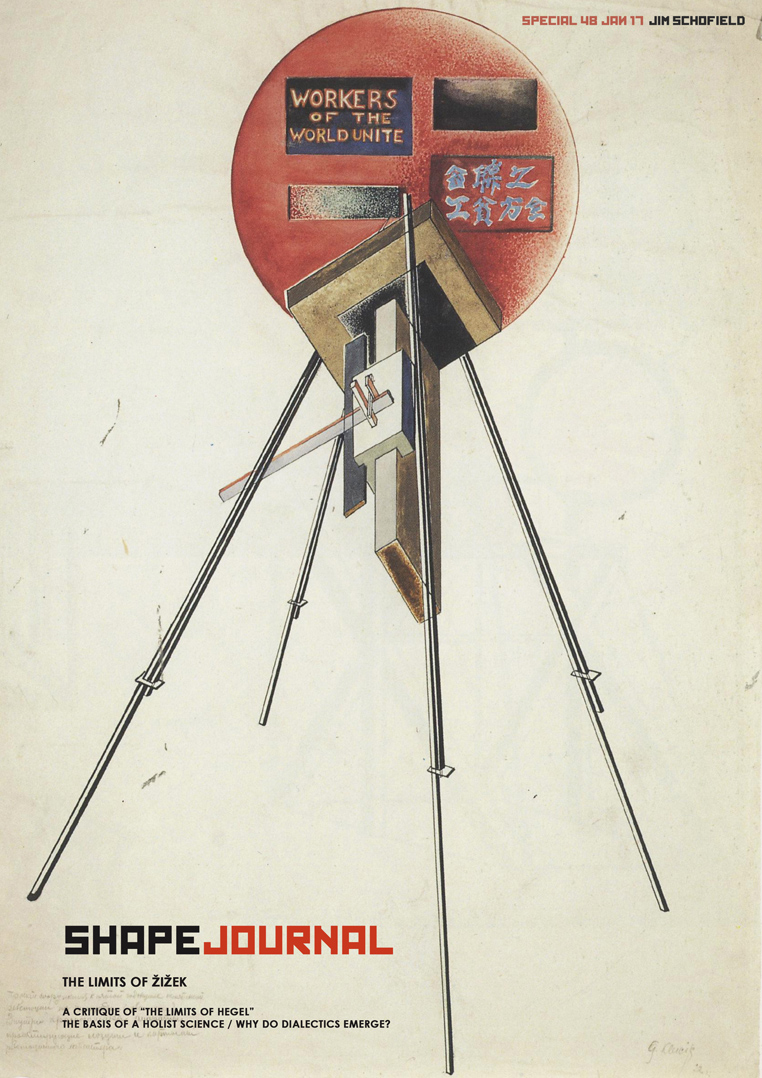
Special Issue 48: The Limits of Žižek
Special Issue 50: Žižek's Ontology of Quantum Physics
It also might interest readers that we are imminently publishing the 100th Issue of SHAPE Journal
after eight years since our launch of
SHAPE Journal, SHAPE Blog & SHAPE Youtube Channel.
Labels:
Dialectic,
Emergence,
Hegel,
Jacques Lacan,
levels,
Marxism,
materialism,
Philosophy,
Shape,
Slavoj Zizek,
Stability,
Thinking
07 May, 2017
What is missing in Žižek’s Marxism?
When attempting to deal with someone like Žižek, you are constantly trying to cope with, both a way of thinking, and a whole consequent vocabulary, that are saturated, nay determined, by his still-idealist premises. He claims, of course, to be a Dialectical Materialist - a Marxist, but that is evidently just the coat-and-hat that he feels it necessary and comfortable to wear.
And, it is made even more difficult, when there are parts of his stance that you not only agree with, but would have to defend alongside him, against the massive consensus, which takes a very different position upon these shared premises.
The most evident shared premise is, of course, Dialectics. But, much more basic than that, is the shared subscription to the Principle of Holism, rather than the consensus belief in the exact-opposite - the Principle of Plurality.
The trouble is that Marxism, or more correctly Dialectical Materialism, was not totally and finally defined by Marx, for he had a Social Revolution to prepare-and-organize for, and much still had to be done to maximise the reach and power of this revolutionary attempt, to ultimately unify both Philosophy and Science, into a single coherent, comprehensive and consistent stance.
For, in spite of Michelet’s brilliant History of the French Revolution, the task not only required the full participation in such an epochal Event, but also the professional Knowledge and Understanding of a scientist, to be able to move towards a generalised, indeed, a true comprehensive stance.
And, the main trouble is with crude, basic Holism!
For Holism and Plurality are a Dichotomous Pair of alternative concepts - indeed, the extremes generated as the result of incomplete premises as Hegel himself had crystallised in his Dialectics - the more real-and-active alternative to Formal Logic, in dealing with Abstractions. Indeed, “Ultimate Holism” as embodied in “Everything affects everything else”, is true, but totally unusable, in almost all circumstances: for absolutely Nothing is fixed, and in its most basic application - absolutely everything changes along with everything else, all the time.
How could any sort of Reasoning be possible on that basis? And the answer is, “None!”.
The possibilities of a kind of Reasoning were, however definitely achievable with the opposite concept of Plurality. But, Plurality - as it is usually defined, is yet another crude concept, for it assumed that all elements to be used, in any way, MUST be fixed: so that they don’t change at all!
The cornerstones of Plurality are the ideal-fixed-forms of Mathematics, and the eternal Natural Laws of Physics. So, as long as these incorrect assumptions are made, some progress in dealing with complex mixes seem possible.
And, it certainly was in Mathematics, for a great deal of purely formal complication was, indeed, possible: a whole world of Pure Mathematics could be built.
But, it wasn’t our World!
Major “engineering” was necessary to make our real world fit-in with Plurality. In what became known as Science, literally nothing was possible, historically, until Mankind learned how to control, modify, and maintain limited situations to approximate to a pluralist state , but only for a given sought-for relation.
And, that wasn’t all! The Greeks not only gave us Pure Mathematics, but also Formal Logic - again made possible by making Statements fixed and unchangeable too!
Now, any thinking about these crucial areas had to be by Reasoning, and so it too was severely hog-tied by Plurality.
As before, it worked in “maintained circumstances”, where things were constant, but failed miserably, when things naturally changed into something else.
Now, the reader can imagine that these ideas could be pursued comprehensively, and we could and indeed would go a very long way, if I was to carry on with it.
But, this isn’t a treatise upon Epistemology, but merely “The trouble with Žižek”, and that is difficult enough!
Clearly, for him, and everyone else, crude Holism is a major problem, and his total solution, as you might expect, is Hegelian Dialectics. But, in dealing with quantum physicists, he cannot oppose them, as he should, with ‘The Full Monty’, so he uses a combined approach with Engels’ Dialectics of Nature methods of revealing resonances between Dialectics and unavoidable opposites in the Copenhagenists’ researches and theories: the “look we are the same” technique, while, at the same time accepting their idealist retreat from Materialism!
He can do it because that is his real position too - retreating from materialism into idealism at every turn!
Not himself being a real scientist, he cannot intervene, as a Dialectical Scientist would, by resorting to concrete Reality. He cannot do that because his Holism is of the crude type. He hasn’t had to, as a true Dialectical Materialist scientist would have to do, develop holism into a new Level involving long standing Stabilities, involving multiple processes, systems of processes and self-maintaining super systems that can then act, as if they are independent of context for long periods, but ultimately are, at first, just sorely-threatened, and then defeated by Crises, with an ultimate inevitable Collapse towards Chaos.
In other words, he should have further developed Dialectical materialism, first to explain why Stabilities occur, and then, how the major transformers of such seemingly permanent states - major changes usually termed Emergences, or in Social Organisation - termed Revolutions, can transform things radically!
How can I say this?
It is because I personally have done just that, via my:-
Truly Natural Selection
The Theory of Emergences
The Physical Theory of the Double Slit
The Theory of a Universal, yet undetectable, Substrate and my demolition of The Copenhagen Interpretation of Quantum Theory via A Physical Explanation of Quantized Orbits
An Explanation of Energy Propagation though “Empty Space”
An Explanation of so-called Quantum Entanglement and Pair Creation and Pair Dissociation
That is what a real dialectical materialist scientist can do!
This paper is from our latest special issue of the Journal
Labels:
Dialectic,
Idealism,
Marxism,
Marxism & Science,
materialism,
Philosophy,
Shape,
Slavoj Zizek,
Special Issue
12 April, 2017
The Grounds for a Žižek Critique
I had previously read his Chapter - called The Limits of Hegel, from the very same book: and though by no means in full agreement with him, did recognise his brilliant use there of Hegelian Dialectics.
He was certainly worth a read!
But, when it came to my specialism - Sub Atomic Physics, it was evident that we, immediately, parted company in a truly major way.
Žižek is no sort of Scientist!
And, that didn’t just undermine his ideas upon that subject: it undermined his purported Materialism too.
Looking back to his work on Hegel, it became clear that he certainly wasn’t as critical of Hegel as Marx had been. He hadn’t switched to a consistent Materialist stance! He was still a kind of Idealist - subscribing to Hegel’s Dialectic, but certainly NOT to Marx’s intended objective of unifying Philosophy with Science. He, like Marx before him, just didn’t know enough about Science. And, crucially he, also did NOT understand Materialism.
![]() |
| Niels Bohr |
When the physicists Bohr and Heisenberg established the Copenhagen Interpretation of Quantum Theory, they were reacting to the contradictions, within their subject, due to a majorly flawed philosophical stance, by undertaking a major retrenchment - abandoning holist explanatory theories for pluralist formal equations only. They were abandoning Materialism for an amalgam of Idealism plus Pragmatism!
But, as a non scientist, Žižek didn’t even notice what that involved. He could “integrate” their ideas with his own contributions, particularly what he had taken on from Lacan.
I had to undertake a root-and-branch critique of Žižek’s position.
Žižek does not, and indeed cannot, equip the Working Class for their coming fight to overthrow Capitalism. That is a job for Marxists who are completing Marx’s objective of unifying Philosophy and Science, and providing the theoretical means to achieve that goal. But, Žižek’s version of that objective is, “If you can’t beat them, then join them!” - the opposite of Marx’s objective.
The contributions in this section are, therefore, a small set of preparatory papers giving some idea of the Ground that is, and will be, necessary.
Fuller, more-comprehensive theories are available, if required via SHAPE Journal, but if the reader is already fully prepared, reading these few grounding notes, will not be necessary.
This paper can be found in the latest issue of Shape
New Special Issue: The Ontology of Quantum Physics
Ever since Lenin’s damning critique of the Empirio Criticism Stance of scientists Poincaré & Mach, early in the 20th century, there has been a crucial, and ever more urgent need, to “complete the job”, by tackling the mess that was, and still is, the consensus Philosophy of Physics, which for centuries has been a contradictory amalgam of Materialism, Idealism and Pragmatism.
The writing was already on the wall, even in Lenin’s time, following the discovery of the Quantum - a descrete, particle-like alternative to the prior conception of propagating electromagnetic Radiation as an extended wave - in a then still undetected Substrate or Medium, which was termed the Aether.
The decline in the Marxist tradition due to the victory of Stalinism in the Soviet Union, and the lack of any significant developments elsewhere, either theoretically or organisationally, was mirrored by a steady decline in what was termed “Theory” in Sub Atomic Physics, as the mounting contradictions in the “New Stance, “ led to increasing amounts of Pure Mathematics, propped up by unfounded speculations - from Superposition, Quantum Entanglement, and Physical Singularities, to String Theory, Quantum Loop Gravity, Super Symmetry and even Multiverses!
Surprisingly, increasing numbers of self-professed Marxists lined up to even embrace the New Physics, and even to claim that it was “Dialectical”!
Clearly, the long awaited tackling of Science by Marxists, would also be the only means of its own salvation!
In Cambridge University, self-professed “Marxists” like Gliniecki, along with many others in the United Kingdom, were now extolling the virtues of Copenhagen, and even the “Marxist” Žižek has written a Chapter entitled The Ontology of Quantum Physics in his recent book - taking a similar line.
But, enough is enough!
This fake Marxist must be exposed for what he is, as part of the major task of defeating the Idealist Copenhagen Interpretation, which is now vital. It must be taken on, and completed NOW!
And, after many years addressing this very task, this Marxist, who is also a physicist by profession and experience, as well as a published philosopher, will now commence the final assault by demolishing Žižek.
24 January, 2017
What is left of "Marxism"?
![]() |
| Marxism for sale! Buy now! |
What has happened to Revolutionary Marxism & Marxist Philosophy?
Yet, it has taken me a very long time. And, I got there by a very unusual route...
I had been interested, from the first contact with it as a University student, and slowly built up an extensive library of Marxist works, ever since my first involvement, and have since spent my whole adult life in professedly Marxist-committed parties, or at the very least as an active and trenchant supporter - but I didn't get either educated, or even trained, in any one of those organisations.
I come from a working class family, resident in a major industrial city - Manchester, in the North of England, in which my dad was an unskilled labourer, and my mam a sewing-machinist: but, somehow, I got an education, and ended up as a physicist and teacher.
I did, briefly, make a real difference, politically, when still a very young man, as I worked almost exclusively among working class youth, on the same kind of Council House Estates, on which I had lived and grown up, but, very soon I was outnumbered-and-outargued in the parties to which I belonged, by middle class "intellectuals".
From being a leader I was soon relegated to being the always-available working class activist, to send in, where the middle class certainly could not productively venture, and indeed, feared to tread!
And, my commitment to becoming a Marxist, though undiminished, never found any teachers either willing, or even able, to take me forward - and, I don't just mean in my chosen discipline - Physics. Indeed, though I met fairly able Marxist Economists, I never met a single Marxist Philosopher, any Marxist Mathematicians, or Marxist Scientists whatsoever.
Now, I had first got into revolutionary politics for a very unusual reason. I had been totally disgusted in my very first term at University, when presented with the Copenhagenist drivel (that was then, and still is, the current-received-wisdom) being dispensed by my professors and lecturers. My puzzled questions only elicited ridicule, both from both my tutors, and even my fellow students. But I was, certainly in the right place, and made lifelong friends - one of whom recommended me to read Lenin's Materialism and Empirio Criticism. (He was, by the way, a fellow student, studying, of all things, English Literature).
And on reading this, my first Marxist book, I immediately realised that Lenin had the answer to the decline in Physics. His chosen opponents in the book were the famous physicists Henri Poincaré and Ernst Mach, who were the immediate theoretical predecessors of the Copenhagenists who later came to totally dominate Physics.
So, I began to read Marx, and then Engels, but I clearly needed help.
The politics was easy to understand coming from my background, but the philosophy, most certainly was not! Indeed, it was clear that Marx was preoccupied with using the newly established Dialectical Materialism in tackling Capitalist Economics, and it was left to his colleague Engels, to "describe" that stance's detailed Nature and Methodology. And, though he did a great job upon materialist Holism, he was by no means, the dialectician that Marx certainly was. Indeed, Engels "found" Dialectics everywhere in Nature, but NOT as its driving fornce, but rather as a kind of set of properties.
It wasn't enough!
Nevertheless, pamphlets like "The Part Played by Labour in the Transition from Ape to Man", were indeed brilliant.
I discussed Lenin's book with my colleagues, in my then Party, but they were absolutely no help, and they even began to get annoyed. "Pack in this Physics stuff! It's an excuse - a diversion from the real work!"
But, they were wrong.
I had no trouble relating to working class youth: after all, I was one of them! In fact, I was pretty successful working with such people. Any new target area that was decided upon, in my branch, would always involve sending me into the fray.
Clearly, my concerns with Physics Theory could play no role there, it never got addressed - ever!
So, my working life as a Mathematics and Science teacher, was separated from my work in political activities, to the real detriment of both.
I began to make real gains as a teacher, and had a successful career, which took me from a Middle school, teaching 11 year olds, by stages and changes of job and disciplines, until I finally got a series of posts in Universities. The separation was remarkable, as when working in Glasgow, I would spend my daytime assisting post-graduate researchers, by writing tailor-made computer programs to aid in their researches: while in the evenings, I'd be teaching unemployed working class youth Computing in a converted warehouse.
But, crucially, it was in my professional daytime work that I, all by myself, made significant progress, philosophically, when designing multimedia aids along with a dance expert colleague, to crack an important problem in using film and video footage in the teaching of Dance Performance and Choreography.
The old Paradoxes of Zeno, in addressing Movement, were finally integrated via Hegel's Dialectics, and, I began to put together my interpretation of what Marx had been implictly using, throughout, in creating Das Kapital.
And, my original problem with the ill-famed Copenhagen Interpretation of Quantum Theory, could now, potentionally at least, be tackled and resolved!
I returned to Hegel - to review his vital criticisms of Formal Logic, his identification of Dichotomous Pairs of contradictory concepts - occurring frequently at non-transcendable rational impasses, and his recourse to holist, "dialectical" means to correct mistaken premises and begin to establish his Dialectical Logic.
![]() |
| Reciprocal Structures by Michael C Coldwell https://michaelccoldwell.blogspot.co.uk/2017/01/reciprocal-structures.html |
And, as an "aspirant-and-intended" Marxist, AND a competent physicist, I began to tackle the key 20th century developments in Physics, which had led to Copenhagen. The first requirement was obvious: it had to be the addressing of the crucially important Double Slit Experiments. Using the very methods I had unearthed in cracking Movement Studies, I addressed the assumed premises of the Double Slit Experiments, and realised, not so much a flaw, as a crucial omission.
The inclusion of some kind of Universal Substrate, theoretically, at least, resolved every-single-one of the anomalies of these Experiments.
Initially, of course, it was, indeed, a purely theoretical solution!
But, the same approach led to further theoretical successes, in defining the concrete nature of such a substrate, endowing it, not only with the necessary properties to deliver all required functionalities: but also explaining its undetectability.
NOTE: Also full experimental credit must be given to the French physicist, Yves Couder, whose "Walker" Expedriments - using only a silicone-oil-substrate and energy, enabled him to create his Walker entities, and even show how they could be made to move in "quantized orbits" - far from the confines of Sub Atomic Copenhagenism.
After decades incorrectly claiming to be a Marxist, I had finally made the grade. But, notice, in that important process, I didn't even mention political activities. What I had achieved was purely philosophical! Marxism is after all a Philosophy.
So, instead of deciding political activities by means of precedent, which is what all the professed Marxists I knew did, the practising Marxist, as I now appeared to be, was able to use Marx's methods, and NOT only his past experiences and solutions, to analyse situations afresh, as they are now, and also in every possible field.
To be a Marxist, you have to be a practising Marxist Philosopher!
The inclusion of some kind of Universal Substrate, theoretically, at least, resolved every-single-one of the anomalies of these Experiments.
The Wave/Particle Duality resolved-itself into a classic Dichotomous Pair, and was explained away by a dialectical, recursive relationship between moving particles and an affect-able and affecting Substrate.
Initially, of course, it was, indeed, a purely theoretical solution!
But, the same approach led to further theoretical successes, in defining the concrete nature of such a substrate, endowing it, not only with the necessary properties to deliver all required functionalities: but also explaining its undetectability.
NOTE: Also full experimental credit must be given to the French physicist, Yves Couder, whose "Walker" Expedriments - using only a silicone-oil-substrate and energy, enabled him to create his Walker entities, and even show how they could be made to move in "quantized orbits" - far from the confines of Sub Atomic Copenhagenism.
After decades incorrectly claiming to be a Marxist, I had finally made the grade. But, notice, in that important process, I didn't even mention political activities. What I had achieved was purely philosophical! Marxism is after all a Philosophy.
So, instead of deciding political activities by means of precedent, which is what all the professed Marxists I knew did, the practising Marxist, as I now appeared to be, was able to use Marx's methods, and NOT only his past experiences and solutions, to analyse situations afresh, as they are now, and also in every possible field.
To be a Marxist, you have to be a practising Marxist Philosopher!
Understanding, and then using, Marx's Philosophy was absolutely vital. Without it, you had to depend upon the past experiences of others: and that just isn't good enough. Having made these conclusions I returned to accessing all the usual supposed sources of Marxist analysis currently available, and their uniform lack of a Full Dialectical Materialist Method was immediately evident.
The supposed "Use of Dialectics" boiled down to the usual tenets of Thesis-Antithesis-Synthesis, Extremes Meet, and the Driving of Change by the interaction of opposites - employed by the activists, OR, the "Back-to-Hegel Dialectics" of theorists like Žižek.
The inadequacies, of them all, have been tragically exposed by events like the Brexit result in the UK Referendum and the Trump victory in the US Presidential Election.
"A plague on both their houses", is not Marxism.
When the Left fails utterly, Populism tragically triumphs! We need the philosophy of dialectical materialism now more than ever.
So, the answer to the question posed in this article's title:- "What is left of "Marxism?" has to be Marxism! And the time to start using it is now...
Labels:
Economics,
Education,
Engels,
Lenin,
Marx,
Marxism,
Memoir,
Philosophy,
Physics,
Politics,
Revolution,
Slavoj Zizek,
US Election
11 January, 2017
New Special Issue: The Limits of Žižek
![]() |
| Hegelian Marxist? |
This issue presents a collection of papers on Slavoj Žižek’s The Limits of Hegel from his book Less Than Nothing.
The introductory papers are important here, because without them the different stances of both Žižek and this critic would not be understood.
Jim Schofield, the author, feels that the various philosophic stances of both Holism and Plurality, and Hegelian Dialectics versus Marx’s Dialectical Materialism, would simply be confused by Žižek’s Limits of Hegel piece, either taken alone, or with a comprehensive criticism by Schofield.
The deterioration of Marxism has proceeded long- and-variously over the last century, to have left literally no-one with the wherewithal to “do a Marx” upon this “professed” Marxist, who casts a long Hegelian shadow over Dialectical Materialism.
A reasonable amount of ground must be attempted to be established, and a “quote-all-with-commentary” method of dealing with Žižek’s offering, along with three preparatory papers, constitute his attempt to deliver as much as possible.
“Why”, you may justifiably ask, “is this amount of effort necessary?”
It is because the World Working Class are entering the most dangerous period in almost a century, and are doing so without the real Marxist leadership it needs.
Labels:
Academia,
Dialectic,
Epistemology,
Hegel,
Holism,
Idealism,
Marxism,
materialism,
Philosophy,
Reviews,
Slavoj Zizek,
Special Issue
11 January, 2014
Slavoj Žižek - The Safe and Useful Rebel?
It is usually explained as being an attempt to speak in a language everyone can understand – presumably to win him or her to a better and more profound standpoint. But it isn’t, and it doesn’t! Instead, it is bound to pull the writer into the “currently dominant” standpoint, where such definitions have been developed over centuries to fit what basic assumptions and explanations were readily available, and indeed, in common use.
And, the question has to be asked, “Who would have been in a position to both formulate and disseminate such concepts?"
Is it the man in the street? Definitely not!
It will always be the products of those in power: those will have the education to be able to express such things, and the wherewithall to be able to disseminate them through their “owned” organs of information.
Any radical motive cannot be easily maintained in such circumstances, and the prophet, in seeking resonances with an alien readership, and in order to get into print, can very easily become the apologist!
The contradictions in meaning between any revolutionary criticisms and the acceptance of the status quo, can never be resolved, as the words used only make any kind of sense in their currently employed meanings: and who is it that will be doing the using? The dominant standpoint within a society that produced the current meanings of that vocabulary will unavoidably be those of the people in charge, and NOT the mass of the population, who for most of their history couldn’t even read, never mind write!
So, the “radical Marxist”, attempting to make a living in the highest institutions of learning must explain things using the accepted vocabulary of those who will make up the vast majority of his colleagues, though couched in the occasional words that seem to be revolutionary (but aren’t!)
Slavoj ŽiŽek seems to be the perfect example of this!
On reading the Introduction to his book In Defense of Lost Causes, he manages to set the stage for this long book, by excusing the “failures” of revolutionaries, and he does it by revealing their clear good intentions. He even calls their “evident virtues” – idealism – a quality of trying to achieve a better world. But rather than the usual advice to therefore, “Give up now you’ll never do it”, he alternatively says that unavoidable failure is really the best that anyone can ever do!
Isn’t that stimulating?
“NO!” And, if you think that, you are right!
Here is the absolutely-guaranteed, safe revolutionary for you!
Does this self appointed prophet not know what Idealism really is? And it has absolutely nothing to do with Marxist revolutionaries. They are nothing if they are not the most realist operators in the world! Real philosophical Idealism is the direct opposite to Materialism, and Marxists are avowedly materialists! They commit to an entirely materialist standpoint, which takes Matter as primary, and attempts to explain things in terms of the entities present, their properties and their inter-relationships.
And, in case anyone is assuming that these Marxists see everything in purely mechanistic terms – the exact opposite is the case! Their standpoint is the only one that can both deal with real qualitative change, and is also essentially multi-disciplinary!
Indeed, these two philosophical words have very different meanings to what ŽiŽek attaches to them: and his meanings are those of the ruling classes, NOT those of committed revolutionaries.
Instead of the idealism of the status quo defenders, revolutionaries see Idealism as a standpoint that has the whole of reality determined entirely by eternal abstract laws, which can be totally encapsulated in purely formal equations. Contrast this with ŽiŽek’s chosen interpretation as a yearning for something better. And, if he were to be consistent with his chosen language, he would also use materialism to mean chasing after material gain, wealth and position. Not even remotely similar are they?
And yet, such very different meanings were considered crucial by real Marxists. Not only Marx and Engels, but also Lenin took this position, and wrote an important book entitled Materialism and Empirio Criticism to counter an idealist trend within the Bolshevik Party (led, I believe, by Lunacharsky, who after the Revolution became the Minister for Education in the Revolutionary Government)
So ŽiŽek’s introduction establishes an amazing position!
One side of it has already been established above in his choice of language, and the second must be his breathtaking apology for the catastrophes following the Russian Revolution, which he, along with the enemies of that revolution, sees as inevitable, but in his case somehow excusable too!
WHAT?
His "inevitable consequence" was no such thing, for it took Stalin many years, a World context of active hostility, and even military interventions by 14 capitalist powers, and, in addition, there was an externally, as well as internally wealth-sponsored Civil War, with the Royalists and Capitalist attempting to overthrow the Revolutionary Regime.
And, even then for Stalin to complete his proposed transformation, internal dedicated revolutionaries had to be successively removed, imprisoned and executed, or even pursued and assassinated (as was Trotsky) to achieve this supposedly “inevitable result”
It’s an odd kind of inevitability is it not? It’s a bit like the opposite of damning Stalin with faint praise to excuse this traitor to the revolution, both in Russia and worldwide!
Let us put our self professed revolutionary Marxist in his proper context!
You can picture a dinner party in London (say) where the “radical” ŽiŽek had been invited to entertain the gathering where various very comfortable academics could “discuss” ŽiŽek’s ideas without any rancour, and with conclusions such as, “All Revolutions are bound to fail!” and “Their idealism simply doesn’t match with Reality”, not to mention, “The inherent greed and insufficiency of people guarantees ultimate failure.” And, such a group beating up ŽiŽek with their mutually agreed vocabulary, could go home to their own comfortable beds, and sleep peacefully!
And such a description is certainly accurate, for this writer was similarly invited to such a Dinner Party for the same reasons, and with a similar bunch of invitees. The only difference was, that I didn’t speak their language, and if anything they went home worried to death!
Also, watching a discussion programme on TV yesterday, a wholly similar social situation was evident. And in a similar way to how I have described the certain treatment of ŽiŽek, with a similar Aunt Sally as he, it was clear that no matter what were the professed affiliations of the participants they all used exactly the same language, and just as effectively tidied away as ineffectual, idealist and bound-to-fail were all revolutionary threats.
Yet somehow major interventions, or their possibility, were constantly coming up in response to the Arab Spring, and you have to ask, which side they would be on when it came to resolving the situation!
P.S. And this is only in response to ŽiŽek ‘s Introduction!
Addendum
Once more into the breech, dear friends!
For, on thinking about ŽiŽek’s lead-in to In Defense of Lost Causes, I felt that I should do the same with the introduction to his book On Belief.
And it was indeed the right decision. For, he analyses the debate occurring in 2000 on US TV in which clerics from the Jewish, Roman Catholic and Southern Baptist faiths discussed religion and Heaven. The Baptist explained that many “good people” would most certainly end up in Hell, as they hadn’t committed themselves to Christ during their lives.
And such an unwavering “principle”, ŽiŽek likened to that shown by Lenin in his revolutionary activities in Russia, and in his “re-casting” of Marx’s position with respect to political tasks.
[Clearly this academic philosopher is scared to death by such intransigence!]
But, of course, such a supposed resonance, could only be found by a modern “opponent” of Liberal Capitalist compromise, and was totally disregarding of the actual political natures of these two completely opposite men. For it handily coupled the two extremes as essentially similar in their steadfast positions. It is, of course, total and completely irresponsible rubbish, and sees them both as steadfast in their “beliefs”!
And, to thereafter promote himself, as ŽiŽek does, as being on the same side as Lenin, is total nonsense. As Trotsky said when describing such people as ŽiŽek – “They wear the yellow jacket of rebellion, but are still fast asleep in their beds when the factory gates are receiving workers in their thousands”. That would be anathema to someone like ŽiŽek: he is an informed faker, and no revolutionary!
Even mentioning Lenin’s name in a book about belief soils Lenin’s real and significant contributions, and effectively demotes a revolutionary commitment to merely another kind of “idealist” belief! Clearly, this analyser of Society is no Marxist at all, and certainly no revolutionary.
He, though, takes, along with all the enemies of that revolution, a position in opposition to Liberal Capitalism and compromise, which will resonate very well with the Right in US politics.
What a remarkable stance, it is so full of contradictions, it is no wonder he is visibly in constant, jerking agitation when he speaks, but it will certainly get readers. For if he (even if only apparently) took a Leninist Bolshevik stance, he would be crucified as are all such dangerous outsiders, so he wisely appeals to all sorts of people, and he does it from an evidently impotent, yet “clever radical” standpoint. Can you guess which side he will be on when the time comes?
I vividly remember innumerable avowedly “marxist” tendencies in the UK, when the troubles escalated in Northern Ireland, they all supported the sending of troops “to defend the republican Catholics” against the then rampant unionist mobs.
But, whom were they used against?
Any Marxist would know that immediately!
That betrayal, more than any number of written treatises, revealed their real position. Only one tendency opposed the sending of troops and they were the nearest thing to revolutionary Marxists at that time. And I know this because I was in that tendency!
Labels:
Academia,
consensus,
Idealism,
Language,
Lenin,
Marxism,
materialism,
Philosophy,
Religion,
Reviews,
Revolution,
Slavoj Zizek,
Writing
Language and Plurality: The Disabling of Science
This was pointed out to me, in response to my damning critique of the self-professed Marxist philosopher Slavoj Žižek, who’s implicit, but unstated, position on revolution, revealed a very different kind of person. For, I had made it clear, in that critique, that the very language and assumptions he used in defining his “radicalism” was absolutely nothing to do with either revolution or Marxism, and clearly everything to do with his position and milieu in the Universities in the capitalist world.
Yet, that criticism of mine wasn’t an appropriate example of a similar standpoint to Wittgenstein’s, for though mine is based upon a holistic philosophical standpoint, a working class origin and a lifetime in revolutionary politics, Wittgenstein’s was just as clearly based upon the usual pluralist philosophical standpoint, and it also implicitly justified, as absolutely essential, the identified set of different languages as unavoidable in the various different specialist disciplines. Indeed, it implied that the only way that investigations could ever be conducted, by specialists, was by first isolating, and then thoroughly simplifying a particular area of interest, and only then applying an analytic method to it. And, such an analysis would be meaningless, unless what is so revealed would definitely be unchanged from when it also occurred in totally unfettered Reality.
Indeed, that crucial assumption is embodied in the famed Principle of Plurality - often alternatively stated as the separability from context of all relations extracted by such means.
But, that assumption just isn’t true! You simply cannot assume that!
And, to prove my point, no one can apply relations found by such methods and apply them with confidence in a totally unfettered environment! They have to reconstruct the exact same and essential context, from which they were able to originally extract their “eternal” relation, in order to successfully employ it towards some sound and predictable outcome.
Now, how does this modify Wittgenstein’s statement?
It confirms that all such walled-off, and purposely “farmed” areas, as with all others from very similarly arranged situations, will inevitably generate their own “local lingo”. How could it be otherwise? In Wittgenstein’s mouth, such a statement is surely a consequence of a pluralist position, and a pluralist methodology. It is nothing to do with socially determined language in a Class Society.
Now, Wittgenstein may have considered that to make judgements in any specialist area (that would be of any real value) you would have to have studied it sufficiently to know what is meant by the terms other experts will use, and that is certainly true! But, you cannot ignore the effect of the pluralist filtering, which can only isolate specialisms, one from another, due to such a universally applied method. And, it therefore makes almost impossible, any more general realisations that occur between many very different areas of study. For, instead, this universally adopted method crucially encases each extraction with its own ideally-tailored context, and is therefore and unavoidably, a locally-determined knowledge.
Indeed, it usually amounts to a set of such situations, and their relations, that are sufficiently close in their required contexts, to be taken as a coherent subject, but still walled off completely from the rest of Reality. Indeed, the specialisations just get more and more restricting as new entities and their properties and relations are discovered. New specialisms seem to grow around particular investigative means.
The most glaring example of this being in Sub Atomic Physics, where the almost total reliance of investigators on High Speed Accelerators, or more properly, Colliders, have produced a remarkable walled-off World, so odd, that it is said to have its own unique laws, and even its own and very different Philosophy to the rest of Science – and, of course, its own language!
Now, if these criticisms are considered to have some merit, the usual and necessary response must be to ask “What is the alternative?" The so-called pluralist methodology has not only allowed a vastly extended knowledge of Reality, but crucially, it is entirely useable to required and valuable ends. What can possibly replace it with at least a similar efficacy, if not something clearly better?”
Well, these are certainly valid points to make, for the alternative standpoint to Plurality, is Holism. And its main tenet is that you cannot separate out a relation from its context without changing it or indeed, sometimes even destroying it altogether! Holism has all things affecting, and, to some extent, actually determining, all real behaviours.
Plurality actually “solved” that difficulty by isolation and comprehensive tailoring in order to make such extractions, and then replicating such ideal conditions in order to be able to effectively use the relations so achieved. What on earth can be done if we turn our backs upon such a powerful and useable method, and instead, somehow, attempt to directly study Reality-as-is?
The criticism is that any strictly holist approach is bound to confront us with unfathomable, simultaneous complexity, and hence the impossibility of making any explanatory progress at all! But, such a criticism only holds if Reality is some complex mechanism making any kind of analysis totally impossible. But, that is not the case!
Indeed, in spite of its “everything included” tenet, that does not stop coherent overall behaviours emerging from the melee. In spite of its complexity, it does not ever become totally chaotic, or indeed wholly unpredictable. And the reason for this is that in these all-things-included interactions, there are always systems and sub-systems that can, and indeed do, become dominant.
But they are never permanent!
Indeed, in most situations, though a period of relative stability can become established, so that conditions, for a time, can seem to be unchanging, and particularly important relations can be so frequently glimpsed, that stability is clearly a kind of active balance, and what is glimpsed comes and goes. It is that suggestion of an underlying eternal element that caused investigators to establish their tailor-made Domains of Investigation, and extract their presumed “eternal“ relations. But, without this artificially imposed stability, such temporary interludes will always subside and the situation will regularly, for its own fleeting interlude, become a different one.
Clearly, what the pluralist approach does, is it attempts to “freeze” a varying situation, then simplify it until its dominant relation is clearly and permanently displayed, and can be effectively extracted.
“So, what is the problem?”, I hear in a chorus of cries, “Isn’t the pluralist approach vindicated?”
Well no, I’m afraid it isn’t!
For it is totally unable to deal with the qualitative changes that will definitely terminate that prior wobbling Stability, and cause it quite naturally to turn into something else no longer dominated by that prior extracted relation.
Plurality is a method for dealing with Stability only, and it also erroneously extrapolates its findings by considering them to be eternal.
Major flaws, I think you will agree!
Let us be clear, it only allows a "hopscotch" type of Science, where only isolated stabilities can be subject to analysis, BUT not a single transition to a new, natural and consequent situation is included! You have no option but to “hop” onto the next stability (and its consequent rules) without any understanding of why it had to occur!
Important? I should say so!
For example, a pluralist approach will never, ever in a million years, discover and understand the Origin of Life on Earth, or its Evolution. It will merely provide a few stepping stones towards (and away from) such transformations. Without any real understanding of the actual changing dynamics involved.
Yet, the disabling of Science by Plurality amounts to far more than that. For, the proliferation of ever narrower defined specialisms is inevitable, and even more significant, the transitions in Reality between these ever dwindling footholds, is totally prevented from ever being properly addressed, as long as that standpoint and method continues to hold sway.
The exemplar for the only possible future, pluralist development is demonstrated already by Computer Simulations.
In these totally pluralist models of unfettered situations the situation is removed from its natural holistic nature, and is replaced by an invented situation wherein multiple, eternal relations are all acting both simultaneously, but also separately. And, the actually existing problem of dynamic transitions is simply stepped over by evidentially established Switches. When a certain “key parameter” passes an established threshold value, the program is written so that it merely switches out one relation to be replaced by another, both of which were laws of the usual pluralist type, but rather than any sort of real dynamic transition, we model it with a simple switch-over that being the only way the pluralist standpoint can attempt to deal with a holist Reality.
Plurality deals only with Stability, and even then, very inadequately, as Mankind delves ever deeper into its newly revealed entities, causes and processes.
For Reality is not, as it is assumed, monolithic! It, on the contrary, consists of distinct and qualitatively different Levels, which are not mere hierarchies with a straight-through causality from bottom to top, but a system of superstructures, each of which is established by creative and indeed revolutionary Emergences.
The Origin of Life on Earth is the Key Exemplar!
Let me attempt to make this crucial point as clear as possible.
You can never reduce Life entirely to some new arrangement of separated pre-Life elements. For, an Emergence of this stature isn’t just a new turning in an entirely predictable development, but a Revolution, which can only occur when prefaced by a terminal crisis in the prior stability, which then precipitates a wholesale collapse into something resembling Chaos, but which is then followed by a remarkably creative period entirely holist in its nature that creates the entirely New via a myriad of simultaneous and mutually modifying processes to transform their own natures and context top down!
The new Level is not just a foamy product on the surface of a once calm, and now stormy, sea, but a wholly new Level that has significantly changed its own causing context.
How could that ever be analysed in a pluralist way?
Yet, it can still be disregarded as absolutely unnecessary because of the pragmatic effectiveness of pluralistic extractions, when used in production, and that, I’m afraid, is much more damaging it at first appears.
Like Formal Logic, the current pluralist-based Sciences really only deal with things which do not change into something else. It stops the actual dynamic of real qualitative developmental changes, by an approach assuming, or even purposely guaranteeing stability. It turns its back upon real qualitative changes, and attempts to transform what occurs in those indisputable interludes of significant qualitative change into descrete-state situations, with signals of when to switch. The actual beauty and power of emergent interludes is swept under the carpet, and replaced by non-explanatory rules-of-thumb.
It is therefore a major and damaging retreat, and in fact transforms what we proudly call Science – the attempt to get ever better explanations of all aspects of Reality, into mere Technology – the effective use to produce easily organised results!
Science is gradually shunted out, to be replaced by useable discoveries and methods of employing them.
Indeed, the attempt to explain things in a certain areas are not only abandoned, but actually banned as “self-kid”, as is increasingly the case in Sub Atomic Physics, which has transformed itself into a branch of Mathematics, and has left Reality behind to explore the much more conducive delights in the seemingly universal laws available in the World of Pure Form alone – Ideality!
Labels:
Academia,
Computer Programming,
Holism,
Language,
Marxism,
Philosophy,
Physics,
Plurality,
Quantum Theory,
Slavoj Zizek
Subscribe to:
Posts (Atom)