Showing posts with label Diagram. Show all posts

14 June, 2017

The Myth of Graphs


Theo van Doesburg, 'Counter-Composition VI' 1925

The Problem with Mathematics I

The "Geometrification" of Phenomena

In criticising the formal, mathematical treatment of real world phenomena into graphs, I am, in a way, NOT damning this marvellous development as wrong, but, on the contrary, drawing necessary and vital attention to its common mis-interpretation and consequent misuse, beyond its evident pragmatic efficacy.

Let us be both precise and revealing about this particular and remarkable union of Materialism and Idealism - made possible by Pragmatism - "If it works, it is right!"

The clearest, useful cases occur with the quite evident geometrical advantages of Graphical representations of whole data sets, taken from real World experiments, in up to three dimensions (using the actual three dimensions of Real World Space) to handle up to three variables across a given range of real instances.

Such a clever capture of a whole-set of related instances within a single situation, which maintains its relations in spite of quantitative changes in its evident contributions, clearly has advantages, and, pictorially, delivers the whole measured range simultaneously, "effectively" revealing the same thing as does a fitted-up formula can do covering the same real data, but is definitely a more informative representation.


Parabolas: These two graphs are not to scale and are here just to illustrate the two types of graph explored below


But, before we take things any further, it is important to differentiate between the two graphs that can possibly be constructed from the same data. For, though these two look very similar to one another, they are, in fact, very different.

CASE ONE: is when raw data is directly plotted in a graphical form.

while

CASE TWO: is when a pure abstract Form, defined by an Equation, fitted up to that data, is similarly plotted.

Now, mathematicians deal exclusively in Generalised Forms - a mixture of Variables (representing measureable as varying quantities), and Constants (which can actually be a vast range of values, giving a host of versions of the very same Form, without changing the relational nature of that represented Form).

These two come from two different Worlds - the data-based plot is from Reality (the real World - though usually extensively farmed), while the formula-based plot is from Ideality ( the World of Pure Forms alone)! And, of course, they have to be related in some way, to make the latter Purely formal Relation helpful for the real world situation - captured via its measured data.

Initially, of course, they are merely approximately the same, but are clearly resonating-analogues of one another, in the mind of the observer of them both, but the astute investigator recognises this, and is determined to tailor, or fit-up, the easier-handled, general abstract form to fit the collected data.

And, such tailoring is a purely mathematical operation! The original General Form has, as yet unknown, constants within it represented usually by placeholder alphabetic letters. The tailoring process involves substituting sets of data, representing a measured real world instant, into the general equation giving a formal relation in only the constants. Other sets are then substituted-in giving different versions, in which he unknowns are, once again, the constants.

Using the technique of Simultaneous Equations, these constants can be calculated from the combined use of the various versions, and substituted back into the general form to produce a particular instance or Equation representing (reasonably well) the original real world data. But, it is STILL an idealised form!


It is by no means identical with the dealt-with Real World situation, OR EVEN the full content "resident" within that measured data. And, perhaps, most important of all, it behaves very differently indeed "in the limits".

For, while the real world situation flips into another totally unpredictable situation in Reality, the Equation merely blows-up, via asymptotic approaches to Infinity or Zero: and these Singularities mean absolutely nothing in the real world - merely indicating "the usefulness over!" So, any assumption that the Equation (so-obtained) is the true encapsulation of the real world relation is, most certainly, incorrect.

Indeed, it is usually much worse even than that! For, data taken directly from totally unfettered Reality can only very rarely be treated in this way. More often, the only way to deal with the situation is to quite radically farm it to produce more conducive and informative data. The real world situation is changed - by removing any evidently confusing factors, and then also controlling others, until a possibly targeted factor becomes clearly displayed, and only then is the required data-set extracted. But, even that is usually insufficient for reliable data: so several sets of measurement are taken over the exact-same sequence of the independent parameters, and averages taken of all the results.

This technique removes other still-there variable effects, and it is only this Well-Formed-Data that is finally used in the above-described techniques.

As this theorist has explained at length, elsewhere, what is then used is both from a highly simplified & stably-maintained context, and fitted up to an idealised mathematical form (suitably adjusted to be as close as possible to the farmed data). It is pragmatically useful, if used in the same context to that from which it was extracted. BUT, does not behave the same over all extended situations. AND, even more crucially, gives major errors when used theoretically in more complex reasoning.

IMPORTANT NOTE Though not the main purpose of this paper, it must be mentioned here that the main philosophical error involved, in both sides of this inter-discipline co-operation, is the adoption of the Principle of Plurality, which is never true of Reality-as-is, where Holism certainly dominates. Plurality, in fact, only-ever-holds in strictly-stable natural and artificial situations, and, of course, in wholly idealised discipline areas such as Mathematics.

And finally we must emphatically differentiate between Graphical Dimensions and Real World Dimensions.

For, the former are in Ideality and can be as many as there are varying parameters, whereas the latter are limited by Reality itself to ONLY THREE! As soon as the wedding to Formal Equations ousted Causal Explanations in Physics, the legitimisation by reference to Reality was lost, and replaced by the Rules of Mathematics alone. Dimensions, beyond 3, were objectified by various ruses totally illegitimately.

Of course, the practitioners involved would never agree to this point, primarily because it would undermine their whole "world". They worship Form so finally, that they study purely formal equations in preference to studying Reality itself. "A blackboard-and-chalk will suffice!"

Further Reading:

David Malone and Chaos Theory

Computerised Solutions, The Nature of Mathematics & The Necessary Revolution in Philosophy (Special Issue 46)


03 October, 2016

Marxist Theory Today IV


Assimilating and Using the Marxist Method

My first tack in pursuing this objective was basic but crucial: I had to understand Mankind's developed processes of Abstraction-from-Reality, in order to begin to see how our original concepts were arrived at.

I back-traced the processes involved all the way to initial Observations. Then, gradually unearthed the necessary sequence of processes, and the productions, that were involved.

Crucially, I then attempted to concentrate my findings into a clear and concise diagram.

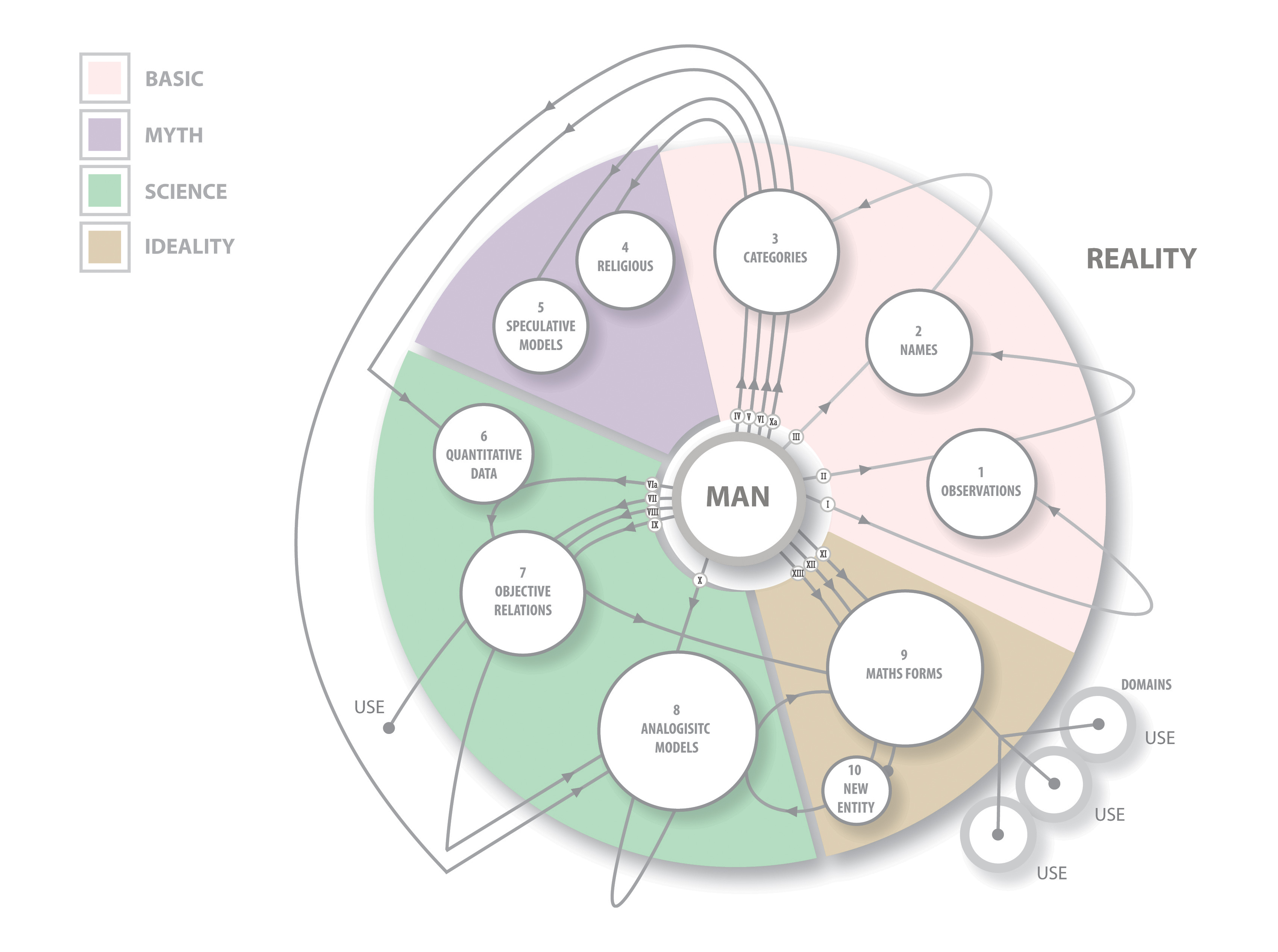
The completed diagram (shown below) related Man and Reality, via those Key Processes to deliver Abstract Productions (or concepts), without which, any kind of understanding would be impossible.


New Marxist theories: Jim Schofield's 'Processes and Productions of Abstraction'


The final result was profoundly significant, for it not only showed the sequence and hierarchy of processes and concepts, but also revealed a higher order of phases of development from Basic to those involved in Science.

And, profoundly, it also revealed clearly exactly how Mathematics arose via a specially devised subset & extension of Reality, which I termed Ideality!

And, his began to inform a trenchant criticism of my own most successful subject Mathematics, as well as the contradictions present in Science itself.

It also led to the next and most important phase of my philosophical researches.

By 2010, I had devised The Theory of Emergences, as a culmination and focussing of 50 years as a professed Marxist, transformed by this vital and revealing last few years. Let me regale you with the final diagram of that Theory.


New Marxist theory: Jim Schofield's Trajectory of an Emergence

This wasn't as general as its title seems to claim, for it was primarily an attempt to trace out the trajectory of a known and well-documented (by reliable Marxists) an actual Social Revolution - The Russian Revolution of 1917.

The profile was from pre-Revolution Stability, through Crises and Oscillations, via seemingly terminal Collapse, to a construction/dissolution oscillating and ascending Phase, gradually achieving a final and persisting Stability at a wholly new level.

I, finally, had an inkling of what someone like Lenin had to cope with, to analyse objectively, and do what was required, in the midst of a Social Revolution - indeed, to ride the rollicking, dangerous tiger to a successful outcome!

But, I was a scientist, and, I believe, a good one.

I knew that my task, and also the most important task for Marxism, was to free Science from the idealist manacles of the Copenhagen Interpretation of Quantum Theory for good.

My use of the gains that I had made, would have to be employed across the board!

Now, this latter development was in many ways putting the cart before the horse. Though both immediately and fruitfully applicable, it all still lacked the use of the detailed discoveries by Friedrich Hegel and Karl Marx, which had profoundly transformed Philosophy, and severely criticised Formal Logic and the methods of Reasoning that were the only ones available, and totally incapable of dealing with the creative, qualitative developments, as in Evolution, and the whole History of the Universe.

Hence, a detailed study of those essential early stages followed, starting with Hegel's revolutionary Thinking about Thought, and his realisation of the many, and recurring, rational impasses occurring in all thinking that is limited by Formal Logic, the Principle of Plurality and the unavoidability of clearly rationally-insuperable Dichotomous Pairs of contradictory concepts (Abstractions), which arose directly from the very same set of assumed, basic premises.

He was able to show that when the relevant premises were dug out, and carefully traced through, to deliver both arms of an evident Dichotomous Pair, it was entirely possible to examine all those premises one-by-one, identify possible dodgy ones, and find out whether changes could be implemented, which allowed a transcendence of the caused impasse.

Hegel immediately knew that he had discovered a new kind of thinking, which for the first time delivered a working method of addressing the weakest aspects of the 2,500-years-old Formal Logic, and also included the beginnings of what he called his Logic of Change, and a means of not only dealing with the evident failures of strictly Formal Logic, but much more widely, by addressing the trajectories of Qualitative Change that, thus far, had never been properly addressed.

The basic method described here, only in outline, he termed Dialectics. 


Systems Dialectics - interesting diagram trying to address something similar in theory, not sure if it quite works! - source: https://rdln.wordpress.com/2014/06/14/dialectical-systems-and-chaos-part-2/


However, among his Young Hegelian followers, Karl Marx considered that the features, which Hegel only applied to Human Thought, were also true in all areas of natural development. He exported both Dialectics, and his own philosophical stance, from Hegel's trenchant Idealism to Materialism!

But, clearly, Marx's subsequent direction was not what Philosophy usually did. If at all, such things as Marx was now including, were usually addressed by historians, scientists, economists and mathematicians etc. etc.

Marx realised that all those disciplines, too, were also limited by Formal Logic, and its kind of Reasoning, so he declared that his new Dialectical Materialism alone could, and indeed, would transform these areas too, initially by using the same methods of addressing the impasses involving Dichotomous Pairs, and caused by inadequate premises.

And, his primary target just had to be Economics! He needed to understand the current Economic System of Capitalism, and its avowed principles and premises.

And, both History and Archaeology showed quite clearly that Human Societies had definitely developed, and moved through a sequence of distinct Economic Systems - and, each one had been terminated by what had become known as Social Revolutions.

And, to strongly focus such an investigator's attention, the 15 year trajectory of the French Revolution had only very recently occurred, and very nearly totally transformed a continent.

It just had to be understood!


Jules Michelet - History of the French Revolution


And, as circumstances also dictated, the right historian had been similarly focussed into logging the whole event in meticulous detail: the brilliant French historian, Michelet, in doing this, had transformed the methods of his discipline, and the full richness of a studied Revolution was there in his brilliant work, for people like Marx to study: and that is exactly what this serious and brilliant philosopher did!

Now, you can see why I and millions of others had been let down by generations of self-professed Marxists throughout our political lives.

None of this was revealed and explained!

None of it was even used!

The Dialectical Materialist Method was not delivered!

And, clearly and crucially, none of it was ever applied in Science!

So, what was left was just Political Activity, maintained, primarily, by the prestige and momentum generated by the Russian Revolution, without the necessary extensions, in the manner of Marx himself, into the many, still-outstanding and absolutely-necessary disciplines, such as Science, and most crucially of all, Physics!

Such people were a long way from being real Marxists.

In fact, their distortions of Marxist Theory had actually misled the world Working Class, and failed to cope with the rise of Fascism, and yet another World War, where literally millions of workers died at the behest of their ruling classes.

And, even the landside election victory of a Labour Government in Britain led to only temporary gains, now being increasingly flushed down the toilet at an ever increasing rate.

We were ALL, from workers to intellectuals, betrayed by these fakers! As my original title for this essay declares:- They were, at best, merely "Descriptive, Retroactive and Activity-Based" in both Theory and Practice.

And that isn't Marxism!


The Large Hadron Collider

Tackling the Crisis in Physics

So, having personally got to this point, what did I now do?

Since I was 19 years old, I had been stymied by what I had been taught in my Physics Degree Course at University, but had no idea what to do about it. Lenin's Materialism and Empirio Criticism promised a Marxist alternative, but it was never subsequently delivered.

But, NOW, I was in a position to tackle this vital task myself!

Throughout my career as a physicist, I had been brought to a halt by a classical Hegelian Dichotomous Pair embodied in the infamous Wave/Particle Duality insisted upon by the Copenhagen Interpretation of Quantum Theory.

Clearly, now, I had to use the Dialectical Materialist Method of Marx to reveal the flawed common premises, which gave rise to this impasse, and determine what was wrong.

Initially I found simplification, context-farming and even idealisation embedded in the universally applied Scientific Method, but I still couldn't correct the premises involved. UNTIL, that is, I noticed a glaring omission. Most Sub Atomic Phenomena had NO physical explanation - only detailed descriptions and useable formulae - allowing effective use, but totally without any explanations, without any Theory!

Now, Mankind had explained things in the past, which they couldn't do any longer. So, I looked at these and realised that the current impasse was due to the banning of the explanatory concept of a Universal Substrate in the basic premises upon which Sub Atomic Physics was then built.

So, I checked out what would happen in the ill-famed Double Slit series of experiments if a substrate were included.


The Double Slit: Matter in Motion?

Amazingly, all the problems and confusing anomalies dissolved away: all phenomena, in every version of the experiment could be explained physically! No Superposition or Wave/Particle Duality: no collapsing of the Wave Function - it all became totally irrelevant.

Now, this concept, of a Substrate, had long been jettisoned because it could not be detected, but, as James Clerk Maxwell had shown, if such an idea could lead to successful theories they were, at least temporarily, valid - remember it was he, assuming the Ether, that produced the still universally used Electromagnetic Equations.

Of course, the belief in eternal, directing, Natural Laws, long assumed in Physics, made the validity of concepts like an unknown Substrate reprehensible: but that prejudice was mistaken!

Mankind's theories were all approximations, but as long as they contained enough Objective Content to be better than those they replaced, they would be legitimate steps forward.

Man has never had access to so-called Absolute Truth, though the myth of eternal Natural Laws, encapsulated fully in Formal Equations, implied the opposite.

Clearly, the assumption of a Universal Substrate, was significantly BETTER than the Copenhagen retreat from explanation entirely!

However, scientists have certainly sought the presence of a Universal Substrate over an extended period, and never found even the slightest trace. Yet, here we are, with its firm assumption of existence, demolishing the whole edifice of Copenhagen.

So, I decided to theoretically devise a "real" Substrate that would, for sound, physical reasons, be entirely undetectable, yet would deliver, in a physically explicable way, ALL the requirements I had worked up for The Theory of the Double Slit - and I succeeded!

The flaw in the premises, was not a mistakenly described component or idea, but an actual omission.


New Marxist theories of Physics by Jim Schofield

I had used Hegel and Marx's Dialectics to crack a problem, not only in Sub Atomic Physics, but generally. 

For, apart from the inclusion of the Universal Substrate, the whole mish-mash of contradictory philosophical assumptions, which for millennia had not only involved Materialism, but also Idealism and Pragmatism.

That amalgam had also been demolished.

An amazing claim, you might think, but the Double Slit success has been followed by other equally important gains, in dispensing with Quantum entanglement and Superposition, while a totally non-Copenhagen explanation of Quantised Electrical Orbits in Atoms has also been completed.

The door is now ajar, and through it could be seen the Future of Science, and a re-invigorated Philosophy of Marxism!


This post is the last in this blog series entitled Marxist Theory Today. Watch this space for more articles in our grand Shape Journal series on Marxism & Physics.


14 February, 2016

Inflation, Wages and Profit


How the Capitalists make their Capital!

What are the causes and the role of Inflation in a Capitalist Economy? To the ordinary, working citizen, it seems to indicate a rise in prices, not only when their wages are kept fixed, but also always over and above that crucial income, and recurring year after year. So, clearly it is always an extra added to the overall costs of production.

It, clearly, isn’t in either the customers’, or the workers’ interests. So let’s consider how it happens, and what excuses for it, are trotted out by those who always actually benefit from it!

Argument one: It is always offset by wage rises in line with inflation!

No, it isn’t! Prices rise all the time, but wage awards, if you are very lucky, happen only annually. So, only after the cumulative effects of a year’s inflation have been suffered, are the wages risen to “the same rate”.

You won’t have been spending it, when the prices were actually rising, but only in the following year, while inflation is, still, all the time, rising prices further.
Even if you get the exact same %age rise as the inflation at that point, you will still lose every single year!

They will never give you a rise to cover the coming inflation!

Argument two: We will recoup those increases by selling abroad!

Not necessarily so, I’m afraid, for if inflation abroad is less that it is at home, they will buy our exports cheaper than what we made them for. We are constantly told about exports to other countries being invaluable, but NOT if our inflation outstrips theirs”
And, if inflation in the receiving country is more than ours, then they cannot buy as much of it: it will be too dear!

Argument three: We can avoid home inflation by buying our necessary resources to go into our manufactures abroad.

But, that will only work if the suppying country has high inflation, if it has low inflation the exact opposite will be the case!

Finally, various overall factors can severely change these relationships. If circumstances outwith a particular country, cause a severe drop in trade, as with the 2008 worldwide slump, then the necessary wherewithall within each country to pay for many things is severely reduced, and in a Capitalist country, the employers will lay off workers, and also change the conditions under which they employ anybody else will be considerably reduced.

Now, such a discussion as this, cannot be carried onwithout any reference to Profit¬ For, the main purpose of Capitalism is to make Profits – for these accrue to the owners of the means of production, who use them to ensure an ever better life, and as accrued Capital for re-investment.


Profit is the most important thing in a Capitalist Economy!

So, what is it and where does it come from? If economic transactions balanced out perfectly: that is if costs exactly balanced income, then Capitalism couldn’t work! The necessary change has to be the ADDING of a necessary profit to prices charged for goods and services produced. Things MUST cost more if they are to produce this crucial extra! In a way it is similar to the effect of inflation, but it always has the same purpose. It goes to the investors in, or owners within, the producing country. They get an annual dividend, determined by how much their investment is now worth (whatever it was originally). It is produced by an added increase in price over and above all costs of production.

Now, this may sound reasonable, but it certainly isn’t!

For, not only can they get these dividends for many years, without any of it reducing their invested amount, but they can sell their investment at a significant different kind of profit, if the company is successful!

One way or another ALL the proceeds of Capitalist enterprises go ONLY to the Owners and Investors. And, clearly, if the level of workers pay can be restricted, it naturally increases the profits.It is interesting where this econd kind of profit comes from! It is, clearly, from those who buy the goods produced, – and they can be workers too!

Longstanding and large dividends make investment in such a company very lucrative, so investors will pay a premium to get in on the act!

Now, if there exists a permanent inflationary situation, with prices constantly rising, and that isn’t reflected in in consequent rises in wages, then that TOO will end up as profit! FACT: an ordinary house in 1965 may have cost £2,750 –while in 2015, the same thing costs roughly £275,000 a hundred times more. That is also inflation – as it shows itself in house prices.


Of course, that still isn’t the full story

For, after such a slump, when taking on a new worker, employers will, if they can get away with it, be paid less than the prior rate.

Profit is sacrosanct in Capitalism!

So, from such an outset, a margin will be built into prices (or extracted from wages) to ensure that Vital Profit! So, in a simplified form, we now have the system clearly defined!

  • First, the worker is always paid less than he or she should get.
  • Second, prices are manipulated in the same way to guarantee regular profits!
  • Third, both of these extract a surplus from workers to pay this profit to the capitalists!

Clearly, inflation is always the enemy of the Working Classes; because even if they get a rise “in line with current Inflation”, it will occur AFTER they have been getting paid and buying required goods at these constantly inflated prices. By the end of that year, therefore, they will have been buying things at prices ABOVE the rise thay had received. And, if they then get a similar in line with inflation rise, they will be paid fairly only once: for the rest of the year thay will be paying at inflated prices that they have not received enough to cover..

See the following diagram, which shows not only exactly how this works, but also gives how it should would so that workers are not ripped off!


The diagram with its “minus signs” shows how inflationary rises rip off workers at a fixed rate of pay!

Clearly, you can see why, in the present depressed state of World Capitalism, the bankers require a measure of Inflation; In the U.K. they have a required target of 2%.

Why do YOU think that is?

20 January, 2016

The Early Solutions


What is to be Done: VI
The essential tasks for the Marxists of today

Now, in spite of the difficulties with the current pluralistic forms, they had emerged fairly late in the history of Mankind, and throughout that long, long "prehistory" Man had developed OTHER important views on the World around him. Indeed, sometimes Reality itself seemed to be organising against him, and a holistic attitude to Nature was unavoidable. In addition Man was an intelligent animal, who had learned to intervene with Reality in order to survive and prosper. His own necessarily purposive actions coloured his World View, and he felt the need to endow purpose to Reality itself. He expected causes, just as he himself was the cause of many things in his day to day life. Of course, this led to animism and ultimately to a God, made in his own self-image, but it also expected useable causes to be available for dealing with Reality in general.

Contradiction Premise

Now this led to primitive versions of philosophy and science originally, and when Experiment finally arrived to invigorate his investigations, it also accompanied the experimental method as its Explanation. The tradition of looking for causes gelled with the extraction of relations and gave a meaningful narrative to those isolated achievements. Mankind developed Explanatory Science. But, this cosy idea of what Science became was a myth. Indeed, the experimental imperative was technological(?), whereas the explanatory imperative was surely scientific(?). These were NOT a perfectly matched pair!

Abstraction

Some years ago I realised this and determined to investigate. For a long time I kept tripping over my own incorrect basic assumptions and getting nowhere. But I finally settled on the man-made process at the heart of all of these diverse things. It was Abstraction!

I began to try to categarise exactly what Abstraction consisted of, and to effectively define it, started to conceive of the crucial Processes of Abstraction, and their resultant Products at various stages in a sequence of essential Abstraction Processes.

The task turned out to be prodigious!

For Mankind's earliest conceptions were also abstractions, So, I began to attempt to construct a sequential list of the Stages of Abstraction used by Mankind in his attempt to comprehend the World.

He certainly started with Observation, Recognition, Categorisation and a crude very speculative attempt at Explanation, but after the advent of Societies wonderful new forms appeared including Logic and Geometry.


The Processes and Productions of Abstraction

Finally, with the rise of Experimental science, the first true Theories began to emerge.. [I have written a great deal on this, under the title of The Processes and Productions of Abstraction, which has even culminated in a general overall Diagram. This figure attempts to relate the whole area as a single system] We cannot attempt here to replicate the whole of this extensive research here, but its final diagrammatic Form can be useful, and is reproduced here.

Now we must never lose sight of the fact that Abstraction is a man-made invention. It recognises diverse things in Reality which display features in common, and attempts to concretise this commonality under an appropriate Category Title, whose Name, then represents that commonality.

Note: This diagram is NOT the latest version, nor can it ever be, as it is constantly being revised and improved. But for the purposes of this paper it should prove quite adequate.

Once more the usual dichotomies and difficulties occur, due to our assumptions and premises, and even in Thinking and Thought ñ more particularly Abstraction ñ the bifurcations appeared which clearly showed TWO diverging roads which seemed impossible to merge.

Without this necessary excursion expanding into a veritable ìworld tourî, let us just concentrate on this parting of the ways. A brief explanation of the Diagram will be necessary.

Explanation of the Diagram

At the centre is the Active Element in the whole series of Processes ñ which is, of course, MAN, The background to the whole figure is, as it must be, Reality. While, in between these two there is an annulus containing the various Productions of Extraction ñ shown as labelled circles.

Between Man, Reality and the Products of Abstraction are the Arrowed Lines which represent the actual Processes of Abstraction. They too are numbered to both indicate their presumed sequence of use, and to allow them to be referred to precisely.

The earliest likely Processes can be seen to be fairly simple loops. From Man via Reality to the Product. Later the Processes take in previous Productions on route.

For example: Man via Categories to Objective Relations

The crucial Split occurs in the Science Region, where we have:-

VII --- Man --- Objective Relations --- Reality --- Analogistic Models

IX --- Man --- Objective Relations --- Maths Forms


Now, this is not a treatise on Abstraction, so the reader is asked to merely notice these TWO Processes.

Though the Process ending in Analogistic Models goes via Reality, and ends up within the Science region, the second alternative Process bypasses Reality and ends up in the World of Pure Form alone, which I have termed Ideality.

As you have probably guessed, I have highlighted these two because they reveal exactly where the most important problems arise. If we are to use our relations back in Reality itself, we have to go via this realm of Pure Form. Yet, it is a thoroughly laundered place. In it there is NO Reality, only Abstract Form. 


This post is the sixth in a new blog series entitled "What is to be done?" on the crises in both Marxism and Science, and how a revolution is necessary in both. This body of work is now available as a Special Issue. Read it all here!

30 June, 2015

A New "Constructivist" Experiment

Long Exposure of double pendulum with LED at end of each pendulum

Here is a suggestion for a Couder-like constructivist experiment, to attempt to get similar stable effects as results. The key elements for such experiments have to be in the tuneable interactions of mutually affecting oscillations, underpinned by a constant applied vibration, that also interacts significantly, but is also the crucial energy supply, which keeps the resultant system going.

It is hoped that a final, overall rotation will again deliver the required cup de grace – Quantization!

To deliver the appropriate conditions, let us choose a Compound Pendulum as our starting point, for even without any of the intended extra additions, these produce fascinating and complex behaviours. So, that if it is successively modified and appropriately “tuned”, it will take us through a range of stabilities, and even a final extra example of quantization – entirely as a result of oscillations and rotations alone.


But the usual form of a compound pendulum will require several additions in order to tune it into the possible stable forms that we are seeking. The diagram below shows the necessary construction.


This new form would commence by changes to the structure of the pendulum and the overall vertical vibration to attempt a “Walker-like” stability. Once this has been achieved, we could add a horizontal rotation via the included motor, and see the effects achieved at different rates.

If the discoveries of the Couder “Walker” experiments are applicable generally in appropriate circumstances, when driven by an overall vibration as a key component, that is also a continuous source of energy, we should expect to get both the establishment of a stable system, and, even more important, the clearly quantized results of the various added horizontal rotations.

Who fancies having a go at this task?

17 May, 2015

Vortices


Diagrams taken from a forthcoming issue - a new theory of the atom.


Part I of The Atom and the Substrate is now available.


19 February, 2015

Consensus or Truth?


The Purpose of Academic Journals

(Originally published 2010 in response to an article in New Scientist)

In both the editorial and in a Special Report in New Scientist (2764), the issue of the moderated publication of scientific papers was addressed. The main emphasis in both these contributions was about the relative ease or difficulty involved in getting your contributions published in Journals, and they concluded that it is much easier to do so in the USA than elsewhere. Their main figure is shown below.


The main discussion around this figure is interesting and worthy of study, but there is another quite different and significant slant on the data presented which was not addressed in the New Scientist article. That unrevealed content is just how the consensus in a particular research area gets both established and maintained. It will, of course, be initially generated in conferences and with department discussions, but such collaborations are both too local and too personal to achieve any significant weight and momentum.

Surely then, the main areas for the establishment of a consistent view must be via the Journals and their implicit imperatives evident from what is accepted for publication. It will therefore be, both in what are the commonest positions, but also in how such “agreements” affect what is expected of researchers attempting to get their “foot in the door”.

A colleague of mine in submitting research for his Doctorate was returned to the task several times to “inflate his references”. Without solid evidence of his having addressed ALL the “relevant authorities”, his contribution would not be accepted.

NOTE: Now I have to add here that I have known this colleague for 40 years, and in a long career, he is by far the best teacher I have ever come across, and his methods are both exemplary and innovative. His thesis was on his remarkable contributions in his specialist teaching area, and as usual was a masterful and significant effort, but in spite of all this he was directed to “do it right”. He had to establish his credentials within the relevant body of contributions worldwide before his work was accepted.

Now this seems eminently reasonable, but when I am reading anything, I do not constantly have to make sure that “all possible alternatives have been included”: establishing value is not done by a measure of comprehensive attention to all accepted alternatives.

In contrast I have been writing in my current areas of research for some five years, and include very few mentioned references to other contributors in the same field, and there are very sound reasons for doing this.

The most important process involved in integrating externally sourced ideas into your own coherent World View, cannot be by mere additions. If it was the constant adding-in would make the overall result not more understandable, but indeed a great deal less! The only purpose of including new ideas is that they correct, or extend and deepen what you already understand. NOTE: I didn’t say “know”, but “understand”!

And such a process isn’t a map with flags showing all the places you have visited, but an ever more understandable and coherent part of a general World View. You don’t mention all your teachers and exactly what they taught you in establishing your overall understanding, do you?

If a researcher is presented with an impressive network of mutually referring authors and their contributions in the chosen field, each with an individual slant, and many cross-qualifying or rejecting arguments, it becomes very easy to be sucked into a closed network of assumptions and arguments.

In my recent work on Zeno, I came across an anthology of writings on this remarkable Greek philosopher gathered together by Wesley Salmon, and was duly swamped with a thousand possible lines to follow. But chasing all of these was NOT the way to go forward: only a way to join the club! 


So. I did what I always do, and alighting on something which evidently threw new light on my current concerns (and even difficulties) , in this case Plurality, I set about first understanding what was meant by this philosophical term, and then integrating it into my own work.

But such a process should never be merely a selective rationalisation! Nothing could possibly be gained by such a blinkered undertaking.

Though, from my earlier comments, it may seem that I was cherry-picking, taking only what I could massage into my previously constructed fabric of ideas that would only be possible if you were merely constructing your own personal world. That couldn’t be further from constructing a World View, which attempts to explain all things: to be both coherent and comprehensive!

You can rest confidently on the work of many others, as embodied in the prevailing consensus, or you can attempt to actually understand, piece by piece and as a coherent and holistic whole all that you can choose to experience or access. Such is a much more demanding mistress! You don’t merely collect and remember. You have to inter-relate and begin to understand the necessity of these relations.

When very young, you have no choice but to take on the consensus penumbra of the work of others. You simply do not have sufficient experience or techniques to wrest everything for yourself from this complex World. But as time passes, you begin to be troubled by inconsistencies, gaps and evident uncorroborated assumptions, and you begin to make connections on your own account. But, of course, even then, you find yourself at a major disadvantage, and have to establish your initial small truths and build outwards.

Indeed, you are very soon aware of the flaws and indeed weaknesses in your own position and constantly seek to remedy them whenever and from wherever you can. Whatever it is that you are reading, it will always present considerably less than is the result of your own constant efforts and the supreme arbiter for anything you consider has to be YOURSELF!

So instead of such an approach being local and superficial and definitely NOT to be trusted, with these criteria and approach, the opposite is the case. If you can’t satisfy yourself that you understand something, then you don't. Such imperatives will always be much more objective than those which test your ideas merely by their closeness with some scarcely understood consensus.

Finally, let us be clear just how permanent is the already acquired core of ideas to which new material can be inserted and integrated. It is open for abandonment, at any time, if something better can replace it.

As a long term student of Emergences, I am aware that all “conclusions” will only be temporary stabilities and that every one of them will in time be undermined and dismantled in the process of an Emergence, which will establish a wholly new and higher Level on its conclusion. Knowing this, you can't defend your personal position to the death, but, if it is proved to be wrong, you then undertake its replacement by something wholly better.

The yawning slide into Postmodernist eclecticism was ever presented before my feet, in this large Anthology, if I had succumbed and attempted to check out, and deal with, the vast numbers of ideas contained within Salmon’s offering. There is a method of travelling which says you cannot know in what direction the Truth lies, so you must find the best place from which to survey the maximum of the surrounding landscape, before you make a move. That position is best achieved by my integrating method.

It doesn’t necessarily take me in the optimum direction, but it does ensure that when I achieve my next temporary summit, I will make the most well-informed decisions as to where to go next.

I feel I have to ask what the purpose of an Anthology such as Salmon’s is for! It certainly aims to be “comprehensive”, but in the classical philosophical way, that presents ALL the options (within a general consensus) and seemingly makes no real conclusions, and takes on no resolving responsibility. As a teacher I know that the latter must be addressed. Otherwise no real help is involved, and hence as a contribution no real progress is proffered.

It is a contribution in Philosophy not unlike that of Tycho Brahe’s contributions in Cosmology: which delivered no answers, only facts? So, if the researcher in his chosen area does NOT address this “consensus body of ideas”, you will be rejected out of hand!

As your “lack of required ticks” on the checklist of necessary mentions grows, it becomes increasingly clear that you do not qualify as a serious researcher, but are more of a self-indulgent selector of “conducive scraps” and will be rejected as “unworthy” of inclusion.

You will be assumed to be wrong, merely because you do not supply comments or arguments to everything across this significant consensus.

It turns out to be an easy way of rejecting the majority of contributions. The assessors use the criteria of the consensus to judge whether you are worth considering. Now this is a very surprising criterion!

It's like saying that the Truth is that opinion held by the most people involved in that particular area of study. “You must be wrong because most people do not agree with you!”

The position of mine expressed here may seem to be a very unfair damning of a system of peer-review that has grown up over many years to make the assessment of contributions both fair and “disinterested”, so such comments as I have stated here may seem untenable. But, let us be clear, most scientists while wanting to find their own special area, will, at the same time, find security in settling into the most widely-held basic consensus position. They will basically agree with the consensus (to ensure acceptance), while vigorously seeking barely-trod outposts to establish their own "unique" contributions.

The imperative ensures, on the one hand, a highly conservative and conformist position, while on the other hand, specialising to an extremely thinly-spread area.

For a new member of any group of scientists working in a given area, such a heady and hard-to-integrate overall range of material will, of necessity, demand a great deal of work, merely including the minimum number of meaningful mentions to inflate the final references list to acceptable proportions. The new man will be sucked into the current debate and also, and significantly, into the hidden, but universal assumptions of the group. One has to ask, “With such a forming environment and demanding schedule of legitimising work, will, of necessity, put our freshman on the right road, or will it do the opposite – and wed him to the prevailing consensus, with little chance of breaking through to a better position?"

My contention is that it will, most certainly, and for the vast majority of fresher scientists, lock them into the prevailing consensus.

Important aside: In quite another area, I have been researching the trajectory of qualitative developments of all kinds – not only in the ideas and theories of Mankind (both in Science and further a-field), but in self-evolving Reality itself. And what has become very clear is that such growing changes are NOT merely incremental extensions or additions, but, on the contrary, and most crucially, occur in rather rapid changes of a quite revolutionary nature, generally termed Emergences.

And, after more than a decade of studies in this area, I have discovered that the significant changes are never, ever the results of progressive, incremental developments within our agreed consensus. Quite the reverse is true, in fact, and the initial phase of such an Event is always an initial major crisis, which results in an inevitable cataclysmic dissolution of any previous stable and continuing state. The whole edifice collapses because the structure was based on and maintained by things which though for a period did keep things stable, they were always temporary and are never eternal systems.

The dissolution is then followed by a seemingly chaotic interlude, which turns out to be the only climate in which real, innovatory changes can ever occur, yet also by their “youth” and simplicity, will just as inevitably generate their own immediate challenging, and fairly quick demise. But such a trajectory does not end there. Indeed, what follows is a regular oscillation of developments, both forwards and backwards, though each new temporary stability lasts a little longer than the last, until finally a new, and persisting Level appears which seems to be the end of the process. It certainly is the end of that particular Emergence. The reason for its “success” is always its self-maintaining features, which oppose all other contending possibilities, whether dissolutionary or progressive.

Thus the most remarkable thing about such a New System is that it was born of relatively-free significant change and innovation within chaos, yet to persist it had to become intensely conservative, with a whole galaxy of processes tuned to suppress ALL new qualitative change of any type that pressed in any direction at all.

Now, these trajectories are so strong and universal, that they will certainly apply to scientific bodies of Theory in a given area, just as they seem to apply to everything else. So this must change our prejudices about the generally accepted positions (the consensus) in any particular area, and, of course, the academic journals with their peer assessments will unavoidably be a vital part of this conservatism.

They will suppress non-conformist contributions out of necessity! 


Indeed, it is not far from the truth to state that, “The consensus is always wrong!” Now, this means that to be too strongly determined by the weight of general opinion conforming to a consensus, will certainly have the effect of “drawing your best-teeth”, and in the end, turning you into another member of the “agreeing group” – and hence easily accepted as a “serious contributor”, because you are aware of the consensus and embrace its “collective wisdom”, while thoroughly investigating your own small (usually comparatively non-challenging) part of the general area.

The reader may well get quite angry with all of this (and as with the avid defenders of flawed Democracy – “as the best there is”), and may well demand to know what alternative this critic has to the universally applauded peer-assessment system agreed to by everybody else.

And that would be a very valid point to make. Without some tested and agreed consensus, anybody could say anything and your subject would be more like one of the usual TV channels than a serious concentration of “truth”. I can only make two points to counter such a sound defence:

ONE: I do read what is going on in a remarkably wide range of areas of study, and

TWO: I refrain from being determined by the evident implicit consensus. In other words I take a sceptical position to the consensus, by noticing its evident inconsistencies and philosophical immaturity. I consider it my task to attempt to improve in some way on the current consensus.

It just has to be incomplete, and even erroneous, so my task is to both reveal and correct it where these things occur.

The most significant developments that I ever make come from criticising my own contributions; now this may seem contradictory for my criticisms are supposed to be with the generally agreed consensus.

But, where do you find them? You find them within your own ideas: you cannot avoid them! All knowledge and theories are social (NOT individual), and even when you consider that you are having totally original thoughts, you are mistaken. The bulk of what you “know” is second hand, and cannot be otherwise. But to address such things as they appear “out there” is almost impossible. But, within yourself there is some sort of integration. Without it you would merely be a repository of unconnected “facts”. If you have always tried to understand what you have been taught, read or even found out for yourself, you will have integrated each new morsel into a rich and complex system.

What better place to correctly dig out the socially-passed-on flaws?

So, by now, after a lifetime of doing this, I read both new publications and crucially, my own past papers. And in this latter activity, I always find errors and inconsistencies, that require correction or removal, and my co-ordinating and understanding producing principles are coherence and comprehensiveness.

After a lifetime as a teacher, I realised that NO TRUTH is possible, if localised only within a single specialism. The seeker for Truth must be a polymath, he/she must study all areas of serious research – the search for real understanding has to be completely interdisciplinary.

Now, notice how different that is from my earlier description of “joining the consensus”, while “finding your own niche”. That trajectory only leads to conformism and narrow specialisms, whereas what is required is the widest range of areas and the attitude of the revolutionary. Do you agree?


Addendum

Now I cannot terminate this paper without a word about the diagram from New Scientist that triggered it off. I include it again here, so the comments will at least be adjacent to their subject.


This diagram was provided along with the article The Stem Cell Wars [New Scientist 2764]. Have a good look at how the various contributors are related by cross references. On the non-US side literally all of them refer to a single source (Yamanaka), while on the US side, apart from Yamanaka, there are a series of key contributors who refer to each other as well as who seem to be referred to by a large proportion of the rest of US contributors. You would be hard pressed to consider that the non-US side amounts to a consensus, but what about the US side, some 17 different individuals form a network of cross references. To supply informed peer-assessors would doubtless draw upon this network to judge new offerings.

How do you think that this might affect a determining consensus?

10 February, 2015

Trees of Life


The Role of Marxism in Science & Thought

Occasionally, realised links crop up in the most surprising of seemingly unrelated places. For example, though any Marxist would see a definite link between Hegel’s Dichotomous (Contradictory) Pairs in Thought and Darwin’s Evolution of Life on Earth, they would not expect the same descriptive diagram to throw light upon both, but that is certainly the case.


When considering Darwin’s famous scribble of the Tree of Life, with all its bifurcations and extinctions as a product of Natural Selection, who would have guessed that an almost identical figure could be as revealing a descriptor of Hegel’s studies in Thinking, and his recognition of Dichotomous Pairs as results of expiring sets of assumptions and principles?

Yet, we should have guessed that something like this was possible, for, such Pairs are both based upon the very same premises, yet cannot both be true, and hence, deliver an immediately, terminating possibility of staying pragmatically, with such opposites, and using each only when it fitted certain situations, OR, alternatively, and much more productively, go on to exposing the errors embedded in their common premises, correcting them, and thus allowing a transcending of the impasse to a better, and further developable set of ideas.

Yet, as even these simple diagrams show, the two descriptive diagrams are certainly very similar, AND, crucially, the extractions from one, informed by the fossil record and current studies of still living species, could surprisingly also throw light upon the problems encountered in Thought, and particularly in Formal Logic. While, in the opposite direction, extractions, from the developments and extinctions in Thought, could better inform our ideas in evolution.

Now, it is true, these comparisons could be seen as both trivial and man-devised, delivering only how clever the deviser had been. But, what has been described here and illustrated by these diagrams, are merely only the first step, in a thorough-going, and profoundly informing, investigation.

For, how is it that Marxists were able to study Social Development in human History and thereby be able to recognise the universality of revolutionary events, as true, not only in societies, but also in absolutely all developments in Reality?

It is the most profound contribution of Marxism to Human Thought! But, we can also put it in a very different way.

Is it not precisely because most scientists are not philosophical Marxists that Modern Physics has got into the unholy mess it now resides in – not to mention the many spin-offs from this, such as Modern Cosmology? Do you, for a second, believe in the Multiverse?

No, to ban such crossovers is counter-productive and guaranteed to lead into the mire!

Admittedly, clever, man-devised analogies, without any profound content, will regularly be put forward, but the proof of the pudding is always in the eating. Really profound cross-links will immediately begin to reveal new and important understandings, and lead to obvious progress.

For example, the epiphanies experienced by this Marxist were in very surprising areas of study. For I have been both an educator and a researcher all my adult life, and in my fifties and sixties I was involved in developing Multimedia aids for teachers of Dance Performance and Choreography, along with an expert in the field of Dance Education. Who would have thought that, philosophically, the only solutions to the many problems presented by effective Access and Control to exemplar video and film footage would demand a Marxist approach?

And, later, when my sight was failing, and I looked to the scientist Ramachandran, with his studies of Blind Seeing and Visual Neglect, to find ways for me to cope with my deteriorating condition, that I should begin to understand what the actual Eye-Brain system was doing in delivering effective vision.

Only in the last month (January 2015) I read about studies in the conception of Time by the human Brain, which gelled very well with my own work of 12 years ago upon Seeing.

Now, in case my readers will dismiss these gains as unimportant, I feel that I must bring in my “Big Guns”. After a lifetime as a physicist, and throughout that time an opponent of the famed Copenhagen Interpretation of Quantum Theory, this scientist found that he was able to apply his now further developed Marxist philosophical approach (coming, of course, from the above mentioned researches), to Wave/Particle Duality in its prime citadel – The Double Slit Experiments, and managed to explain all the anomalies without any resort to the Copenhagen stance. And, following this, I am now involved in a detailed study of the real, concrete contents of what is usually supposed to be purely Empty Space.

Indeed, in retrospect, I think I can say with confidence that the failure of the self-proclaimed Marxists, to have tackled ANY of these questions, is a measure of just how far they have strayed from what Hegel, Marx, Engels, Lenin and Trotsky had put into our hands. The failure of Marxists is because they were no longer continuing to develop Marxism in the many areas that required such an approach. They were NOT Marxists.

11 January, 2015

Qualitative Abstractions and Emergences


The latest issue of the SHAPE Journal is on Abstraction. From a beginning some years ago, with The Processes and Productions of Abstraction, this theorist has now made another foray into this subject, this time going well beyond that initial diagram, and has begun to address Abstraction applied to Dynamic Change too. This following paper shows just where this new turn is beginning to lead.


Qualitative Abstractions and Emergences:

Having more generally addressed Abstraction, though mostly at a single Level, and entirely within a local Stability, we now have to leave the confines of such a pluralist standpoint, and instead, reach further into both Qualitative Changes, and, indeed, what we term as revolutionary transformations that create wholly New Levels – termed Emergences.

The whole methodology of abstractions in Science is locked into a strictly pluralist perspective, which sees all acting relations as entirely separable, and this assumption makes any found relations into fixed Natural Laws. But, actually, such can only approximate to Reality, and limit the applicability to within either natural or man-made stabilities only, and, indeed, can never transcend a Level boundary.

And, Laws at a higher Level can never be explained in terms of the prior “producing”, lower Level.

Indeed, it would be entirely incorrect to see the new Level as a natural causal consequence of the Level that preceded it! This might be surprising, but, in doing so, we are applying what is usually acceptable for within Level relations, to still be legitimate across Level Boundaries, and that is not the case.

Why?

It is because such a revolutionary transformation is never a continuous, incremental process, but always involves a truly major crisis and collapse, followed by a fundamental re-building along totally original lines. In other words, none of the factors involved in the re-building would have even been present, as such, in the erroneously-called “producing” Level!

So, we have a major problem!

We have learned how to use the very same methods within each New Level, as were successful within prior Levels. And, though we can get away with this, it will only work for processes entirely within the new Stability. And, we can certainly never fully explain the features of that higher from the lower! Indeed, the source of the newly-created Level is only possible via a situation that the prior Level would never allow – indeed, a general chaotic tumult, in which literally all the characteristic stabilising relations of the prior Level have been totally dismantled! What then occurs is like a rebuilding, not just out of old “bricks”, but also, and primarily, involving entirely new ”bricks” of a new construction.

And, this is why the explanation of events like The Origin of Life, in terms of prior, non-living processes is impossible! The actual basic context has been radically altered and relatively few factors remain unchanged, and even those that do survive intact, and play no part in the features of the new system.

So, what happens in the New Levels of Reality?

They beget their own relations and abstractions, though, once more, we always predicate them upon a totally pluralist perspective. Yet, what can these new ideas mean for the universally accepted Principle of Reductionism – which states that all causal sequences are traceable, all the way down to fundamental particles, and their basic Laws? Obviously, it makes such an assumption totally unfounded and unavoidably misleading!

Now, the real, overall trajectory of Development of concrete Reality is certainly NOT pluralist! It may well involve long periods of Stability, in which Plurality is a fair approximation in local, stable contexts, but each and every epoch will always terminate by being continually undermined, by its own internal contradictions, leading to, first, a major crisis, and then, a total collapse of the stability, into what appears to be complete Chaos! But, such is not our usual conception of “chaos”, in which totally random, undirected processes get absolutely nowhere (for that is yet another kind of Stability, is it not? On the contrary, this real kind of “Chaos” is both the most productive and creative interlude that is possible to exist!

We call such an event an Emergent Interlude!


Yet, thus far, in this account, we have only described its initial catastrophic phase. From the results of that dissociation into a seeming Nadir of Chaos, multiple productive processes accelerate, and begin to associate into conducive, ever-more-complex systems.

Why they happen now, is that all such constructions had previously been prohibited, or even destroyed, in the prior Level Stability, but all of its many restraints have since perished along with the Level itself, and so free-forming sub-systems appear everywhere, usually competing, but occasionally forming ever bigger, conducive super-systems, and ultimately one such system not only grows largest and dominates, but also includes sufficient, destructive sub processes within it, directed at all other non-own-system processes and even systems. So finally, a new overall Stability is achieved on a new basis, with its own Laws!

And, perhaps surprisingly, the assumption of Plurality gets more acceptable again, and the old methodology can be used once more, though, of course, with new components.

Clearly, if anyone wants to plumb the causality of Reality from top to bottom, they will never be able to achieve it, using only a pluralist perspective and methods. The crucial links in the causal changes will occur ONLY in the Emergent Interludes, and it is there that a wholly new Holistic Science must be built – literally from scratch!

New Special Issue: Abstraction

Although the following series of papers addresses the question, “What actually is Abstraction?”, in various ways, we must start by being absolutely clear what Man is always attempting to do with the processes of abstraction that he generally uses. For, he is, quite definitely, transforming what he can somehow extract from concrete Reality into purely, cerebral forms, suitable for “thinking about”. Reality-as-is is far too complex, inter-related and evolving to be grasped formally exactly as it appears. Also, Mankind is NOT naturally equipped to handle such complex things. In spite of this, Homo Sapiens is still well-named. His intelligence was a product of the brain’s evolution, due to its relation to more prosaic and everyday problems of survival. But, he then attempted to apply it to much more general problems.

Classically, throughout his evolutionary development, Mankind did not arrive at the sort of means he required to tackle why things came to be the way that they were. Indeed, to get anywhere at all, he had to effectively “pull himself up by his own bootlaces”, and indeed, somehow, “Make Himself”, in gradually beginning to equip himself to make some sort of sense of his World, via struggling to answer the remarkable question, “Why?”!

Naturally selected-for, as he was, as a hunter/gatherer, there was no mental implements available to tackle such questions, so it, unavoidably, turned into “How?” instead, and even in doing this, he had to both simplify and idealise what he observed, and such a general set of processes is termed Abstraction.

What were extracted from concrete evidence were not the required “reasons”, but instead the Forms suitable to be then thought about – conceptions, idealisations and even all-embracing principles, which he as a hunter/gatherer could think about and attempt to apply, as he did with his hunting.

He began to construct an entirely novel means of doing this via Language, and much later, writing, but the crucial developments were in how he abstracted from Reality, and thereafter, begin to think about such forms. Clearly, initially, all he could do was to attempt to fit the ideas he employed in his daily life to such questions, so all his determinators were like himself – a thinking Man. But, also clearly, the one-to-one correspondence with concrete Reality was impossible. Reality-as-is and the conceptions that Man managed to create were not the same things at all, and never could be. Man managed to reveal and extract ever more crucial aspects, views or components, which were turned into elements-of-thinking, and with his well developed mechanisms of sense, thought and subsequent action, that had been made so by selection as a hunter/ gatherer, he managed to use actions, based upon his concepts, to confirm or deny them to an increasing extent. But, they were always cerebral reflections of real things, so that the Absolute Truth of concrete Reality was never possible to be achieved. Let us therefore see what he heroically did achieve, and crucially where and why he failed!

Read the issue

For more on the diagram "Processes and Productions of Abstraction" watch the video below.