Showing posts with label Chaos. Show all posts

18 November, 2022

Issue 79 - The Systems Theory of Everything VI

Read Issue 79 of SHAPE Journal


The last in this series of papers on Jim Schofield's Systems Theory deals with how science needs to move on from a mechanistic understanding of systems and evolution, and finally embrace dialectics.

Contents:

Introducing Schofield’s Systems Theory

Natural Multi-Factor Interactions

Dialectical Materialist Evolution

Addendum: Emergence and Randomness; Order out of Chaos?

Systems Structures & Top-Down Causalities

A Revolutionary Understanding

The Need for a New Approach to Theory in General


25 July, 2022

Revolution and Evolution


Real Evolution: The Dialectical Materialist Version


This is the latest in the long series of papers on The Systems Theory of Everything, currently being published in instalments on the SHAPE Journal. The most recent unpublished papers in this series have been, without any doubt, Revolutionary!

And it has taken some two thousand five hundred years of mistaken & Wholly Pluralist Misguidance, to finally announce the Ultimate Demise, and the Impossibility (at least at present), of both a Sound and Developable Truth-Revealing Approach, that will radically transform Human Understanding of all Development.

And, let us be clear, it is not a moment too soon! We need a new Dialectical Materialist Science to understand and deal with rapid changes happening today - both socially and in the natural environment.

The War in Ukraine, similar to many that, for example, the USA regularly indulges-in - without the Whole World System having to be purposely-and-consciously put in Existential Jeopardy - now threatens to be a repeat of the Second World War, when both sides were also Capitalist, and the Capitalist Dominance of the World turned out to be at stake then too.

Now, this will NOT be a primarily Political Paper, but these points are much too important to be ignored, and they will always be regularly addressed when appropriate. But, at this point, the Full and Crucial Replacement of the Millennia-long errors made by Mankind, were clearly, and will be, by far, the most important initial task: so, the arguments arising from abolishing the currently Universal-and-Incorrect Stance, have not yet been by any means sufficiently elaborated - so, let us, at this time, continue with that First & Foremost undertaking, and get what we will more generally require, initially, from the clearly emerging ideas in this set of papers.

For, upon a re-assessment of the currently major mistakes in Science, I am sure that we will reveal, in addition, answers to the more general questions too! And, the Key Area, is surely in correcting our conceptions of the Required Context for any Sound Analysis of Systems undergoing transformation.

Absolutely Nothing will take place, anywhere, unless the required features are available-and-beginning to come across what they will quite naturally combine-with! Indeed, what we now know are vital are the CHAINS of Processes - linked by the Output of one being the necessary Input of the next in the series! And, of course these will never all be happening at the very same time: they simply couldn't do so, as initially they would totally all be entirely separate - distributed singly throughout a relatively unstructured melee.

The trajectory of the subsequent-build, could only be a One-at-a-Time situation! And for the whole CHAIN to be successfully sequentially-acting, would not only take an inordinate length of time to complete the CHAIN, but would be regularly-interrupted and even sometimes prematurely terminated, by adding other links from different potential-partial-CHAINS that were available with the same link, but inappropriate.

Any Outside Observer would confidently only predict just a different kind of Random Chaos resulting for the whole population of Partial Chain potentially available by the same link. And such a conclusion would be correct, and remain so, until by chance after maybe Eons of Time, a favourably functioning Complete Chain was finally executed. But still entirely alone, what could it DO?


Indeed, the answer would surely be Absolutely Nothing, and would remain so, until a different and somehow Complementary Chain also arose, that could connect with the other one, and thereby produce something Absolutely New, with always reproducibly favourable functions!

Now, such seeming miracles have been, and still are, considered Totally Impossible to occur - within the established Thinking of Mankind!  For, within their known World, such situations would just have to be the result of a Supernatural and All-powerful, yet Man-like Director of Absolutely Everything - indeed A GOD!

Order could never actually Emerge out of Total Chaos! All the consonances of Everyday Reality simply must have been arranged-for: how else? Clearly, these remarkable and complex situations, just with Reality alone as the Sole organising Source, and if just left to itself, would perhaps Complicate, but surely never mutually Co-operate! Order couldn't happen purely by Chance!? Surely, the everywhere evident, Direct Contentions would always predominate?

Indeed, the trajectory of Human Development has long been attributed to particularly powerful Men! You have never been able to just sit back and observe Reality, bringing up all things everywhere exactly as is - & carrying you with it, has it? On the contrary, Early Mankind was always lucky-to-survive at all, in a mostly hostile World! And, it appeared to be the actions of particular individuals that changed the odds to every single greater extent that enabled the subsequent rise of Mankind to dominate their environment.

Nature was only very rarely conducive, perhaps initially only in the Eden-like tropical jungles, with their plentiful fruits and shelter from the elements. But the following Open Plains habitat was almost totally devoid of any natural succour for humans, who had to transform into fierce hunters of the Plains Animals, simply in order to survive.

Indeed, conceptions of natural mechanisms of Development, through all the Stages that must have been involved: and particularly the earliest ones - those entirely without Life - have never been really understood!

Yet, it is certainly those, existing at the Base of all subsequent processes, which have always been the Real Productive Drivers of Absolutely All Development!

Let's make it Crystal Clear.

We have to explain the earliest Pre Life Developments, that enabled everything that happened subsequently - including the Origin of Life itself!

12 June, 2018

Special Issue: Iteration


This special issue explores the idea of iteration in Mathematics and Philosophy. 

In Mathematics it is a way of trying to find answers through repetition, but it certainly isn’t the usual way of using equations. Originally an invention of pragmatic engineers it then became an extension of Mathematics, giving birth to all manner of wonderous inventions, from fractals to Chaos Theory. It is a fascinating area for sure, but it isn’t what the mathematicians like to pretend it is.

Iteration is a descrete way of approaching the continuous - and a static way of dealing with movement and change. It embodies all the chaos, paradoxes and infinite blow-ups you’d expect from such internal contradiction.

The papers in this short collection are presented in a different way from the usual updates. For it is such a difficult, and yet crucial, area that “the latest” seems both too esoteric and too abstract, and its relevance not immediately apparent.

It certainly wasn’t obvious to me! It has taken about 30 years for me to finally begin to understand iteration’s importance, in providing a very different approach to both Reasoning and Science. So, clearly, delivering the latest developments, without some idea of how it was finally achieved, would also leave most areas unexplained and unaquainted readers cold. So, this collection spans, one way or another, all the significant steps in that ascending trajectory.

First of all, these papers are not part of a complete and final narrative. They, instead, each and every one, come out of an only partly referred-to past, which had certainly left the necessary traces-and-questions in my head, but not yet upon the written page. Nevertheless, the fact that each poses as yet unanswered questions, does ultimately connect up with later papers, and, as it does so, begins to light-up a wholly new path towards Truth, inaccessible from the usual approaches.

As a whole, it brings together the inadequacies of disciplines that cannot deal with real Qualitative Change, such as Mathematics, with the finding of evidence for possible solutions actually within the very tricks and extensions that infer something beyond those steadfast limits, and which become attempts to solve the inherent problems of that discipline’s usual and in fact essential approach.

Indeed, as Hegel had always insisted, progress only resides in what appear to be untenable contradictions.

Read more

04 June, 2018

Penrose and Ideality


Why Cosmology is Irretrievably Broken


As a serious and active theoretical physicist and mathematician, I have been inevitably driven to Philosophy, in order to try to explain the many apparently unavoidable contradictions encountered literally everywhere in both of these disciplines. And, it was there, within Philosophy, that I had been irrefutably presented with a damning indictment of both the bases, and of the assumptions, underlying these disciplines, which are also present, in the usual Basic Formal Logic type of reasoning used there too.

Such an extreme realisation was, itself, of course, a very long way from being an immediately-arrived-at conclusion. For, on the contrary, those very same now-rejected beliefs had been, without any doubt, a tremendously empowering past achievement by Mankind, and had led to significant progress in their attempts to make sense of their finally coming-to-be-thought-about World.

Indeed, to this day, most people, even including most professionals, and in these very same fields, do not, as yet, even doubt their crucial underlying premises, and have stuck, consistently, to them, ever since their major revelation by the ancient Greeks. For, they were, and still are, neessary-simplifications of Reality, and still retaining a true-if-limited measure of Objective Content within them.

They are often true-for-now, and hence wholly dependable in the short term. Indeed, in some cases they even appeared to be true-for-ever, such as in Number, for example! But in reality it depends on what you are counting - for, if your 1 + 1 is a Man and a Woman, it could, in time, equal 3, or 4 or even more. Then, as the parents die, it can decline, maybe even to 0! Yet, who would give up Number as a truly valuable concept, because of this clear time-dependence: it still has true value in many relatively unchanging scenarios.

Indeed, the key-misleading-assumption involved, when applied generally, has a name: it is termed Plurality. Put simply, Plurality asserts the permanence of certain things, ideas or beliefs, and their independence of other simultaneously-present entities or happenings. It was intuitively arrived at by the Greeks, in their first major revelation - that of Mathematics, originally concerned with perfect shapes in Euclidian Geometry, but soon extended to the whole discipline involving all Pure Forms.

And, let us be crystal clear, with Mathematics, within its well-defined bases, Plurality is, indeed, always valid! Its very power depends upon its definition of perfect shapes, or more generally, Perfect Forms, for this enabled the whole discipline to be built into a relatively consistent and developable system.

But, this was only at all possible by limiting study to Pure Forms alone, which, as a consequence, also made it necessarily conform to Plurality too. But, consequently, Mathematics does NOT apply to Reality, as such, but only to this reflection of its Pure Forms and nothing else - basically, it is true only of a parallel and restricted World, which we term Ideality.


Roger Penrose and some Ideality


Now, the problems with my chosen disciplines arose, when situations unavoidably involved Qualitative Changes. For, Mathematics, as originally defined, excluded this possibility entirely, but also for the very same reason could still be developed into a remarkably informing descriptive discipline, when restricted to things conforming to Plurality - that is to only quantitative changes, usually only within what are termed Stabilities.
But, my consequent turn to Physics (from my first love, Mathematics) didn't help, for the benefits of Mathematics in staying with Plurality, had also been exported illegitimately, first, to Formal Logic, and thereafter to the Sciences too.

Though Physics, for example, was temporarily rescued by a form of Positivism which allowed the co-existence of various contradictory stances which could be switched-between with the long-standing pragmatic excuse of, "If it works, it is right!" So, an amalgam of stances were simultaneously-allowed, including Materialism (from Reality), Idealism (from Mathematics), Pragmatism (from his Hunter/Gatherer past), Plurality (from Formal Reasoning), and even Holism (from attempts, in spite of all the above, to physically-explain real phenomena).

The major crisis, was finally unavoidably precipitated, in the 20th century, by the increasingly-emerging failure of the above amalgam, which led to the dropping of Physical Explanation totally, and the whole-hearted embracing of Mathematics as the "sole-saviour", particularly in Sub-Atomic Physics, but also with a devastating carry-over into Cosmology too.

Now, this particular essay was precipitated by a video on the internet by Professor Roger Penrose upon the assumed-cause - the Big Bang, and inevitable final-demise, of our Universe! Penrose started by mentioning his resolute faith in Mathematics, and, in particular, of Einstein's Relativity Equation, and though he didn't question the Equation, he felt that certain prior assumptions, upon which it was erected, might well be erroneous.

Interestingly, he located the difficulties within the Singularities seemingly occurring at either end of that existence - the Big Bang beginning, and the Zero ending, indicated within the equation by its effective blowing-up at those singularities.

His problems were with the (indisputable-for-him) Second Law of Thermodynamics, which indicated that the trajectory of that whole History was -

from a High-Energy, Random-movement, Minimum Entropy Start

onto a Low-Energy, Random-movement, Maximum Entropy End

It didn't make sense in Penrose's conception for it seemingly went from Chaos to Chaos via Structured Foms and even Life? But, his doubts weren't because of Penrose's "rich and wide" experience of Reality: for he, on the contrary, only "dwells" exclusively in a pluralist world determined-and-describable only by Mathematics!

Indeed, if you expected any Explanatory Physics, from his then-emerging Conformal Cyclic Cosmology, you will be sadly disappointed.

Both in the Universe's Origin (as in a Big Bang)

and in the Universe's Demise (as in a Terminal End)

they are described as being in an identical Conformal featureless "Flatness".

You have to remember his total dedication to pluralist Mathematics: in "explaining" anything, he actually says, "The equations deliver all these outcomes"! No references are made to any actual Substances and their properties. Absolutely everything comes from the Abstract Equations alone, and, ultimately, all his descriptions will be shown as the consequences of Formal Equations - they, we are told, determine-everything!


Yet, such means not only do not, but also cannot, deliver Qualitative Change, so all adherents to the Copenhagen Interpretation of Quantum Theory, with their Maths-only stance, can never ever explain such changes: they can only, in the old pragmatic way, switch between equations because - "If it works, it is right!" That is NOT Science. It is Idealism as embodied in purely Formal Equations. It can only ever be descriptive, but never explanatory, so it actually terminates Science to be replaced by a dry and dead formalism.

Now, with justice, the response to all of this might well be to demand that this critic must deliver the alternative to this Dead End, and that is certainly a legitimate position to take. Yet, the routes taken in the whole of Mankind's various intellectual disciplines, over millennia, have unavoidably brought us to this significant current Impasse. The contradictions have been built into the Amalgam of such Premises, which were all retained, in order, pragmatically, to be able to achieve the many required particular outcomes, in a variety of areas.

And, that Amalgam must now be dismantled, via a route admitting of, and dealing comprehensively with, Qualitative Change.

But, in spite of several heroic attempts to do this, particularly since the Dialectics of Friedrich Hegel, some 200 years ago, this has not been achieved, primarily, because such an undertaking has never been systematically-and-comprehensively applied to Science, and, crucially, to Physics.

And, the usual restriction is, invariably, to only ever do Studies of Stability, either natural or arranged-for, which is now required to be extended beyond the point where formalist equations FAIL - where each-and-every essential Stability dissociates, and where the Real World processes, which alonedeliver the Qualitative Changes, termed Emergences,or even Revolutions,must now be the New Focus.

This is not new, descriptively, of course - for in Biology, Evolution is both totally accepted and well described. And, Geology has revealed the 4 billion-year-long History of the Earth, and even the time of the Origin of Life, and the Tempo of its consequent stages of subsequent development - its Evolution!

But, what are rarely, if ever, investigated, are the relatively short Interludes of Emergent Change, which are totally unavailable by current scientific methods, which ONLY EVER investigate Stability! It has been shown that an interlude of Qualitative Change is a cataclysmic transformation, requiring, initially, repeated Crises within the current Stability, which turns out to be a self-maintaining balance of multiple-opposing-factors, and which finally totally collapses - seemingly heading for a Nadir of Dissociation - that is, in fact, a complete dissolution of the prior System-Stability involved.

Yet, consequently, this then allows the still-existing individual processes, from the prior Stability, along with co-existing others, to find new "partners", in both conducive-cooperating and opposing relationships, which ultimately achieve a wholly new self-maintaining balance, in a new Stability, at a new and different level!

We currently recognise the Stabilities, upon either side of such a Transforming Interlude, but know nothing of the process which brought-about The Change. We use the passing of Threshold values, in certain Key Parameters, to signal when to switch getween the alternatives, but we can never explainthe conyent of that transition!

Now, such an absolutely necessary inclusion of these changes into Science is not just a dream! It is already underway, with a major Holistic attack upon the Copenhagen Interpretation of Quantum Theory, and its many consequences. The ill-famed Double Slit Experiments have been fully explained, purely physically. And the quantization of Electron orbits in Atoms has also succumbed to the new approach. Of course, the very heart of this endeavour has been to produce a coherent, consistent and comprehensive Holist, Materialist Philosophic Stance. And, the demotion of Mathematics from its current primary position to that of a flawed but useful Handmaiden in both Science and Technology has been necessary.

How can Science become Holist rather than Pluralist?


This undertaking, almost exclusively by a single individual (the writer of this paper), has amounted to over 1,000 papers, published at a rate of approximately 9 per month over the last 9 years, but based upon a lifetime's involvement, at a professional level, in all the disciplines addressed.

Postscript: The obvious question that may be considered important, about this philosopher/scientist, must be, "to what tradition or milieu does this researcher belong?" He has been a aspiring Dialectical Materialist since early adulthood, but only began to make significant philosophical contributions in the last 20 years.

09 October, 2017

Issue 53: Real Emergence


There are many different definitions and uses of the concept of Emergence - but surely the most important are those crucial events when something unpredicatble, and completely new changes the game forever - a revolution such as the origin of life on Earth.

When the complexity of Reality is studied taking into account all phases from the beginning of the Universe (if such can be conceived of), then many new, innovatory Levels will be shown to have emerged at many different times, which also changed the whole environment. New forms of matter successively emerged from the basic resource of Hydrogen, and doubtless before that the same could be said of pre-Hydrogen forms. From this it is clear that Matter itself has developed, and emergent Levels (in my definition) have proliferated throughout this history, each one significantly changing the environment and changing its potentials.

So, the emergence of Life is only one of many emergent Levels before and since.

How can we characterise this sort of Emergence?

17 May, 2017

David Malone & Chaos Theory


Revisiting David Malone's High Anxieties documentary from 2008 (you can watch it below), he seems, at first, to blame the collapses in social situations to ordinary people's own-and-increasing lack of confidence - their damning negativity, but, he then moved on to explaining that negativity upon to the discovery and vocabulary of The Mathematics of Chaos. 


He also recognised a generally-adopted Prejudice-of-Safety, which he put down to the prior widespread belief in Stability, as the absolutely necessary norm for Reality - for it, alone, seemed to allow the delivery of both reliable Predictions, and effective human Control of natural phenomena, via a mechanistic Newtonian-Laplacian kind of causality (taken from Mathematics).

But, clearly, the main assumption in such a stance, was the idealist-belief that what happened in the Real World was wholly determined by wholly-separable and eternal Formal Laws.

Remarkably, in the documentary, dominated by images of the debris of crumbling, abandoned factories in what had once been flourishing, industrial cities like Detroit, Malone sticks to his "revelation" that absolutely nothing is exempt from the ultimate inherent Chaos latent in literally everything that exists.

It is easy to see why some people, including Malone, are so pessimistic.

The only possible conclusion seemed to be, "Give up now, you'll never do it!", for you can't do a thing about it!


Detroit

Malone, and seemingly his version of the rest of humanity, are all locked into a philosophical Dead End, totally ill-equipped to deal with such cataclysmic events. There is not the wherewithal, in their assumed stances, to suggest anything that could possibly be done about these unavoidable calamities: "they are inbuilt into all aspects of Reality!"

But, of course, he is wrong!

The universal stance, which he tried-and-failed to accurately describe (and blame?) is not the only possible position to take philosophically. If you study Philosophy, with a view to equipping yourself to actually get closer to understanding things, you can trace its development from the Pragmatism of early Homo Sapiens with, "If it works, it is right!", down through the Idealism of the Ancient Greeks, as shown in both Euclidian Geometry and Formal Logic, and then to the beginnings of Materialism with Aristotle.

All of which, surprisingly, then co-existed with prior stances for literally millennia, which were due to the universally-subscribed-to Principle of Plurality that crucially made all causative factors separable-from-each-other, so that they could (though only very occasionally) be extracted as eternal Laws.

But, even, at the very outset of this adopted amalgam, the Greek Zeno of Elea did discover-and-reveal (in his famous Paradoxes) important contradictions, due entirely to this messy-and-incorrect mix-of-stances, but, even he had no idea what to do about it. Indeed, it wasn't properly addressed for a further 2,300 years. And, long before that turning point was finally reached, Mankind had found a pragmatically-effective way of "making-it-all-work-out", by imposing a version of Plurality upon defined and controlled areas of Reality, which they had constructed deliberately to reveal, as clearly as possible, a single, targeted, causative factor.
Now, this turned out to be a major breakthrough, because it enabled the reliable use of what could then be extracted, as long as the situation-for-use exactly replicated the prior situation-of-extraction!

Indeed, without further developments, this important change enabled the whole Industrial Revolution via sequences of processes, each one delivering only a single causative factor, so that after sufficient of these stages, the required, "predictable outcome" was finally achieved.

And, it was this that enabled the mounting growth and dominance of factory-based Capitalist Economics!


Abandoned factories in Detroit

Now, Malone seems to be totally unaware of this trajectory, and instead, can only mistakenly-identify its definite undermining via "discoveries in Mathematics". But, all his conclusions are only true, if all the underlying conceptions and consequent resultant Laws are assumed as being absolutely true.

And, that they most certainly are not!

The amalgam of Idealism and Materialism, made "possible" by Plurality, and the flaws of this illegitimate amalgam, got around by the regular use of Pragmatism, was bound to generate multiple contradictions.

The resultant Dead End was true only if such a mixed stance really did reflect Reality.

And. the initial proofs that this certainly wasn't the case were delivered by Hegel around 200 years ago, when, on the basis of the very different Principle of Holism - "Everything affects everything else!", was able to show that Dichotomous Pairs of contradictory concepts were inevitable with the current mistaken pluralist stance, and even showed how such impasses could be transcended by the seeking-out, finding and correcting of the underlying premises that had led inevitably to these dead-stops in Reasoning.

It was, of course, his assumption of Holism that alone gave him a handle upon the real situation of Reality, and which led to the addressing of qualitative changes - impossible with the pluralistic fixed-and-separable Natural Laws.

A very different stance was established, which had complex mixes of causal factors, which didn't merely "sum-unchanged" in varying amounts, but, instead, actually modified one another, until some sort of balance was obtained, which invariably consisted of the dominance of one of them, within a balance of the rest!

Such a situation, which mostly only changed as a variability, around a single dominant relation, was defined as a Stability, which had the appearance of being both predictable and permanent.

BUT, in fact, the actually simultaneously-acting multiple factors could not be extracted as they really were.

And the one-factor-at-a-time method that had been developed, always gave different factors to the ones actually acting together in unfettered Reality-as-is.

So, the sequence of processes, one for each factor, though they produced an end product which could be predicted, NEVER delivered what unfettered Reality-as-is would deliver naturally.

And, most important of all, the times when the Stability in the Real world situation was finally undermined by small but crucial qualitative-changing of the contributory factors, for then, things changed in a major qualitative way, which could never be delivered by the pluralist methods described.

Hegel realised that a situation under study in the real world, without both the simplifications and idealisations into separate processes, would instead by a varying nexus of factors, emerge often with two exactly opposite possible dominances, and which of these predominated depended upon the changing mix of contributory factors.

His studies of such situations, which he termed Dialectics, could identify these opposites and consider what might occur due to the particular changes involved.

He termed his method the Interpenetration of Opposites.

But, of course, there was an important handicap! Hegel was an idealist, so he was speaking only of Thoughts, whereas these alternatives were much more generally true. Indeed, as I have slipped into describing them above, as of Physical processes too.

So, to do more than be a criticism of Formal Logic, Hegel's Dialectics had to be transferred wholesale to a Materialist stance - a task begun by Karl Marx.


Thus, the whole analysis of the situation which Malone was attempting to deliver, in High Anxieties, was like asking a non-scientist to explain Quantum Physics. Neither he nor his supposed audience would have ever been equipped with what is necessary to address such questions, and, of course, social positions with a whole array of political beliefs as well!

07 June, 2016

The Eternal Golden Braid


A Matter of Approach IV

Reality is indeed complex!

But, what kind of complexity are we talking about? For, in “Mathematical Chaos and Complexity Theories” there is a special kind of “emerging” phenomena suggested, which are very different, indeed, from any holistic view of an Emergence, as a creative and, indeed, Revolutionary Event. So, let us attempt to clarify.

Starting with Laplace we had the classical idea of Causality, where natural causes produce entities or situations , which, in their turn, can cause another layer of complexity - but completely predictable from the causalities involved.

Now, such a sequence delivers a wholly linear conception, which can always be traced both forwards – as Prediction, and backwards - as Reductionism. Yet, attempts to trace backwards never succeed beyond a few, same-level, steps, and can never be carried through-and-beyond any full- blown Emergence Event – in either direction! So, such conceptions are rarely held with conviction these days.

Yet, versions of such are still legion, including the fabled “Complexity”, wherein many such simultaneously- present, “linear causalities” produce overall mixes of consequences, which can have very different results and varied overall properties.

It is these higher level consequences that are incorrectly termed Emergences – because they seemingly “emerge” from a given complexity,

In such cases, an important principle is involved, though only very rarely overtly stated. It is the crucial Principle of Plurality, which effectively asserts that that all the causal strands involved are completely separable, and the resultant, “combined laws” so coming out from that situation are considered eternal!

With such a premise, the validity of the widely-used statistical approach is said to be confirmed, and many “Laws”, of such a composite nature, can be revealed and used. And, theoretically, at least, the causal strand is involved, and, being “totally separable”, can be traced back. But, it doesn’t take a great deal of research to undermine the assumption of Plurality, for it can never explain any kind of qualitative change, nor, most important of all – the actual Evolution of things.

To attempt to reduce Human Thinking, in such a way, is derisory. Indeed, you simply can’t! Plurality has been useful, especially in carefully designed and maintained situations, but it certainly isn’t true generally. It is a pragmatic trick!

So, what other way of dealing with Causality do we have? It has to be the opposite conception to that of Plurality – indeed, it can only be that based upon the Principle of Holism. For, within that concept, “Everything affects everything else!” And, this means that any found relations are NOT separable! There can be NO eternal Natural Laws, such as those assumed to be delivered by carefully organised pluralistic experiments. What Plurality delivers is a simplified and idealised general relation, which will always vary in different contexts, due to its unavoidable modification by everything else!

The pluralist route can give us a first order of approximation, as to what is actually going on, but it does not deliver the fabled eternal Natural Laws!

Clearly, to impose such fixed Laws in all contexts is erroneous. If the reader doubts this analysis let him consider the USE of pluralist Laws. To ensure that they are obeyed, the exact same conditions as were necessary for extraction have to be replicated in use! If a complex item is to be manufactured, it can never be achieved in a single, fixed context: every single step of its construction will require the right conditions for each Law used – sometimes quite separate factories are the only way to achieve success, with each specialising in its own limited set of processes!

So, how are we to consider so-called Complexity? For, surely, that is actually the simultaneous occurrence of multiple causal effects, all happening in the very same context? 

It cannot be that the pluralists’ eternal Natural Laws are acting, exactly as they were found, each one in its own special tailor-made circumstances. So, the simple addition of those Laws (exactly as found) has to be incorrect. 


While Plurality is supposed to just “weave-them-together unchanged” – in an “Eternal Golden Braid”, Holism sees them unavoidably affecting one another, which can result in an overall effect – they have all both “changed and melded” into an overall effect at a higher level!

The combined result cannot simply be analysed from a summation of the unchanged, “separable” components involved. They will all have new forms in such a combined context – more like the formation of a functional “tissue” than a mere knitted braid of unchanged parts. The various contributions have been both changed and merged into something else, with its own properties.

Pluralist analysis may correctly identify what components were involved, but it will say nothing about HOW they have been changed, and HOW the forms behaved to produce what finally came about!

The alternative the holistic version of an Emergence, involving different orders of complexity, can, indeed, be meaningful at every level of Reality, all the way to Human Thought.

But, though the analysis is assumed to be easy in an assumed to be pluralist world, it falls to the ground in an holistic World. For, we cannot merely separate each and every cause, and manipulate them into an “explanation” of the higher level behaviours merely via the “addition of fixed Laws”. We have, on the contrary, to see what Qualitative Changes are most certainly involved, which can never be derived from the “producing” level. There is, though, a chance that, once occurring, the new situation could be explained NOT purely as a summation of separate and fixed causes, but as the creation of something wholly new, where possibilities are instituted with completely new properties. Indeed, real Development or Evolution requires such creation: it can be explained no other way!

Yet, such things don’t necessarily happen immediately, or even automatically. In fact, they are rare, and are usually stopped from occurring for very long periods, by prior inhibitory structures, which we term Stable Systems.

These Stabilities are largely self-maintained Systems, which intrinsically react to prevent innovation and maintain the status quo, against any significant Qualitative developments.

Now, this role of Stabilities modifies the trajectory of changes in such Systems radically. Normally, such Systems resist change for long periods, but are never permanent set-ups.

There will always be crises, which are resolved to re- establish an adjusted version of the Stability.

But, always, changes at some point in a crisis, are sufficient to precipitate a wholesale collapse that is not recovered, but swoops ever downwards into a total dissociation of the prior System.

But, it must be emphasized that it is the system- maintaining-factors that are overwhelmed: the majority of the contained processes continue as before, but are no longer constrained into a persisting System of Stability.

Now, what we end up with is “something like” Chaos. For, now innumerable processes are un hindered and all continue without restraint. This transforms the situation radically! Inter-relation associations occur, and multiple mini-systems, of kinds previously prohibited, now grow unhindered, and gradually a new Stability is constructed. Interestingly, the key solidifiers of the new system, will be its defensive processes to prevent competing alternatives from getting a hold.
With the integration of cooperating processes and the defensive palisade of prohibiting policeman processes, a Stability finally emerges.


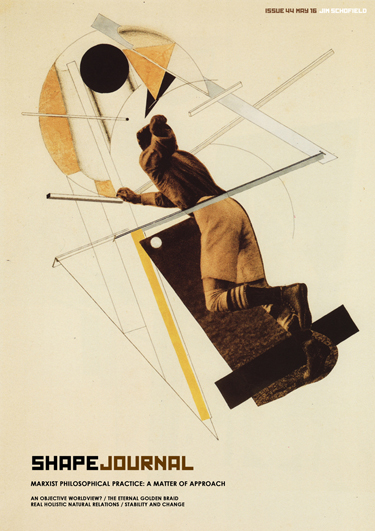
Issue 44 now available

This paper is the fourth and final part of a series of articles published here weekly, on the theme of Marxist Philosophical Practice. This work isn’t about Capitalism or Socialism, and certainly says nothing about Economics. This is about Marxism as a philosophical approach, applicable to any field of study, any aspect of reality. The series takes four very different issues in Philosophy and investigates them via this Marxist stance, which is termed Dialectical Materialism.

These papers are also collected as a new issue of the Shape Journal (44) available here

12 April, 2016

New Special Issue: The Secret Death of Chaos


This edition is a strange sort of double review. A review of a TV programme on mathematical Chaos from 2010, and a review of a "Marxist" review of it!

Having recently come across Daniel Morley’s review of the BBC TV documentary The Secret Life of Chaos, and finding that his critique (he is a avowed Marxist) was dramatically opposed to my own (also Marxist) series of review papers on the very same TV Programme, I considered criticising his contribution, but relised that a better service to those interested in such things, would be better served by simply re-issueing both together for readers to make their own decisions as to what was correct.

I commenced by simply writing a review of his review, but soon realised that readers would be better informed by seeing not only Daniel Morley’s contribution, but mine also. Access to the original programme would also be essential of course. Here it is:


The.Secret.Life.of.Chaos. by costello74


I was, to say the least annoyed at Morley’s review, but soon came to the conclusion that a Marxist versus Marxist head-to-head would be nowhere near as useful as a presentation of everything under discussion. So contained in this Special Issue of the SHAPE Journal there will be:-

This Introduction
Masters of Another World
Where is Their World?
Formal Chaos
What is The Secret Life of Chaos?
Notes on Daniel Morley’s Review

27 September, 2015

Issue 39 of SHAPE: Philosophical Papers


This new issue is a kind of review of how far we have got in describing and assessing Man’s struggle to understand his world.

It has not been a straightforward history, for Man had had to literally change the game, in order to make any progress in understudying both his own context and, indeed himself. But in making that significant progress, it has been undoubtedly a heroic trajectory!

It is very important at this stage that a difference between Knowledge and Understanding be established. For, the latter was never an automatic development from the former.

To use the common description “Man has had to pull himself up by his own bootlaces” - or to use V. Gordon Childe’s appropriate title Man Makes Himself. Attempting to understand the world has not been at all easy, and perhaps surprisingly, has been predicated upon just how successful Man has been in more everyday tasks of survival and even prosperity. For, his basic general method was initially to grasp whatever was to his advantage, whatever that entailed, and gain himself both a measure of leisure and repose.

The brilliant ideas did not come first! For, it proved almost impossible to solve all the many problems of Mankind’s usual hunter/gatherer existence, including the many seemingly unavoidable and unbridgeable impasses in his contradictory development.

For well over 90% of human history, Homo Sapiens roamed the Earth in small family groups, his most sophisticated tool being a sliver of brilliantly knapped flint. Clearly, significant developments in his mode of life were impossible without large gains in that sphere. And while there were brief interludes during that long “childhood”, when he was able for a time to acheieve remarkable things - such as the cave paintings at Lascaux: they were brief and excenptional events. Something permanent in his means of life had to occur, to enable real and persisting gains. 


It wasn’t until the invention and spread of agriculture and animal husbandry in the Neolithic Revolution that the developments in human understanding really took off. For instead of constantly living on the edge of survival, Man could then settle and gather in growing aggregations of people.

Even then the trajectory of developement was never smooth or incremental. Indeed, it was characterised by a series of “false leads” which enabled progress to be made, but which always, in the end, ground to a halt in yet another impasse.

So this brief foray attempts to trace out the subsequent paths, dead-ends, and hopefully the way forward, from where we have finally reached.

23 July, 2015

Both Ways Causality


The Crucial Importance of Recursion

Is causality a one-way mechanism? Do certain circumstances simply produce a single predictable outcome? Are cause-and-effect phenomena a one-way transaction, governed by an unchanging Natural Law? For, if all these were indeed true, then the outcomes, produced in a given context, may then become the cause in yet another unavoidable happening.

Causes and effects will be possible in long forward-moving linear sequences to predict future outcomes, yet can also, just as certainly, be traced backwards to original starting points, as is assumed in both Analysis and Reductionism.

Now, essentially, this position is clearly embodied in the rare even mentioned Principle of Plurality, and it alone has established the assumptions underlying the investigative methods we employ in many areas of study, and, most importantly, in what we call Science.

Though normally left entirely unstated, this Principle is almost universally dominant, and this is because it alone seems to provide us with an applicable investigative and theoretical process, which both delivers what are termed Natural Laws, and, as already mentioned, allows extension via both Analysis of complex situations, and even a tracing back through Time via Reductionism.

Indeed, physicists, studying what they regard as the Fundamental Particles of all Reality and hence the basis of all the sciences, justify that claim, by assuming that Plurality is indeed the true Nature of Reality. Many leading scientists have claimed as much, such as Murray Gell-Man, with his book The Quark and the Jaguar.


But, is this unstated assumed Principle really true? The simple and correct answer is, of course, “No!” Nevertheless, it has been, and still is, a useful initial stance, for in carefully chosen adjusted and then maintained circumstances, it can work quite well in many applications, where certain outcomes are required, and can reliably be made to occur.

The best description I can think of is that this approach is akin to The Farming of Reality. And, when this is done properly, it can certainly be made to work, and for the same reasons that Agriculture has been so effective in the large-scale production of food.

Instead of relying exclusively upon Reality-as-is, and simply using what we could find naturally occurring in the World around us, and using it “as found” (as was the case in our Hunter/Gatherer stage of development), we instead found ways to both change and prepare the land, to facilitate high yields from purposely sown-and-grown crops of what we required. And, that is also exactly what pluralist Science has managed to achieve in tackling a much wider series of situations and possibilities in our World - we are managing reality in order to use it.

Farming reality - agriculture as seen from space

But, just as Agriculture did not form a basis for understanding the Biology of Plants, so purely pluralist methods cannot automatically lead to a full understanding of Reality. It is clearly a pragmatic system of assumptions, concepts and methods, which necessarily kills the thing to be investigated, in order to try to understand it. It holds the piece of Reality dead still, in order to study it!

“Mix thoroughly and wait for equilibrium to become established before taking measurements” - does such a credo tell us anything about what was dynamically achieving our finally measured result, while we sat and waited?

So, if we can get by with most of our requirements by believing in this Principle, why is it also so misleading, and ultimately inadequate to addressing, and then explaining, the most important problems in Science?

The problem is partially to do with its too linear idea of Cause-and-Effect, as well as its too simplifying approach in its descriptions and its definitions. Effectively, it is an ideal method for studying static or stable situations only. But, it is useless for dealing with dynamic, evolving, or even only qualitatively changing situations.

So, its consequent way of dealing with Recursion is almost useless for it turns an actually ongoing and repeatable series of phases into a single caused effect, always ignoring ongoing, and frequently recursive transformations entirely.

Yet, when certain causes produce an effect, which only later on brings about a significant change in the original cause, a pluralist approach does not deal with that vital process at all: for it is, instead, addressed as just another cause affecting the original situation at a later time only. But it certainly isn’t that: it is a recursive consequence of the earlier cause, reflecting back upon it.

Now, such dissociated causes and methods as this are also carried over to become the main cornerstone of the ever more used method of Simulation. For, that has to be the only possible pluralist approach in complex, real-world scenarios, which cannot be separated into single effectively dominant contributions to be individually studied, without losing the actual crucial dynamic of the overall process.


To cope with the unavoidably complex situation, that have various intermediate outcomes, which cannot be predicted by isolated causes, a significant and unpredictable qualitative change is, instead, identified, from prior experience, with the passing of a threshold value of a certain variable. So, that, when this occurs, the situation is merely switched from one dominant model and its equations, directly to another dominant form, with its own equations. Both dominant phases are simplifications of what really occurs, and the Threshold variable is simply used as a switch between them, without the smallest vestige of an explanation as to why it occurs in the real situation.

The pluralist solution to a real-world complex and holistic situation, is a large set of pluralist, dominant simplifications, with the switches between them governed by rules of thumb, involving variable and the threshold values at which switches should be made.

Such means are not only very crude attempts, but are also entirely retrospective, in that they will only cover already experienced phases: it can never deliver the wholly new!

Now, Man is a highly intelligent animal, and has honed these methods to a remarkable degree, and just as our hunter/gatherer ancestors invented and effectively used Bows-and-Arrows, which transformed their lives, without their knowing why they worked so well, the scientists of today can manage to get remarkable results out of their studies, even though their resultant Laws are NOT of natural Reality-as-is, but only of specially farmed sections of Reality – though never, even then, representing what is actually going on, but, instead, using one particularly dominant part of that situation, until it has to be replaced entirely by another.

Clearly, Pluralist Science is the study of Static and Appropriately Farmed Domains, and totally omits the really important processes of a Developing situation, which very often will unavoidably involve Recursion.

True Causality is not one-way, and rarely strictly linear.

We can make farmed areas of it, in specially prepared and maintained Domains, but true Reality doesn’t work like that, particularly when it's on the move! The reason for the creation of phenomena, that are wholly new, is that Reality can, and indeed does, work both ways. The result of a certain conjunction of causes can, and does, react back upon those causes, and changes them, and their then consequences, significantly.

NOTE: It is certainly worth mentioning here that the recent solution to the perplexing anomalies, in the famous series of Double Slit Experiments, involved just such recursive effects caused initially, by the things travelling towards those slits, upon a reactive substrate, which later on reacted back upon those very same causes to deliver the full set of anomalies, unpredictable by any pluralist means.

Such significant, qualitative changes do not happen constantly, of course, for Reality’s commonest mode is one of settling into a series of relatively Stable Regimes – into so-called Eras of Temporary Stability, but every single one of these periods are always finally terminated: for developments occur in what are called Emergent Interludes outwith Stability, which start with crises, then deepen into wholesale collapses, and only then finally climb again via tumultuous, and even chaotic, periods of new, qualitative changes, which we term Emergences.

NOTE: So, it isn’t only the holistic changes that are necessary, but equally important is to recognise the oscillations between Stability and Emergences, without which creative Evolution could never happen.

And, in attempting to understand what occurs in these crucial interludes, Plurality is totally useless.

The only effective approach has to be the direct opposite one, which is emphatically holistic and replaces the static with the dynamic, and “keep it stable” approach with the alternation of Stability and Emergence that actually is crucial to understanding qualitative changes!

25 March, 2015

Thinking Randomly


The Inevitable Dead End of Pluralist Science

I am about to tackle a whole special issue of New Scientist (3012) on Random Chance (contributed by several different science writers). Now, I have, for some time, rejected purely formal investigations into physical phenomena, as being solely about Abstract Form, and, therefore, concentrating only upon description, rather than the actual physical causes of the natural happenings. Indeed, I have demonstrated that the seeming coherence of formal equations is more about the consistency in the parallel World of Pure Form alone (which I term Ideality) rather than being about the true nature of, and causes within, Reality itself.

Clearly, there are, indeed, some real situations in which physical reasons for a random-like outcome are also valid. But, both kinds came to be seen as the same – when they are most certainly NOT! Indeed the two get swapped around completely, as with The Copenhagen Interpretation of Quantum Theory, randomness is promoted from being a mere consequence of multiple opposing causes, to itself becoming the cause!

Thus, as the preparation for this may be a massive undertaking, I feel it necessary to prepare for all the usual tricks. And, as I have learned from similar situations in the past, I prepare by consciously laying out my current stance, so that I will be adequately prepared to register precisely where the two approaches begin to diverge significantly. In this preparation, we must, of course, start where the two approaches actually coincide – where physical reasons result in a situation best seen as completely random. And then, thereafter, trace out the diverging paths (and consequent assumptions) from that mutually agreed situation.

We must also, of course, make clear the differing assumptions and principles of the two approaches. They are categorised by the very different principles of Holism and Plurality, which turn out to be the grounds for the two alternative approaches.

Holism sees Reality as one composed of multiple, mutually-affecting factors; while Plurality sees such factors as separate and eternal Laws.

The distinctions turn out to cause the two alternatives to lead off in entirely different directions, because there is no doubt that such complex situations have contributions from all involved factors. All phenomena, in one way or another, are results of many different factors acting simultaneously.

The crux of the problem is whether that joint causality is merely a SUM of independent, unchanging factors, OR the result of all the acting factors being changed by presence of all the others, and delivering a result, which then cannot be explained in the same way at all.

For, the pluralist approach, where phenomena are mere complications of unchanging natural laws, assumes that explanations can be arrived at by extracting each of those involved, one-at-a-time, until all the laws involved have been identified.

Whereas, from the Holist stance, that conclusion is seen as a pragmatic method of deriving simplified and idealised “laws” via experiment, while, in contrast, Holism would have, somehow, to see how all the various factors involved are modified by their context – that is all the other factors, and the same will be true for each and every one of the rest.

Now, the pluralist view does approximate reality very well in carefully isolated, filtered and controlled situations, so, needless-to-say, that approach soon came to dominate our way of doing things. But it could never cope with certain results, the most significant being those occurring in qualitative developments, where wholly new features emerge, and most dramatically in what are termed Emergences (or in another parlance – Revolutions).

Plurality became the norm, for it could be made to be both predictable and very productive, as long as it occurred in stable situations (in both naturally stable situations, if available, or in purpose-built man-made stabilities).

Now, this coloured the whole level of discoveries arrived at with such a stance and method, and also unavoidably caused multiple areas of study to be separated out from one another, simply because causal connections between them were unavailable.


Reality-as-is was literally constantly being sub-divided into many specialisms, or even disciplines, which could not be made to cohere in any simple approach. And, as the required “missing-links” just proliferated, the gulfs between these separate, created areas of study grew ever larger – even though the belief was that, in time, these inexplicable gaps would finally be filled with explanations of the same type as within the known and explained areas, but not, as yet, discovered.

It amounted to cases of investigators “painting themselves into corners”, by following their primary principle – Plurality.

Now, such a trajectory was historically unavoidable, because the gains of such pluralistic science within their defined and maintained contexts were so successful and employable in effective use.
Naturally and pragmatically, Mankind moved as swiftly as possible, where they could, and the flowering of this effective, pluralistic stance was, of course, Technology. But, such approaches could never address the really big questions. And, of course, both understanding and development were replaced by increasing complexity and specialisation.
So, quite clearly, such a mechanistic conception could never cope with the emergence of the entirely new, which were always described as particularly involved complexities, yet never explained as such.

Now, to return to the supposed “common ground”, this was interpreted as a complex, multi-factor situation, in which opposing contributions tended to "cancel out”, and the result was a situation best described as one in which random chance predominated. And, of course, such could indeed be true, in certain situations – for example in an enclosed volume of mixed gases, you could derive both temperature and pressure by assuming a situation of random movements and collisions.

But, such required it to be a continuing and stable overall situation. If the gases were reacting with one another, and other substances were present, and reacting too, then the persistence of that stability might not reign very long.

As always, such an assumption was invariably a simplification and an idealisation of the given situation.

Now, such situations were frequently adhered to, as stabilities are the rule in most circumstances, so such ideas can be used with a measure of confidence, BUT, whenever any development began to occur, such a stance could never deliver any reasons why things behaved as they did.

In Sub Atomic Physics, for example, as investigations penetrated ever deeper into Reality, problems began to occur with increasing frequency. The discovery of the Quantum became the final straw! 


For, in that area, phenomena occurred which blew apart prior fundamental assumptions about the nature of Reality at that level, and, for example, what had always been considered to be fundamental particles, could seem to be acting like extended Waves. Yet, with the smallest of interventions these could immediately revert back to acting as particles again. These phenomena were deemed to be beyond explanation, and what was used instead of the usual explanations, was the mathematics of random chance, not merely about a given position, but significantly about the probabilities of it being in each of a comprehensive set of positions (presumably relating to a wave) when they reverted back to particles again.

The formalisms of waves were used in this very different and illegitimate context. At the same time, physical explanations were dumped completely. The only reliable means of predicting things was in the probability mathematics developed originally for Randomness.

Now, the question arises - what do the Copenhagenists think they are doing with this new position?

First, they have NO explanations as to why it happens the way that it does.

Second, they deal only in Forms – equations and relations! Do they consider these to be causes?

Well, maybe you have guessed their position. They have no adequate answers, and hide behind the known physically-existing random situations (as described earlier), and say that their equations have exactly the same validity as those. Not so! For, this researcher has managed to explain all the anomalies of the Double Slit Experiments merely by adding a universal substrate into the situation. You don’t (as the Copenhagenists insist) need their idealist “interpretation” at all.

But, nevertheless, a great deal more still remains to be done. If the real problem is the incorrect Principle of Plurality, and the only possible alternative is the Principle of Holism, then we are still a very long way from a comprehensive explanation of natural phenomena from this stance.

The whole edifice of current Science (and not just the current problems in Sub Atomic Physics) is undoubtedly based upon flawed assumptions - not only in how things are explained, but also in Method. It is exactly how we do all our experiments!

To change track will be an enormous undertaking, and a look at the current state of “a Holist Science”, reveals that almost nothing has yet been achieved. Honourable exceptions, such as work by Darwin, Wallace and Miller are simply not enough to fully re-establish Science upon a coherent, consistent and comprehensive basis, for that will be an enormous task. But, there is a way!

First, we carry on with the current pluralist methods, BUT no longer stick to the pluralist principle as correctly describing the nature of Reality. It becomes a pragmatic method only. We can use it both to reveal the contents of a situation and to actually organise productive use, BUT we must abandon the myth of eternal Natural Laws revealed by those methods. We must accept that what we can extract in pluralist experiments are NOT “Laws”, but actually approximations confined to the particular imposed conditions, in which such were extracted.

Second, we must begin to devise and implement a new paradigm for scientific experiments. Stanley Miller’s famous experiments into the early stages in the Origin of Life, and Yves Couder’s “Walkers” experiments, clearly show two valid routes.

But, most important of all, scientists must become competent Philosophers!

Pragmatism and positivist philosophical stances are just too damaging. A clear, consistent and developed Materialism must be returned to, but it can no longer be the old Mechanical version.

We must learn the lessons of Hegel, and actively seek the Dichotomous Pairs that indicate conclusively that we have gone astray, and thereafter, via his dialectical investigations into premises, recast our mistaken assumptions and principles to transcend our own limitations, at each and every guaranteed impasse.

The main problem in Holist Science is the fact of the many, mutually-affecting factors in literally all situations in Reality-as-is. Plurality validated the farming of experimental Domains to simplify such situations, and in doing so cut down the affecting contributions either to a single one, or to one that was evidently dominant. So, with repeated experiments with different target relations, such investigations delivered, NOT Reality-as-is, but a simplified and idealised set up, with a recognition of the factors involved, but with each one, in a particular Domain, presenting a version, which could also be replicated to allow effective use of the idealised form extracted. But, the whole series of different tailor-made Domains, each with one of the factors as target, also delivered a list of the factors involved.

Pragmatically, each could be used effectively to some required end, but the list, though each one was idealised, would as a full set, allow a theorist to attempt an explanation of what was seen in the unfettered and natural “Reality-as-is” Though achieved using pluralist methods, and hence distorting each factor, a Holist theoretician could use that list in a very different way.

It was, after all, what had been the situation in the past including BOTH views, that had been the usual way of doing things, before Wave/Particle Duality and the Copenhagen stance had brought that to an end.

Yet, of course, the new stance was not the same as before. For now, plurality was just a pragmatic trick, and the real Science was in Holist explanations.

The pluralist mistake of assuming eternal Natural Laws, which produced all phenomena merely by different summations, was no longer allowed. And the belief in Natural Laws was replaced by an acceptance that all extracted laws would not only be approximations for limited circumstances, but would also and inevitably at some point produce contradictory concepts, and that only by unearthing the premises that had produced these, and changing them for something better, would the produced impasse be transcended, and further theoretical development made

The Holist scientist did not deal in supposedly eternal Natural Laws, but factors that were indeed effectible by their contexts. So, this new breed made the investigation of how factors were indeed changed by their contexts, and were always prepared to directly address major impasses when they arose.
Now, there are different ways of doing this sort of Science. In this theorist’s re-design of Miller’s Experiment, he realised that the provision of inactive pathways within the apparatus would facilitate certain interactions and their sequencing. So, a series of versions of the experiment were devised with such appropriate inactive channels, which were also equipped with non-intrusive sensors, sampling on a time-based schedule. Then, on a particular run with a given internal channelling, data collected from the various phases, would be taken and could be analysed afterwards to attempt to discover certain contexts at different times. 


Something similar is currently done by Weather Forecasters in their simulation models linked to large numbers of sensors at weather stations, but the crucial difference in the New Miller’s Experiment was in the Control that was in the hands of the experimenters. That was never available to the weather Forecaster; he had to take what he was given, but the new holistic experiments allowed something greatly superior to their Thresholds, when one law was sidelined to bring in another. The Weather simulations with thresholds were a crude invention to attempt to deal with a real Holist situation, pluralistically.

In the described Miller-type experiments the investigation would be constantly re-designed, both in the inactive structures provided. And in the necessary kinds of sensors to maximise the information and allow progress to be made. Clearly such control is never available to weather forecasters.

11 January, 2015

Qualitative Abstractions and Emergences


The latest issue of the SHAPE Journal is on Abstraction. From a beginning some years ago, with The Processes and Productions of Abstraction, this theorist has now made another foray into this subject, this time going well beyond that initial diagram, and has begun to address Abstraction applied to Dynamic Change too. This following paper shows just where this new turn is beginning to lead.


Qualitative Abstractions and Emergences:

Having more generally addressed Abstraction, though mostly at a single Level, and entirely within a local Stability, we now have to leave the confines of such a pluralist standpoint, and instead, reach further into both Qualitative Changes, and, indeed, what we term as revolutionary transformations that create wholly New Levels – termed Emergences.

The whole methodology of abstractions in Science is locked into a strictly pluralist perspective, which sees all acting relations as entirely separable, and this assumption makes any found relations into fixed Natural Laws. But, actually, such can only approximate to Reality, and limit the applicability to within either natural or man-made stabilities only, and, indeed, can never transcend a Level boundary.

And, Laws at a higher Level can never be explained in terms of the prior “producing”, lower Level.

Indeed, it would be entirely incorrect to see the new Level as a natural causal consequence of the Level that preceded it! This might be surprising, but, in doing so, we are applying what is usually acceptable for within Level relations, to still be legitimate across Level Boundaries, and that is not the case.

Why?

It is because such a revolutionary transformation is never a continuous, incremental process, but always involves a truly major crisis and collapse, followed by a fundamental re-building along totally original lines. In other words, none of the factors involved in the re-building would have even been present, as such, in the erroneously-called “producing” Level!

So, we have a major problem!

We have learned how to use the very same methods within each New Level, as were successful within prior Levels. And, though we can get away with this, it will only work for processes entirely within the new Stability. And, we can certainly never fully explain the features of that higher from the lower! Indeed, the source of the newly-created Level is only possible via a situation that the prior Level would never allow – indeed, a general chaotic tumult, in which literally all the characteristic stabilising relations of the prior Level have been totally dismantled! What then occurs is like a rebuilding, not just out of old “bricks”, but also, and primarily, involving entirely new ”bricks” of a new construction.

And, this is why the explanation of events like The Origin of Life, in terms of prior, non-living processes is impossible! The actual basic context has been radically altered and relatively few factors remain unchanged, and even those that do survive intact, and play no part in the features of the new system.

So, what happens in the New Levels of Reality?

They beget their own relations and abstractions, though, once more, we always predicate them upon a totally pluralist perspective. Yet, what can these new ideas mean for the universally accepted Principle of Reductionism – which states that all causal sequences are traceable, all the way down to fundamental particles, and their basic Laws? Obviously, it makes such an assumption totally unfounded and unavoidably misleading!

Now, the real, overall trajectory of Development of concrete Reality is certainly NOT pluralist! It may well involve long periods of Stability, in which Plurality is a fair approximation in local, stable contexts, but each and every epoch will always terminate by being continually undermined, by its own internal contradictions, leading to, first, a major crisis, and then, a total collapse of the stability, into what appears to be complete Chaos! But, such is not our usual conception of “chaos”, in which totally random, undirected processes get absolutely nowhere (for that is yet another kind of Stability, is it not? On the contrary, this real kind of “Chaos” is both the most productive and creative interlude that is possible to exist!

We call such an event an Emergent Interlude!


Yet, thus far, in this account, we have only described its initial catastrophic phase. From the results of that dissociation into a seeming Nadir of Chaos, multiple productive processes accelerate, and begin to associate into conducive, ever-more-complex systems.

Why they happen now, is that all such constructions had previously been prohibited, or even destroyed, in the prior Level Stability, but all of its many restraints have since perished along with the Level itself, and so free-forming sub-systems appear everywhere, usually competing, but occasionally forming ever bigger, conducive super-systems, and ultimately one such system not only grows largest and dominates, but also includes sufficient, destructive sub processes within it, directed at all other non-own-system processes and even systems. So finally, a new overall Stability is achieved on a new basis, with its own Laws!

And, perhaps surprisingly, the assumption of Plurality gets more acceptable again, and the old methodology can be used once more, though, of course, with new components.

Clearly, if anyone wants to plumb the causality of Reality from top to bottom, they will never be able to achieve it, using only a pluralist perspective and methods. The crucial links in the causal changes will occur ONLY in the Emergent Interludes, and it is there that a wholly new Holistic Science must be built – literally from scratch!

13 April, 2014

New Special Issue: Mathematical Chaos I


This issue has been compiled to address one of the Key Questions in both Philosophy and Science, while seemingly residing solely in the most esoteric regions of Pure Mathematics.

It attempts to find an alternative to the currently universally accepted formalism, and also the basis for all theories in Science, which is dependant upon the usually unstated Principle of Plurality, but turns decisively away from this now standard approach, to the alternative that sees Reality as more properly characterised as deeply holistic.

It has become a truly major undertaking, not only because of the difficult problems that have been encountered, but also because of the significant breakthroughs that have already been achieved with this alternative approach.

And, these gains have been primarily in what is usually termed Mathematical Chaos. These achievements have been primarily philosophical, for they have questioned the usually agreed ground for this area of Mathematics, by a careful study of the implications of iterative assumptions and methods, NOT, as is usually the case, in pragmatic assemblies, but in the generation of the now renowned Chaotic Forms that they can be persuaded to produce.


But, its status here is not solely dependant upon these researches, but also, and perhaps even more importantly, upon extensive resonances with these forms both in Physics and in Philosophical studies too.

The crucial and revealing studies have been in tackling the need for a scientific methodology, based upon the assumption that Reality is not pluralist but most definitely holistic, yet though this is often conceded, NO feasible methodology or formalism has so far been achieved.

Holism, though probably the more correct view of Reality, seemed incapable of providing Science with any means to rival those delivered by the assumption of Plurality.

Yet, in this relatively small group of papers, a possible way has been devised.

It may not be what mathematicians want to hear, and the vast majority of physicists, immersed up to their necks in the now consensus Copenhagen Interpretation of Quantum Theory, will certainly be directly opposed to these ideas. But, in the opinion of this theorist, these papers represent a significant contribution, and lay down a sound basis for further research, and, maybe even a Major Revolution!