05 May, 2010

Chinese Stamps for Sale

Not sure if any of my regular readers will be interested, but thought I'd mention it anyway!
I'm currently trying to sell my large collection of Chinese Stamps

Visit www.chinese-stamps.com to find out more


15 April, 2010

The Heroic Failure of Mark Rothko


 "...No figurative content is either discerned, or was intended, and though most people “see” windows and doors to somewhere (?) or even nowhere, the real content seems to reside in amazing texture and meaningful “detail”. The substance of the works seems to reside in the almost furry or “blurred” edges of his deceptively simple areas, which seem to articulate directly and sensitively into adjacent “new space”, which is itself packed full of its own colour-based activity.
We seem to be directly discerning real and complex feelings by abstract visual means alone..."


29 March, 2010

A Three Dimensional Problem


Introducing the Soma Strand


These images are from a paper forthcoming to the Shape journal, as part of the "A Structure of Diagrams" series. Here diagrams and models were used to solve a complex three dimensional problem based on tessellation.


This case was to do with a self designed form which I had named the Soma Strand (after Piet Hein’s “Soma delicious Soma”).
Long before the tessellation problem outlined above, I had to design the original form. This, in itself, took a great deal of time and model making, but what finally emerged was an infinite strand, with a re-entrant form, and congruent, singly re-entrant hexagonal faces (with 90o and 270o angles only). It soon became clear (after making a bundle of these strands, that they definitely tessellated to fill three dimensional space completely.
Careful model-making had established this exciting property, but, it must be said that cardboard, glue and bits of wooden dowling (without which the strands were impossible to construct) are not the ideal materials to facilitate detailed studies in the area of volume filling stacking, particularly of such difficult (and indeed infinite) strands. Attempts at solving the problem using 3D graphics packages were soon abandoned, as these so-called tools, may deal with three dimensions, but are generally NOT designed for meaningful and revealing visualisations essential to the designer and creator of new things. You just couldn’t see what you were doing, and the figures soon became unintelligible. In addition to the complexity, that package had not helped me to adjust units effectively and lock them into the required precise positionings. Attempts at colouring to get some order out of the chaos only led to an obscuring of one part of the figure by another. I knew exactly what I wanted to do, but those facilities were simply not available.
As a last resort, I went all the way back to an ancient (and primitive) 2D drawing package that I had used for many years (De Luxe Paint 2).


03 March, 2010

Domains & Quilts


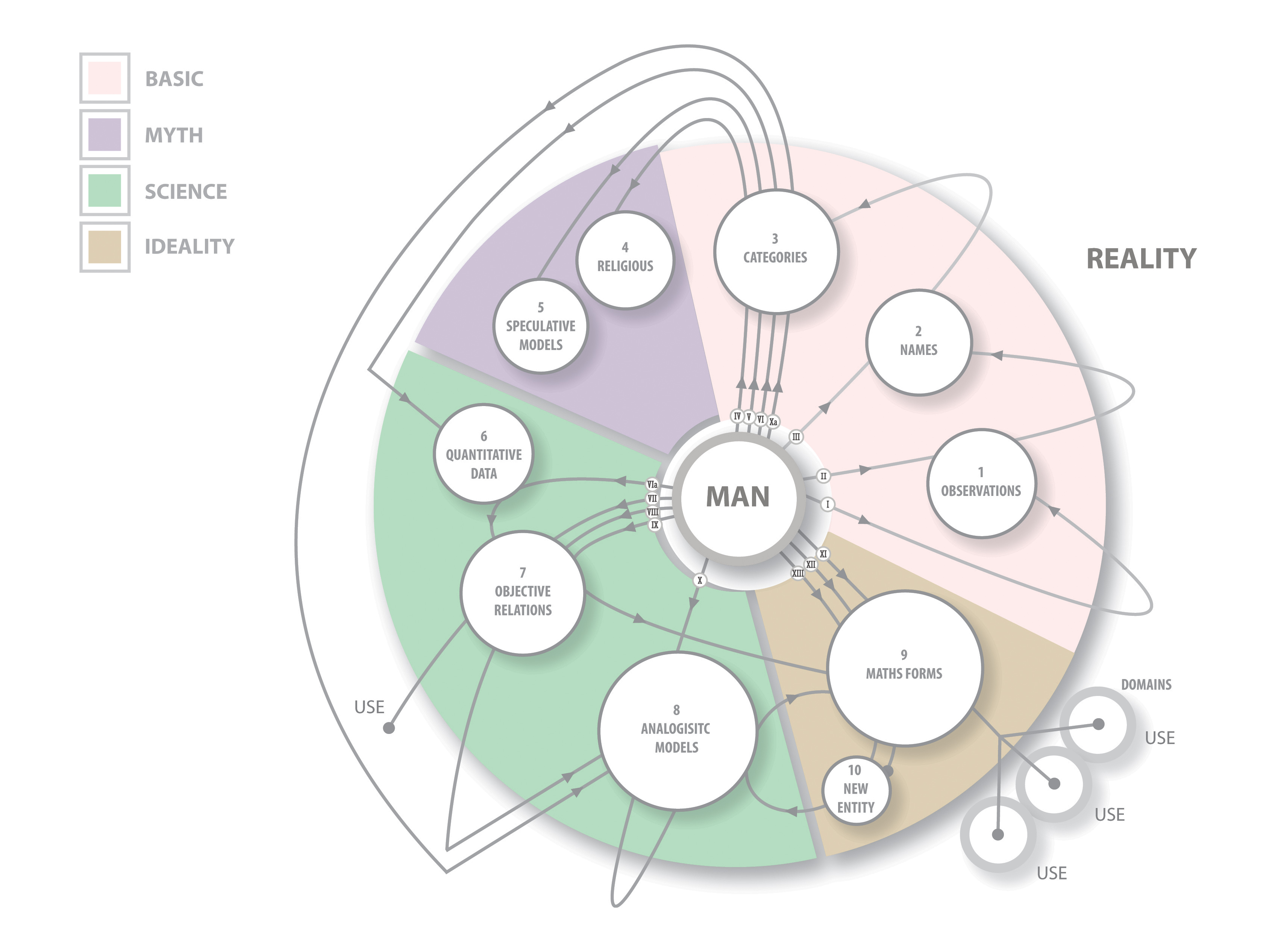
An early investigation of Man's Abstraction of Reality. See my final definitive Abstraction Diagram

The Superstructure and the Base

This philosophical area is a profoundly difficult, yet at the same time, an extremely crucial one.
It cannot be dealt with by a single paper, or even a series of them. It is about our fundamental assumptions concerning the World about us and our understanding of it. It inevitably therefore will display the unavoidable errors that will occur when one part of Reality (Mankind) attempts to explain either that all-embracing World, their own automatic origin, or finally their current place within that World. Clearly, no straight (or Royal) road to Knowledge can be viewable, or even available from within the continuing process itself. Indeed, Man has to promote himself outside of the process in the position of a God, in his attempts to address it. There is no way that the bulk of his attempts will be anything other than fictions and rationalisations. And from the exact same ground, any condemnations of Mankind’s errors in this area will involve a similarly arrogant super-promotion.
Such a trajectory was, and still is, unavoidable, and every gain made in this gigantic task will, of course, be partial and propped up with many formal inventions. How could it be otherwise?

But, that does not mean that Mankind should, “Give up now, you’ll never do it!”
On the contrary, it is the most important purpose ever generated by this evolving World.
So, any paper commencing the task of looking at our assumptions and methods will have to start somewhere, and wherever we choose will immediately and inevitable reveal contradictions. But, that is still the only way we can remedy our misconceptions and improve our attempts. What else can we do?

This author commenced writing about such questions some 14 years ago, under the title, Levels, and it is clear that the currently existing Universe is NOT a single monolithic structure. Not only is it spatially divided, but it has also generated a whole series of Levels of Existence, each with its own entities, properties, relations and even laws.
Life is just such a Level, as is Consciousness, and the real task will have to be addressing these innovatory changes of Level, as well as explaining the more mundane relations within particular Levels.

Nevertheless, we must make a start, and perhaps the best issue, which cannot but expose the essentials of such a World, must be that of The Superstructure and The Base. The main criticism of Marxism by its conservative opponents was that they could not even explain their own existence, never mind that of the rest of Reality.
So we will start there!

In this current period SHAPE is involved in publishing a series of papers addressing these and related issues. They include:-

The Second Law of Thermodynamics
Formalising the Heavens
Truly Natural Selection
The Superstructure and the Base
Order Out of Chaos
Paths to Chaos or Paths to Glory?

These papers were either purposely selected, or specially written, for this period in the establishment of SHAPE as a new kind of Journal.
It will NOT be re-hashing old ideas, but on the contrary making original contributions on all the questions that it addresses. It will, therefore, seek to represent the cutting edge of research, and though most of the early contributions will be from the pen of Jim Schofield, the whole idea is to generate a whole school of contributors keen to tackle these crucial questions.
Instead of playing the role of a conduit for the publishing of all and any papers on these issues, it is intended to deliver coherent, comprehensive and new contributions to a 21st century view of the World!

24 February, 2010

Mankind's Bubble of Abstraction


The Processes And Productions of Abstraction

The version of the diagram that is shown here did not finally reach the state you see until about four years
ago, but it has ever since allowed me to pursue all other studies from an objective standpoint.
It is, of course, by no means the last word on this area, but it has most certainly been for me the first and
dependable one.
To trace the increasingly important sub-processes involved in Mankind’s abstractions, we must start at
Process I (observing Reality) to Production 1 (observations), as on the diagram, and then continuing anticlockwise
around the circle...


Diagram by Jim Schofield
Graphic Design Mick Schofield

09 December, 2009

Eureka! It's Populist Science

New Scientist more populist science on the Large Hadron Collider
"...On reading the current issue [Eureka Magazine, The Times, Nov 5 2009] from cover to cover, I was surprised to find that really nothing new was presented there at all. It reminded me of New Scientist, but whereas that journal is aimed at “scientists” (supposedly), this one is certainly aimed at the “interested layman” in mind instead. And one of the characteristics of such disseminations is that they are totally subservient to the “experts”.
No longer do we have hostile antagonisms by arts-types and other non-believers, but in the new attitude of embracing Science in all its current glory, all the participants merely swell the ranks of the consensus merchants, who “wonder” at the might and power of Big Science as propagated by its producers. This removes that absolutely vital criticism which Science has always needed to continue to progress, and which is now, more than ever absolutely essential, as its ageing philosophy and consequent methodology becomes increasingly inadequate to cope with the major unanswered questions that are daily arriving at the top of every agenda..."


The Fruits of Asymmetry

A Coxeter Polytype
Coxeter - 'n' dimensional tilings - assuming maximum symmetry

A Penrose Tessellation
A Penrose Tiling - concerned with near symmetry cases

Tessellating Asymmetric Re-entrant polygons Jim Schofield
Tessellation utilising re-entrant polygons
(in this case using a singly re-entrant asymmetric hexagon - or "L tile")

"...What was evident to me was that the essential component in these formal investigations was Symmetry! While my colleagues in Physics were totally wedded to complete maximal Symmetry (and indeed Super Symmetry), I was finding that instead of the limited numbers of tilings and crystal forms that were available to them, I was finding (in 2D at least) a seeming infinite complexity of Forms. With maximally symmetric units, these all funnelled down into a minimal set, but with re-entrant forms (the first deviation from maximal symmetry), and various regular asymmetries, the possibilities were vastly increased.
Indeed, from monolithic tilings (using a single basic unit in a single way) there occurred a wide range of hierarchical forms, which could be different or mathematically similar at each succeeding level."

To read the rest of this paper, click here


Diagrams on the Science of Music


One of my many music theory diagrams - this one showing the family of C tunings on the guitar. More images and possibly some papers to come...

22 November, 2009

Colour cycling reveals form in tessellations


Click to enlarge

I have been researching Tessellation since the 1960s, and will be publishing much of my work in this area on Shape Addendum, watch that space for more...

Issue 5 of Shape

Issue 5 The Second Law of Thermodynamics Real Science and Bank Crash continued
Read it here

04 November, 2009

Forms & Causes - What's the Difference?


In identifying things in Reality, we first notice their Forms!
Forms are frequently recurring patterns, which appear in all phenomena, and seemed to be the crucial indicators of the nature of these happenings and their involved entities. All our earliest characterisations of things were unavoidably on the basis of their Form, and things with closely similar Forms would initiallyalways be inevitably grouped together as “closely related”. But, this didn’t usually hold up, as many members of such “groups” later turned out to be hardly related at all: they merely had the same Form. So Forms are not particular and fundamental, but universal: the same forms appear in many different, andcertainly not causally-related, situations. So, though common patterns do recur, and hence need explaining, they are quite different to the more physical causes: they can be common to many unrelated, and differently-caused things.

Now, in addressing why this is, and how Form is characterised by it, we have first to address the other, indeed the primary, consideration, which is what actually physically causes the identified phenomenon!

It is clear that quite different causes, in widely separated areas can display the very same Form, but that this is almost never because they all have exactly the same actual cause. Yet, this being true, why are the Forms themselves so recurrent? They must reflect similar patterns, weights and conjunctions of contributions. (Notice that the conjunctions themselves are not directly involved. It is the MIX that determines Form. Forms must be the natural shapes ofrecurring types of mixes, even if the physical causes of the involved contributions are unrelated. This feature of Form can make it extremely valuable in predicting what is likely to happen next. But, we must also notice that to “follow the Form” in this way does NOT mean that we understand the producing causes, but only the shape, or pattern, of what follows.

These questions are very important because, when asking those who address them what they think, alarge fraction of them insist that the Form is primary, indeed they tend to consider each Form as a kind of immaterial Essence, the makes things the way that they are. Consequences are considered to be driven by Form! Now, this is important because the physical causes can be missed in the worship of assumed Essential Form, and actual causes are not then directly sought for: they become unnecessary if the essential driving forces in Reality are just the Forms. Why do we need more?

Mankind has developed a powerful set of techniques for dealing with Form, and perhaps the most significant stage in its progress has been their distillation into Formulae – into general equations which are abstract mathematical representations of measurables within given Forms.

My Mind to Me A Kingdom Is

The myth of the philistine scientist is not about experience, it is about prejudice. And the sentiments of Sir Edward Dyer express Mankind and not merely the artistic subset...

My mind to me a kingdom is... Sir Edward Dyer or Edward de Vere
In Praise of a Contented Mind

My mind to me a kingdom is;
Such perfect joy therein I find
That it excels all other bliss
That world affords or grows by kind.
Though much I want which most men have,
Yet still my mind forbids to crave.

No princely pomp, no wealthy store,
No force to win the victory,
No wily wit to salve a sore,
No shape to feed each gazing eye;
To none of these I yield as thrall.
For why my mind doth serve for all.

I see how plenty suffers oft,
How hasty climbers soon do fall;
I see that those that are aloft
Mishap doth threaten most of all;
They get with toil, they keep with fear.
Such cares my mind could never bear.

Content I live, this is my stay;
I seek no more than may suffice;
I press to bear no haughty sway;
Look what I lack my mind supplies;
Lo, thus I triumph like a king,
Content with that my mind doth bring.

Some have too much, yet still do crave;
I little have, and seek no more.
They are but poor, though much they have,
And I am rich with little store.
They poor, I rich; they beg, I give;
They lack, I leave; they pine, I live.

I laugh not at another’s loss;
I grudge not at another’s gain;
No worldly waves my mind can toss;
My state at one doth still remain.
I fear no foe, nor fawning friend;
I loathe not life, nor dread my end.

Some weigh their pleasure by their lust,
Their wisdom by their rage of will,
Their treasure is their only trust;
And cloaked craft their store of skill.
But all the pleasure that I find
Is to maintain a quiet mind.

My wealth is health and perfect ease;
My conscience clear my chief defense;
I neither seek by bribes to please,
Nor by deceit to breed offense.
Thus do I live, thus will I die.
Would all did so as well as I!


27 October, 2009

The Cradle of Life - New Scientist is at the vents again...


Hydrothermal vents again - why are scientists convinced that life started off extremophile?

The Cradle of Life?
(Comments on the recent New Scientist article)

1. “Necessity is the Mother of Invention”, but you also need the Funding!
An article entitled The Cradle of Life in New Scientist (2730) is an interesting contribution to this discussion, but in a rather surprising way. Throughout the piece the author, Nick Lane, of University College, London brings forward the works of Peter Mitchell, along with those of Mike Russell, of NASA, to explain the Origin of Life! But, he repeatedly uses the verb “to evolve”, which is a surprising choice for the transition from inanimate Matter to Living Things, and you might think that these contributors are finally moving towards an Emergentist position.But, that turns out NOT to be the case! The use of “evolve” is well within the generally agreed use because the contributions detailed in the article do not actually address the Origin of Life. The title The Cradle of Life gives it away, because what is presented here are the earliest developments inLife after its Origin. Surely, a site for the actual Origin would be called something like the “Crucible of Life”. A Cradle is aprotective environment for a Life already born!

Now, I have been arguing for many years against that School of explanation on the Origin of Life, which looks solely to pre-existing processes within the preceding non-Life Level, and I argue against their whole approach and “revealed causes”, because they do NOT explain the actual Origin at all. Even the contributions of Miller and Oparin were NOT the causes of the Origin but merely pre-requisites for when the real and appropriate causes did finally appear.

Here we encounter a similar approach, but this time working downwards from within the Life Level, and burrowing as deep as possible towards the actual Event of Life’s Emergence. But, in both these approaches there is a basic assumption which prevents them ever unearthing the actual causes.They assume the usual banker of Reductionism - that continuous links which connect each and every phenomenon with its causes, are appropriate right through this revolutionary transition also...


The Time Has Come To Bury The Dead

Friends, colleagues, scientists, listen to me!
The scene all around us is littered with the dead and dying and the war is finally won.In order to proceed we must, clear this present carnage, and in an orderly and respectful way,bury the dead, and proceed to construct a New Order.But first, we must identify each and every lifeless corpse, certify their demise, and with dignityconsign them ALL to the ready earth.There are those, still standing, who would deeply mourn the passing of these heroes, and theyare honourable men, but I must be true to myself and boldly declare that I do not truly mourntheir passing. Nonetheless, I am here without hindrance from their still powerful supporters, tojustify the evident slaughter, so it is clear that they are all honourable men.So, let us begin. Let us start with the leader of all these men, both dead and still alive, theindomitable Rock against Change; the veritable Cause of the recent war.Yet, we must be charitable, as his friends are now clearly charitable in allowing me to speak toyou now - for they are truly honourable men.Here lies Plurality, for that was his true name, who in spite of his many grievous wounds (someinflicted over 2,500 years ago by the mighty Zeno), did stand and fight until now, when he hasfinally and irretrievably halted by death. Let us intern him, and all his colleagues with duehonour, by clearly crediting him with what he gave us, that you all, I am sure, could recount,and cover him up FOREVER!

Plurality stated clearly, and it was agreed by all to be the certain truth, that every Whole is made up ofseparate Parts, and indeed this profound premise DID open the door to a simplification of the World in orderto study it. Now, Pluralism has at least one hidden partner. If we are to isolate the Part from the Whole andignore all connections, links and even causes EXTERNAL to the Part, we are similarly easily pressed into also ignoring all trivial and clearly negligible relations, which STILL pertain after isolation. Indeed, howcould we determine from where cometh any tiny variations still evident, after we have established our Partdefiningconditions? We can’t do it!So we say that maybe the isolation is not absolutely perfect, and therefore, following our principle of deepstudy of ONLY the dominant relations of the Part, we exclude what else we can, and also ignore what wedon’t seem able to eliminate entirely. Whether these tiny variations are small still-existing links with the restof the Whole, or trivial-but-contained relationships WITHIN the Part, we dump them any way.So, this partner of Pluralism can be called Simplification – the dumping of the inconsequential!


Issue 4 of Shape

Issue 4 Real Science Bank Crash Gradual Emergence of Life